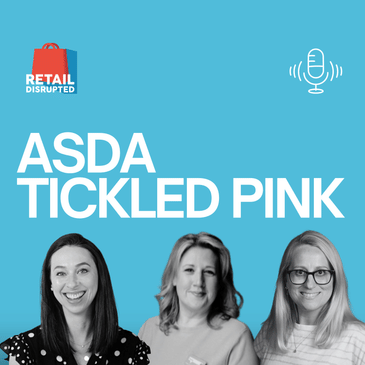

Asda's Tickled Pink campaign has raised a whopping £100 million over 30 years. This isn't just fundraising — it's embedding a cause into the culture of a business. 🎗️🩷
In this episode, I sit down with the team behind it all — Emma Betts (Asda), Rachel Carrington (Breast Cancer Now), and Jo MacSween (CoppaFeel!) — to unpack why this partnership why been so successful, both socially and commercially.
What retail leaders will take from this:
→ Why long-term charity partnerships outperform short-term campaigns — commercially and culturally
→ How supplier involvement turned a cause into a £2.5M fundraising engine
→ The "phygital" future: combining physical and digital channels to drive awareness and donations
→ Why £1.8M came from self-checkout tills alone — and what that tells us about micro-donations
→ How CSR strategy can drive measurable shifts in customer behaviour and brand perception
This is a fabulous feel-good story. It's also a masterclass in purpose-led retail strategy. 🫶
🎙️ Guests:
Emma Betts — Head of Tickled Pink Partnership, Asda
Rachel Carrington — Head of Principal Partnerships, Breast Cancer Now
Jo MacSween — Director of Fundraising, CoppaFeel!
Retail Disrupted™ is a Top 5% Global Podcast hosted by retail analyst and author Natalie Berg. New episodes explore the trends reshaping the future of shopping.
🔔 Subscribe to our YouTube channel for weekly retail insights https://www.youtube.com/@retaildisrupted
[00:00:00] We have breast check reminders on every single till receipt that goes out of Asda. If you think they've got 18 million customers weekly, that's potentially 900 million receipts every single year. There's a prompt to check your chest because we know people need to be checking their chest and doing it regularly. Every single bra sold from George Asda has a breast check reminder on it. The time that people check their chest most likely are in the morning and in the evening. And in the morning that can look like when they're getting ready, when they're showering.
[00:00:27] And last year during our campaign, we had Yorkshire Tea, Shreddy's, Marmite, Warburton's. They are four iconic brands that catch you in your morning and they all had breast check reminders on them. These are the kind of things that can really accelerate our ambition to being breast aware. And we couldn't do that without retailers and the space that they hold within communities.
[00:00:53] You're listening to Retail Disrupted, a podcast that explores the latest industry developments and the trends that will shape how we shop in the future. I'm your host, Natalie Berg. Hello and welcome back to Retail Disrupted. Now as retailers, you have extraordinary reach.
[00:01:21] Millions of customers come into your stores and interact with your brands every single day. That scale means that retailers aren't just commercial platforms. You are an essential part of the community and you can be a powerful vehicle for social good. Now on today's episode, we are going to hear all about how the supermarket chain, Asda, has achieved the incredible milestone of raising 100 million pounds.
[00:01:48] They've done this through their Tickled Pink partnership, which supports both breast cancer now and CopaFeel. This partnership has been going for 30 years. It's widely seen as one of the most successful long-term collaborations between a retailer and a charity. And it offers valuable lessons for any retailer thinking about purpose, partnerships, and driving meaningful, authentic engagement with your customers.
[00:02:14] I had the opportunity to sit down with three people who have been instrumental in making all this happen. Emma Betts, head of the Tickled Pink partnership at Asda. Rachel Carrington, head of Principal Partnerships at Breast Cancer Now. And Joe McSween, director of fundraising at CopaFeel. Let's get into it. Emma, I'd love to start with you and get the retail perspective. Why do charity partnerships matter to retailers?
[00:02:44] And what is the commercial sense behind these long-term relationships? Thank you for that question. Yeah, I think charity partnerships matter because they connect a retailer to something bigger than the products on the shelf. At the best, they give colleagues and customers a shared sense of purpose. And they show that a brand genuinely cares about the community that it serves, the community it trades in. I guess for us, magic comes from a long-term commitment.
[00:03:13] Obviously, we're here talking a lot around kind of the Asda Tickle Pink partnership, which we're celebrating 30 years of supporting our wonderful charity partners, Breast Cancer Now and Copperfield. So that's a real long-term commitment. When a partnership runs for many years, it stops feeling like a campaign, I guess, and it starts becoming part of the culture of the business. Colleagues feel really proud to be part of it. Customers recognize it.
[00:03:36] And it shows social purpose is genuinely embedded in the business rather than something that's just switched on for a few weeks of the year every so often. I think there's also a really strong commercial logic behind having that long-term and consistent approach, because consistency builds trust. And when customers see retailers supporting the same cause year after year, it feels authentic rather than transactional.
[00:04:02] And as I say, after 30 years, many people recognize Asda as a place that supports breast cancer, supports breast cancer charities, and we're using a platform to raise awareness. And we can see that reflected in our data as well, that we run great brush checking and research. And nearly half of our loyal customers recognize Tickle Pink. And none as the shoppers, when they hear about the partnership, they say it improves their perception of the brand. And around a third say it would make them actually want to shop and trade with us, which is incredible.
[00:04:31] So customers can tell the difference between a short-term promotion and a genuine commitment, and consistency is what builds that trust. But the other side of that is the impact of the charity. I think when a partnership is long-term, charities can plan ahead. They can invest in things like breast cancer now, obviously hugely incredible in the research that they do. But knowing that they have that sustainable income over long-term, and for the long-term programming that both of the charities support, it means they can deliver meaningful change.
[00:05:00] So the commercial and the social benefits really reinforce each other. Copus works best in retail, but it's not something you switch on and off. As I said, if it's just for a few weeks or for a month, it's something that you live in year after year. And so for me, I think that's why it matters. So yeah. Yeah. Yeah. It's so interesting. And a hundred million pounds raised over 30 years is, it's just a phenomenal achievement. So can you tell us a little bit more about how you achieved that milestone?
[00:05:29] What were some of the key ingredients to its success? Yeah, absolutely. Yeah. Reaching a hundred million is something that we're obviously incredibly proud of. And we were talking the other day in a meeting, I've been here for 50 of that hundred million, but I never say I raised 50 million because it's incredible thousands of people do it. And I think that's so representative of Asda, that it's part of our culture. It's part of our DNA and that's the only reason that people so kind of behind it is what's made it so successful.
[00:05:59] As I said before, like it was our colleagues who lobbied the business really hard to support breast cancer as a cause. That passion's never gone away across all of our stores. Many of our customers actually have obviously loved it, loved the Tickle Pink campaign and actually come in and support and volunteer when we do fundraising awareness weekends, particularly during Breast Cancer Awareness Month in October. But I think another big factor for us is that consistency. Over the years, we've built up this really recognizable moments in our retail calendar.
[00:06:29] So we have kind of big propositions around Mother's Day and our biggest proposition at event moment is during, as I say, Breast Cancer Awareness Month in October. Customers know that when those moments come around, they will see Tickle Pink on store, online. They'll see products. They'll see our champions out wearing all the pink tutus and all the t-shirts and sharing that awareness messaging. So I think that kind of consistency and like becoming that touch point is really kind of, you know, really important.
[00:06:54] So whether it's fundraising or awareness raising, all the incredible products that we have to support the cause. Like speaking of which, like our suppliers are incredible. I would say definitely the best in the business. So we do have like amazing support year after year. We've really grown it year on year. So it's become like, I say, a really big event moment. And so across our food, our non-ed, our GM and our draw teams, they kind of create exclusive Tickle Pink products.
[00:07:21] So we had about 80 suppliers, I think, last year, over 200 product lines that were live during October, raised about two and a half million. And of those, 50% of them turned pink. And obviously turning packaging pink is a really big endeavor, a really big investment for those suppliers. So it's absolutely phenomenal that they do support that. And even further, 15% of those products actually had check awareness on packaging, which is amazing.
[00:07:47] That incredible retail marketing support that those brands are offering to kind of to bring those check messages to life. Some of my highlights last year was the Nestle for the first time ever changed the KitKat kind of iconic strapline from have a two, have a break, have a check, which is amazing. And then we get some really great legacy support from suppliers like Diet Coke, who has become a social viral phenomenon to go and grab your pink Diet Coke can from Asda.
[00:08:15] So they do an amazing amount of support. They have a big kind of packaging check your cans message on there as well. So a lot of them kind of really lean into it because they are supporting year after year and they want to go bigger and better every year. So like we absolutely love that. And they do feel part of the Tiffany family and having that consistent support from them is amazing for us. And so, yeah, as I say, they want to get bigger and better every year.
[00:08:39] So we pull all that together, kind of passionate colleagues, passionate suppliers, millions of customers engaging with a campaign. You can create a really powerful ecosystem to support. And obviously it happening year after year for that. Like that's why we've reached that 100 million. You don't do that overnight. You do that because you have that consistent support. So, you know, we have big events. We have obviously the product moments, that college sport. That's how we reached that amazing milestone. And obviously it doesn't stop there as soon as we even, I think we reached it kind of towards the middle of last year, didn't we, Rachel?
[00:09:09] And I think as soon as we sort of knew that we were going to do that, obviously it immediately kind of challenged ourselves with bigger targets as well. Yeah, there's a creativity and loyalty that just, there's such an energy that comes with it. And from our perspective, we really feel that with Emma saying, you know, everyone's involved. You really feel that there's no area where it doesn't feel like Tickle Pink is represented or understood.
[00:09:39] And yeah, the creativity that comes out of it is so exciting. Yeah, yeah, absolutely. So I love that. I love how you're getting that support from your suppliers. And yeah, it's just, it's, it's fantastic. So Emma, you touched on a couple of really interesting points there. You talked about the longevity of the partnership and the consistency of support. And I think this is a nice segue into talking a little bit more about the charity side.
[00:10:07] So Rachel, I want to come to you next. Can you tell us a little bit more about Breast Cancer Now? And from a charity perspective, what is the significance of the 100 million pound milestone and 30 years of partnership? Yeah, absolutely. So Breast Cancer Now is the UK's largest breast cancer charity where we have a real focus on science, research and support. And we've been with Asset Tickle Pink since the very beginning as Breast Cancer Now and our legacy charity partners.
[00:10:36] And that is, as Emma touches on, a really long time to have a partner really behind you and supporting everything that you do. We're really proud of that partnership. We have a really bold vision as a charity that by 2050, everybody with breast cancer will live and live well. 2050 feels like a long time away, but actually to achieve that, the work that has to be done now is significant. And we are able to do that thanks to Asset Tickle Pink.
[00:11:03] So 100 million pounds is absolutely phenomenal. And for us, that has enabled us to invest in new and better treatments to support people affected by breast cancer. Over that time, they've invested in over 100 world-class research projects that have contributed to over 500 discoveries. Those discoveries are helping people now and for generations to come. They are the things that will provide the breakthroughs that ensure everybody with breast cancer lives.
[00:11:32] And that is something that we're incredibly proud of. We also know that for people to have a good outcome once diagnosed with breast cancer, we need quicker and earlier diagnosis. And that is a key part of what both Copperfield exists for and breast cancer now. And a lot of the money that we raise through Asset Tickle Pink funds our public health team. It really powers the work that we do. And that is raising awareness of breast cancer.
[00:11:57] You know, as part of the Asset Tickle Pink partnership, we want to make sure that breast cancer is on everyone's list. So what is it? And how can you get support? And what do you do if you think you might see signs and symptoms? It's myth busting. And the campaigns that we run, so we have a campaign called Touch Look Check. Last year, that reached 29 million people. So that's reaching 29 million people and equipping them with information and education to help them get that early diagnosis.
[00:12:25] And we've been doing that for many years and it has been supported by ASA for that whole time. And then just making sure that if somebody is diagnosed, that they're getting the best care and support that they possibly can. So ASDA have funded our support for over three decades from our nurses on our helpline, community support groups, and ensuring that people can access grants to get to our free services. They support people in so many different ways through their fund day.
[00:12:52] And it really helps, you know, hundreds of thousands of women live well. So the 100 million that they've raised has really fueled progress and support people in the now. So it's been absolutely incredible and we couldn't be more proud. I mentioned at the start that retailers really are at the heart of the community. They have such huge reach, huge influence with consumers.
[00:13:14] Can you tell us again from a charity's perspective, can you tell us what it means to have the support of high street businesses when it comes to solving these huge public health challenges? Yeah, absolutely. I mean, charities, we have big goals and big visions, but you know, our pockets aren't that deep. Our reach isn't that great. And that is why we need to work in partnership. We know we cannot achieve what we want to alone. And partnering with somebody like ASDA, I mean, that gives a reach that is unparalleled.
[00:13:43] Very much as Emma said, it's a partnership of two halves. There's the part that is the fundraising that really fuels what we both do as charities. But the real thing there is the awareness raising. And that is equally as important to both of us and what we do with that. So we know to get quicker and earlier diagnosis to save lives and improve people's well-being and quality of life. It requires every single person to be breast aware. And we're doing so many incredible things with ASDA.
[00:14:13] So we have breast check reminders on every single TIL receipt that goes out of ASDA. If you think they've got 18 million customers weekly, that's potentially 900 million receipts every single year that are leaving ASDA stores as a prompt to check your chest. Because we know people need to be checking their chest and doing it regularly. Every single bra sold from George ASDA has a breast check reminder on it. We also have these amazing products. We sell in October, but also throughout the year.
[00:14:42] And if you think we have evidence both from an ASDA customer, but also the general public, the time that people check their chest most likely are in the morning and in the evening. And in the morning that can look like when they're getting ready, when they're showering. And last year during our campaign, we had Yorkshire Tea, Shreddies, Marmite, Warpertons. They are four iconic brands that catch you in your morning and they all had breast check reminders on them.
[00:15:07] So these are the kind of things that can really accelerate our ambition to being breast aware. And we couldn't do that without retailers and the space that they hold within communities. So we're really proud that they've got huge opportunities to work in collaboration with charities to deliver something that we could never do on our own. Yeah. And that proximity to the customer and the ability to, you know, to think outside the box of how you can get that message to them in those right moments. It's really interesting.
[00:15:35] So, Joe, we have talked about the numbers and behind those numbers are real people, real lives. Rachel's highlighted the awareness factor and the need for behavioral change. And I guess my first question to you is, firstly, can you tell us a little bit more about Coppafiel? And then I'd love to get into the human impact that these partnerships are having. Yeah. So I'm from Coppafiel, which is a youth focused breast cancer awareness charity.
[00:16:06] So we were founded in 2009 by Chris Halenga, who was diagnosed age 23 with incurable cancer. And her mission from that moment onwards was to make sure that nobody who was diagnosed was diagnosed too late. And obviously everyone under the screening age has to be aware themselves. So we want to raise awareness of all of the signs and symptoms.
[00:16:32] But mostly, as you just said, we want people to change their behavior and become chest checkers. They need to know their normal so that the moment there's a change, we can also empower them to know exactly what to do and to be really confident in that. Similar to what Rachel said, the funds, of course, help us to do the projects that we already know work and we can scale them up. And it has such a big difference.
[00:16:59] But the community that comes as a result of this partnership is so special. And I really believe, and I know BCN does as well, that the conversations and the messaging becomes really qualitative as well as quantitative.
[00:17:18] And it just means that because people are accessing this information in their everyday life, which is Copperfield's tactic, we want to get that message to people all the time. And in an environment where it's not intimidating, it's relatable, it's accessible. And that's exactly what this does for all these communities.
[00:17:41] And then Tickle Pink itself brings Breast Cancer Now's community, Copperfield's community and Asda's community together and creates a whole nother community of understanding awareness. And that energy we were referring to earlier, where it's celebrated and it's not intimidating. So I think that's one of the loveliest of human elements to this partnership.
[00:18:10] And why does Asda Tickle Pink stand out as a model for charity retail collaboration? This one, the colleagues, the suppliers, the customers, through and through, they're so dedicated and so loyal. As we've mentioned a few times, the longevity of this partnership, it just makes it so much stronger.
[00:18:31] And just to be going for this long and to be doing this much and increasing every year and remaining really adaptable to changing things up, making everything more relevant and keeping up. I think that's what makes it so absolutely stand out.
[00:18:52] And to us as charities, I think what is so stand out is that we have someone like Emma Betts completely and utterly dedicated to us. It's her job and it's her passion to work with us. We have people on our team dedicated to it. It's not something that's just done as a side project for anybody. It's pure focus. And it's been going for so long that it's so ingrained everywhere.
[00:19:22] Breast cancer now, Copperfield and Asda together, it's just such an unbelievable force. And for us to have that amplification and that voice, that platform, it's so incredibly valuable to us.
[00:19:40] And also a really good point that Emma made earlier was that knowing that it's going to continue and knowing how dedicated we all are and that it's not a one off project or that it's not maybe just a couple of years really does make a difference to our planning and our projects that we invest in.
[00:19:58] Knowing that they're going to continue and it's not not investing in one off projects or pilot projects or something we can we can really, really push forward and have far more impact, which is what ultimately we absolutely want. Yeah. Yeah. So to have the confidence that it's going to continue. And yeah, that makes a lot of sense. So speaking of continuing, let's talk about the future.
[00:20:24] So we know that when it comes to the world of retail, the way that we're shopping, it's the landscape is evolving rapidly. You can shop everywhere now on TikTok, on ChatGPT. It's just so many different touch points. And I know, as you said at the start, you're very focused on that younger consumer. I'd love to know how you engage with your younger audiences and how, you know, how do you see that changing with all these different touch points that exist today? It's such an interesting topic.
[00:20:54] And I know that, so our target audience is 18 to 24 year olds. Our community is much larger, but our messaging for behavior change is targeted at 18 to 24 year olds who are notoriously hard to engage with. And so we kind of know how agile we have to remain in order to keep up because not only are they quite difficult to access, the changes is just so constant.
[00:21:22] But we know that they're so digital savvy and that their life is sort of geared towards that element. But we also know that there's a real craving for authenticity and face to face as well. So we keep using the word fidgetal, that we have to be engaging with our audiences face to face and in physical spaces as well as digitally.
[00:21:52] So we, you just have to do everything, I think now. And we also know that even if you take out the exact age group, how differently people are in different areas and different backgrounds. And yeah, there's just so many differences.
[00:22:11] And I think the digital age and the younger age group that we're targeting definitely keep us on our toes, but we have to keep appearing where they are. We know that that's key. It's not easy for you guys then.
[00:22:27] And for retailers more generally, I think anyone who's trying to reach that audience, it's, there's no kind of, like when we talk about retail and the sort of customer journey, it's very zigzaggy, you know, online, social media, in the store, back, you know, it's, and I can imagine from a charity's perspective or anyone trying to target that consumer group. It's, yeah, not straightforward. But Emma, I'd like to come back to you and get your take on the future.
[00:22:54] How do you see the future of charity partnerships in retail? Do you see things evolving much over the next decade? Yeah, I do. But also to reaffirm both of what you just said in terms of that zigzaggy and the digitalness. I think with charity partnerships, it's really about using the full power, isn't it, of modern retail. So both the physical and the digital to drive the impact. So stores are always going to be incredibly important for that fundraising awareness, that face-to-face.
[00:23:21] But we're also seeing those huge opportunities through digital platforms, whether that's contactless donations, which was a hard one, but we got it in our stores and we love it. It's been transformational through to kind of the checkout through the online fundraising. I even think we started our first TikTok shop last year and hopefully bring it back this year. That was a really kind of new innovation for us. We'd not done it before and we launched it and we'd launched it with as part of the Tickle Pink campaign, which is incredible.
[00:23:49] There's so many ways that we can kind of engage customers to bring them closer to the cause. So I should say retail is completely on the channel now. So the most effective charity partnerships will meet the customers wherever they are. Like we say, we need to go to them. So whether that's in store, it's online, it's on social or things like a rewards app, like using all of those together, kind of we have to do it to be the most effective we can be.
[00:24:15] I guess for a still partnership, you know, we've said before, it's in those two parts, fundraising awareness. We do have a massive platform and other retailers have massive platforms and to share those health messages because it can make a huge difference. So we're starting to see the real impact. We've been tracking it over a few years since we've kind of dedicated a lot of that space to breast cancer awareness. So we know that our research, our Great British Check-In, always a boo pun, always a checking pun.
[00:24:42] So it shows that 55% of female as the customers regularly check their chest compared to 45% nationally. So that suggests that partnership is genuinely helping increase breast awareness. So using all of those things and all of those opportunities and, you know, if it's, we always say, if it's not bolted down and it doesn't have something that can't be removed, we'll get awareness messaging on there, even if it's temporarily. Yeah, but hopefully having kind of long term, like Rachel mentioned, the till receipts. You know, we've had those for a few years now.
[00:25:09] Sometimes we even turn them pink because we like to be disruptive as well. And to try and really kind of gauge, you know, get that message out there as much as we can, because it does obviously clearly is making an impact. But I'm really, I guess what I'm most proud about is when we hear those stories, you know, Joe's mentioned a few of them, but personal stories from colleagues and customers. You know, people will recognize the symptoms, signs of symptoms because they've seen them on our mirrors in our toilets. They've seen on till receipts, our grocery and shopping brands, et cetera.
[00:25:37] Like all the value add opportunities that business can give to enable those people to give us those stories. So all those extra things that we can do. So we knew that post-COVID, like screening rates were really down. Like, well, how can we help that? We're a food retailer. How can we do that? It's like, well, actually, we've got kind of a bigger estate than just the stores. We've got car parks.
[00:25:55] So we kind of work with the charities and the NHS to enable where possible, where feasible on our car parks to have those screening units come onto site to make it so much more accessible for customers, for people in the community to kind of be able to access that vital kind of support and those screening appointments. So I think for us and for anybody, it's more than just, yes, we can turn on digital donations. Yes, we can have people, you know, fundraising in our stores or through our products and our brands.
[00:26:24] But it's like, what else can you do? Like always trying to see and unlock other opportunities because we know that it can have demonstrable change, both from a financial point of view, from a donation income driving point of view. But also, if the charity you're supporting has a cause and a message, it can obviously have exponential impact by enabling kind of more opportunities to do that. So as we said, retail's got one of the biggest platforms in the country. And when you use that platform for good, that impact can be enormous.
[00:26:54] Yeah, absolutely. Absolutely. And Rachel, from a charity perspective, what else might you need to do in the future to make sure that your work continues to be relevant and impactful? Absolutely. And I think it's probably a build on a lot of what Emma's touched on, but it's using that insight. So when it comes to awareness raising, yes, absolutely. We want to do that at scale. We want everybody checking their chest regularly. So that is a big goal.
[00:27:20] But we also know that there are health inequalities, that there are certain groups of individuals that have poorer outcomes when it comes to breast cancer. So what is the insight that ASDA uniquely have that can help us target those groups of people? And it might be that it's certain groups. It could be also certain areas. So we know that from the Great British Checking Report that Yorkshire is lagging behind in their regular chest checking behaviours. And that is obviously ASDA's home.
[00:27:47] So what can we be doing in those areas to go, actually, you know, ASDA customers aren't checking as regularly here than elsewhere, so we can do something a bit more targeted. So really looking at scale, but actually also having a real laser focus on who are the people that are not having the best outcomes. And we can put a bit more time and a bit more effort in those areas. Again, we talked about those light touch micro donation moments.
[00:28:12] So last year, we raised 1.8 million through the self-checkout tills. Now, that is a phenomenal amount of money that will make such a huge difference to breast cancer now and Copperfield. And it's a relatively easy way to raise money. You know, customers want to donate. They want to give back. And that is why they choose to do it. But how do we... Sorry to interrupt. That's just at the self-checkout. That is not the... Wow. And it's also Nottingham stores. So how do we scale that up?
[00:28:41] We know that we're currently not in express stores. We know people are shopping online. So there is an option to donate on the grocery website, but currently not on the George Asda website. So if we can scale that up, the difference that will make to the charities will be phenomenal from our fundraising perspective. Obviously, Asda, it's a huge organisation. There are a lot of things that are on their list to change and do. And this is one of many of them. But it's those small changes that actually can have a really big difference.
[00:29:09] And it's that passive income that we can receive as a charity partnership. So we can focus more on those targeted, tailored activities that we know will also have a big impact. Fantastic. So just to wrap up, and Joe, I'm going to come to you first for this question because I have a final question for all three of you. We have a lot of retailers tuning in today, not just from the UK, but all over the world. What advice do you have for those brands who are considering entering charity partnerships?
[00:29:37] Like what are the key things they should get right from the start? Well, I suppose to continue with what we've mentioned a lot is to do it properly, enter into it with true purpose and determination for it to become something really big. And don't enter it lightly, just on a one-off project. Know that you need to get to know the charity or charities.
[00:30:04] There are benefits to having more than one beneficiary as well. And making sure that you have a clear reasoning behind the cause and that it would actually resonate with the retailer and the customers as well. I think that's what Asda has done really, really well. Great. And Emma, I'll come to you next. Yeah, I agree with Joe.
[00:30:31] I think like the biggest thing for us for this success of Tickle Pink has been the colleagues and obviously the customers and the suppliers, but the colleagues consistently when we check in with them, they want to support and continue supporting this. So having that whatever retailer, whatever brand, the partnership or the partners that you choose that your colleagues and your customers are part of that decision making process. I think that's kind of really important. And the longevity as well. Yes, we've got 30 years. We've got other partnerships.
[00:30:58] So 26 years, we've got other partners that are three or four years or five years, but we always, you know, try and have that consistent approach that with that longer term mindset for sure. And I think, yeah, so I think colleagues, customers, making them part of the decision making process or just the nominating process, whatever it is, just making sure it feels like really affiliated to your brand and what it is that you want to do.
[00:31:21] But also just consistently, like Rachel said before, you know, there's always opportunities that we even after 30 years, there's still so much more to go after and to grow year on year. So always look at like, what can you do in the here and now, but also where do you want to get to and like, what do you think you could unlock? So like, think, think obviously what's deliverable now, but also have your eyes on a bigger prize as well. Yeah. And I guess keep evolving, right? Because we talked about all the different channels and the new technologies.
[00:31:49] And I guess that opens up a lot of opportunities for you as well. Absolutely. Absolutely. Great. And Rachel, I'll come to you next. Yeah, I think if any retailers are considering it, I'd say go for it. Just absolutely go for it. And she has breast cancer now and copyshield. Yeah, absolutely. She'd you up nicely. Again, it is that long-term planning.
[00:32:13] If you get a charity partner on board with a long-term goal, it can provide real commercial value for a business. It's, you know, it's not just one way. It's not the charities benefiting from ASDA. ASDA benefit hugely from our charity partnerships. And never underestimate the value and the expertise and the understanding of audiences that charities can bring to retailers as well. There is a huge value in having us part of your commercial plans.
[00:32:41] So I just urge anyone thinking about it to do it. Just get stuck in. Just get stuck in. Fantastic. Rachel, Emma and Jo, firstly, thank you so much for coming on today. It's been such a pleasure to have you on the show. And also, congratulations on this huge milestone. I think you will have inspired a lot of our listeners and viewers. Thank you for listening to Retail Disrupted.
[00:33:07] If you enjoyed this episode and would like to support the podcast, please leave a rating or review or share it with others. It really makes a difference. Thank you.