
From the rise of Temu and Shein to immersive digital commerce - and not to mention the resurgence of good old-fashioned bricks & mortar retail - Amazon certainly isn't short of competitive threats.
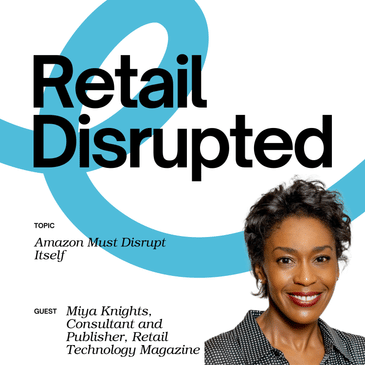
Miya Knights and Natalie Berg, co-authors of Amazon: How the World's Most Relentless Retailer Will Continue to Revolutionize Commerce, reconnect on Amazon's 30th anniversary to explore what comes next for the online retailing giant and whether it has what it takes to stay relevant in the future.
They discuss:
- How Amazon became the most influential retailer of the 21st century.
- Whether Jeff Bezos' belief that most large companies only last around 30+ years still rings true.
- How AI and technology more generally is enabling retailers to level the playing field and future-proof their store estate.
- Temu – how it differentiates from Amazon, whether they can co-exist and what do the authors make of Amazon's plans to launch a Temu-style storefront?
- The future of digital commerce – we don't browse on Amazon! How the rise of TikTok, Roblox and other immersive platforms will require action by Amazon to avoid being perceived as too transactional and one-dimensional.
Connect with Miya on LinkedIn and don't forget to subscribe to her Retail Technology magazine!
For more, visit NBK Retail.
*THE PODCAST IS NOW PAUSING FOR THE MONTH OF AUGUST. HAVE A GREAT SUMMER BREAK AND SEE YOU IN SEPTEMBER.*
[00:00:06] You're listening to Retail Disrupted, a podcast that explores the latest industry developments and the trends that will shape how we shop in the future.
[00:00:16] I'm your host, Natalie Berg.
[00:00:30] If you listened to the podcast last week, you'll remember that I started out the episode talking about Amazon's 30th anniversary.
[00:00:37] I shared a few thoughts about Amazon's achievements over the past three decades.
[00:00:42] I talked about how they did it.
[00:00:44] And I also shared a quote from Jeff Bezos, which in case you missed episode 43, I'm going to share it with you again today.
[00:00:53] Now, a little bit of context before I read out this quote.
[00:00:56] It was from six years ago, and it was Jeff Bezos's response to an employee who asked how Amazon can stay relevant in the future and how they can avoid the same fate as Sears.
[00:01:08] Now, Sears, of course, was once the greatest retailer in the U.S.
[00:01:14] It was hugely disruptive for its time, but it failed to adapt.
[00:01:20] It failed to stay relevant.
[00:01:22] And we all know what happened next.
[00:01:25] So Jeff Bezos, in response, said Amazon is not too big to fail.
[00:01:30] In fact, I predict one day Amazon will fail.
[00:01:35] Amazon will go bankrupt.
[00:01:37] If you look at large companies, their lifespans tend to be 30 plus years, not 100 plus years.
[00:01:46] So on today's episode, we are going to be exploring whether Amazon has more in the tank, what the future holds, and whether it can fend off new sources of disruption.
[00:01:56] There is no one better place to help me do this than Maya Knights.
[00:02:01] Maya is my Amazon co-author.
[00:02:04] She is a retail tech guru and very much a friend of the podcast.
[00:02:09] Maya and I aren't going to pretend to know what the next 30 years will bring for Amazon.
[00:02:14] In retail, the only constant is change.
[00:02:16] So we're not going to call this episode Amazon The Next 30.
[00:02:19] But I think we do have a pretty good grip on how the sector will evolve over the next 10 to 15 years.
[00:02:26] And so I'm really excited to have Maya on the show today to explore the future of retail and to debate whether Amazon has what it takes to ensure that it doesn't go from being the disruptor to disrupted.
[00:02:44] Amazon celebrated its 30th anniversary earlier this month.
[00:02:48] You and I have both been running around doing lots of TV and radio interviews about this.
[00:02:55] We're both on the BBC that day.
[00:02:57] I know that you also wrote an editorial for The Grocer.
[00:03:00] So we got together.
[00:03:01] Actually, it was at The Grocer Awards that evening at the Royal Albert Hall, which was a fabulous venue, where we bumped into each other.
[00:03:10] And we thought, yeah, well, let's do a podcast.
[00:03:13] Let's see.
[00:03:14] Let's kind of pick up where we left off with the book, I suppose, and kind of look at just briefly kind of acknowledge what Amazon's achieved over the past three decades.
[00:03:24] But more importantly, look ahead to what might be around the corner for them and what some of the challenges are going forward.
[00:03:33] So that's sort of what led us to do the podcast.
[00:03:37] And I want to start off with getting your views on what you think the biggest accomplishment has been for Amazon over the past 30 years.
[00:03:48] Now, I'm going to give you a second to think about that.
[00:03:50] And while you do think about that, just for our listeners, a very brief recap.
[00:03:54] I'm going to give you a very abridged version of what Amazon's achieved and how they've achieved it.
[00:04:01] And then we're going to come to you, Maya, and hear what you think has been the most impactful thing that they've done.
[00:04:05] So very briefly, again, this is kind of a super abridged version of the book.
[00:04:09] What they've done, well, they've revolutionized the way that we shop.
[00:04:13] They democratized e-commerce.
[00:04:15] They forced the rest of the industry to kick into gear and offer a better experience for customers.
[00:04:21] So in my view, I think Amazon has been the most influential business of the 21st century.
[00:04:26] In terms of how they did it, well, something I say time and time and time and time again is that they have a relentless dissatisfaction with the status quo.
[00:04:36] They are obsessed with their customers.
[00:04:39] They have the luxury of long-term thinking.
[00:04:43] They have deep pockets.
[00:04:45] They are a technology company, not a retailer, which is why, of course, we came together to write our book.
[00:04:52] And also the clarity and consistency of their vision right from the very beginning.
[00:04:58] I always say, you know, go back and read the first shareholder's letter when they went public in 97.
[00:05:03] It reads as if it was written today.
[00:05:05] So having that consistency and strategy and having Jeff Bezos at the helm for over two decades, I think, has really enabled them to achieve all that they had.
[00:05:15] But I'd love to get your thoughts on this, Maya.
[00:05:17] What has been the biggest accomplishment for Amazon?
[00:05:20] Yeah, great question, Natalie.
[00:05:22] Absolutely.
[00:05:22] I agree that, you know, Amazon has completely revolutionized the way we shop.
[00:05:28] I remember back to, you know, the first time we both agreed that Amazon is not a retailer first, but a technology company.
[00:05:37] When we were talking about writing the book, because we had so many big brands and big retailers worried about what Amazon was doing to their business.
[00:05:46] But in terms of their customer obsession, I would say it's data driven.
[00:05:52] So when we talk about the what and the how, what they've done is to revolutionize commerce.
[00:05:58] How they've done it is by capitalizing on the advent of digital and data.
[00:06:03] And when they talk about customer obsession, it's what does the data tell them about their customers that their customers want.
[00:06:11] And so I think in that risk guard, 30 years on, they can be seen as a little bit transactional, a little bit impersonal.
[00:06:17] But nevertheless, we you and I both kind of tacitly understand what that customer obsession means and what it's led to.
[00:06:26] Finally, I would just say that it's a bit of a fudge.
[00:06:29] There's so many things they've done individually, but they have set the standard for e-commerce.
[00:06:36] I mean, it kind of echoes what you said already. Right.
[00:06:38] But when you break it down, you've got ratings, reviews, recommendations, one click checkout, prime, all of these things, endless scroll, filters, all of these things.
[00:06:50] I don't think retailers would have coalesced so quickly behind a way of selling online that we all understand, tacitly and eightly understand now, had Amazon not set the bar.
[00:07:03] And the final one is, you know, the drop down menus.
[00:07:05] You know, when you all go to the same place, top left, top right, to look for further information, we're all looking at the bottom of the page for the contact us screen.
[00:07:14] I would suggest that when it, particularly when it comes to e-commerce, Amazon has set, not only set the standard, but set the bar.
[00:07:21] I guess my question now is, you know, the world is very different today.
[00:07:25] And sure, what they were doing 30 years ago, 20 years ago, even 10 years ago was very innovative and very disruptive.
[00:07:34] But today, shoppers are ubiquitously connected.
[00:07:38] The pandemic, of course, was a catalyst for digital transformation.
[00:07:41] And just on the podcast last week, I was talking to Steve Dennis, who we were talking about how quickly retailers responded during COVID and how Walmart launched curbside pickup in six days.
[00:07:56] So again, just how fast retailers are moving today.
[00:08:00] The rest of the industry has caught up.
[00:08:02] They're using technology.
[00:08:04] They're using AI to level the playing field.
[00:08:07] And they're also thinking like Amazon.
[00:08:09] They're thinking like a disruptor.
[00:08:11] They're starting with the customer.
[00:08:13] They're working backwards from the customer.
[00:08:15] They're failing fast.
[00:08:17] And I think the final thing, from my perspective, is that they are flaunting the one thing that Amazon has yet to crack, which is bricks and mortar retail.
[00:08:25] The fact that stores today are repurposed, they're revitalized.
[00:08:31] Suddenly, Amazon's model, I don't know, looks a little bit less special, a little bit less differentiated.
[00:08:37] So in your view, how much of this leveling of the playing field, how much of this is a threat to Amazon's business going forward?
[00:08:46] So I would agree with everything you said.
[00:08:50] I think where it leaves Amazon is it needs to disrupt itself.
[00:08:53] And that's really, really, really difficult.
[00:08:55] It's set the bar really high.
[00:08:57] Retailers have improved their digital capabilities to come up to meet that bar.
[00:09:06] And I agree with you.
[00:09:08] Oh, you said stores are revitalized.
[00:09:10] I'm not so sure about that.
[00:09:12] I would say the purpose of stores, the role of stores has become clearer.
[00:09:19] It's definitely changed and morphed in relation to the way that consumers shop both stores and online now.
[00:09:30] So, yeah, you're right to sort of flag the fact that Walmart launched pick up and store click and collect in six days.
[00:09:39] I think it goes back to what I said earlier about the fact that Amazon has used digital and data to disrupt the traditional retail model and become as big as it has now.
[00:09:53] But in using data, being data-driven business does make it feel quite transactional.
[00:10:02] And I think that's why it struggles with stores, because essentially the thing that retailers had to learn from Amazon was how to use data and digital, how to be digitally enabled and data-driven in terms of their offer, in terms of orchestrating their offer with how they engage customers with where their stock is, for example.
[00:10:24] But essentially, retail doesn't change.
[00:10:27] And I say this so often.
[00:10:29] All that's changed, all that Amazon's managed to do in retail is change our means of accessing it.
[00:10:36] When it comes to retailing, I still point to the original market stalls, bartering, merchant curation smarts.
[00:10:48] I know my customer, and therefore I know that my customer will want X, Y, and Z at this particular time in this particular place.
[00:10:56] This has been going on since time immemorial, since time began.
[00:11:02] And I think merchants, not only, as you say, have the advantage of stalls, but they also have the advantage of having run stalls.
[00:11:10] And when you reverse engineer how they've run stalls, that's through a deep understanding of who their customers are, a deep understanding of their journeys, their physical needs, missions, and shopping journeys.
[00:11:22] So Amazon must disrupt itself, but it is lacking that merchant curation smarts that retailers have kind of taken for granted in order to join up the channels and run stalls successfully as well.
[00:11:37] Yeah, I guess it's the human element that Amazon has traditionally struggled with.
[00:11:42] And it's, as I've said time and time again, it's when you marry technology with the human touch.
[00:11:47] I mean, that, I think, is super powerful.
[00:11:49] You can't really have one without the other.
[00:11:50] And I think if we just take a moment just to kind of acknowledge just how digitally enabled stores are now, and I know, Maya, you are very passionate about this, and you've written another book about this.
[00:12:02] But I recently did a, I recorded a podcast, not for Retail Disrupted, but for a podcast called What Next, which is a publicist podcast with Rishad Tabakawala, who is the former chief growth officer at Publicis.
[00:12:17] And we talked about the role of Stores.
[00:12:50] And I think that's a publicist.
[00:12:58] And then all the stuff that happens on the back end, all the kind of magic around click and collect, and not just click and collect, but one hour click and collect, or using your store as a returns hub.
[00:13:09] And there's so much innovation happening there that I won't get into for the sake of this podcast, but also using your stores as fulfillment hubs to allow for same day delivery.
[00:13:18] So the store has really, really evolved.
[00:13:21] And of course, you know, again, there's so much to explore here, but stores do have to be more than just, you know, digital spaces.
[00:13:31] Completely.
[00:13:32] And that's, you know, I think another conversation.
[00:13:34] But I think if we just stick with the digital aspect in relation to Amazon, and how the fact that stores today are so much more powerful, and we're seeing this real resurgence.
[00:13:47] You know, I think if the pandemic taught us anything, it's actually we miss bricks and mortar stores.
[00:13:51] But I want to ask you something very specific about AI.
[00:13:54] And how, as we talk about leveling the playing field and how legacy high street retailers can further kind of raise their game to compete with the likes of Amazon.
[00:14:06] How do you see AI playing a role either in terms of driving efficiencies or improving the customer experience?
[00:14:12] The point about AI is that you can set a computer, a task that will take a human or a human using an Excel spreadsheet far longer to digest.
[00:14:26] So you can actually input so many more data sources.
[00:14:30] So I can find out, you know, how many parades go past this store a year?
[00:14:34] And, you know, is it near a playing field?
[00:14:37] Am I going to get passing traffic wanting to go to the wanting to get picnic stuff if they're going to a park because it's near an apartment, this store three miles away?
[00:14:46] Those kinds of permutations system retailers haven't had access to the compute power to run those kind of permutations.
[00:14:55] So on one hand, I think they need to right size their store offer using AI.
[00:15:01] But also when we come into the store, there's a lot more that they can be doing to monitor dwell time, footfall, movement.
[00:15:11] Are they, is the store optimized for layout purposes?
[00:15:15] And then in terms of total offer, it's, you know, what kind of methods of payment am I use, am I offering?
[00:15:21] What right down to not just the service wrapper, but what am I selling?
[00:15:26] You know, the algorithm, the buy box is what decides that on Amazon.
[00:15:30] And that's traditionally been run on some quite sophisticated machine learning algorithms.
[00:15:37] All that now is completely democratized and open to retailers.
[00:15:41] They can apply AI to every facet of their business.
[00:15:44] I've just called out a couple in relation to the store there.
[00:15:47] The final point, though, that you have to make is that they might be using AI to hopefully optimize their business,
[00:15:53] fine tune it and, and, and upgrade their total offer.
[00:15:58] But they'll be probably be running the running these AI systems on a on a cloud that competes either sits on AWS cloud infrastructure that sits within AWS,
[00:16:08] or is fitting with one of the rivals because it's not AWS.
[00:16:13] So Amazon's still winning in that regard.
[00:16:16] But you'd right to call out the fact that AI tools and capabilities have advanced so far that there really shouldn't be a queue at the click and collect desk at lunchtime because they've got all the data.
[00:16:30] They've got the footfall.
[00:16:31] They've digitized their stores.
[00:16:32] They have footfall counters.
[00:16:34] They've got the point of sale that tells them what they're selling, when they're selling.
[00:16:38] They know who's in their stores.
[00:16:39] Sometimes they even have us identify ourselves as we're going into our stores because they want us to log on to the Wi-Fi or pick up a loyalty scamming gun.
[00:16:48] All of this information means that some of these points of friction I've pointed to needn't exist anymore, and AI can help them with that.
[00:16:55] Yeah.
[00:16:55] Yeah.
[00:16:56] So it's, I guess it's, yeah, evolution, isn't it?
[00:16:59] Yes.
[00:16:59] And I want to ask you one other question about AI.
[00:17:02] I know we just talked about how AI might help Amazon's competitors to raise their game, but I wondered if we can get your thoughts on how you see Amazon using AI.
[00:17:13] Because earlier this year, John Bountfree, the UK MD, who was my first retailer on the podcast, actually.
[00:17:21] But John spoke at Retail Week and at the Retail Week Live event, and he said that generative AI is going to be as transformative as the internet.
[00:17:31] That was his bold claim.
[00:17:33] I guess, Maya, would you agree with that statement?
[00:17:36] And how do you see generative AI helping Amazon to improve the offer to customers?
[00:17:44] No, I don't agree with the statement.
[00:17:47] Why not?
[00:17:48] Oh, the internet.
[00:17:50] I mean, geez.
[00:17:51] We wouldn't have had an iPhone.
[00:17:53] We wouldn't have Amazon.
[00:17:55] Generative AI has the potential to just revolutionize the way we do things.
[00:18:02] I don't think it's a net new thing in terms of what we do.
[00:18:06] Do you see what I mean?
[00:18:07] Yeah.
[00:18:07] The internet was a new channel.
[00:18:09] It was a new way of communication.
[00:18:10] It was a new way of disseminating and collating information.
[00:18:15] Generative AI is like, it's a bit like AI.
[00:18:19] AI in and of itself was revolutionary.
[00:18:21] Generative AI builds on that.
[00:18:23] I wouldn't say it's as important.
[00:18:25] We see a lot of generative AI output in regards to more nefarious areas like the media, fake news, fake imagery, fake talking heads, for example.
[00:18:41] But actually, generative AI sits on top of AI and just makes it more and more powerful.
[00:18:50] So a good example would be in the supply chain.
[00:18:53] I always say machine learning algorithms have been around for 40 years in terms of forecasting and modeling.
[00:19:02] But a traditional machine learning based supply chain forecast model is only as good as it's built on day one.
[00:19:11] And then it needs human beings to maintain it.
[00:19:15] Generative AI allows that same forecast to ingest text, weather, pictures, news.
[00:19:27] It might be all sorts of other data sources that they can then use to cross-reference and correlate against the model and therefore constantly improve the model.
[00:19:35] So you put in a supply chain forecasting model based on the more sophisticated generative AI developments today.
[00:19:42] And it's worse performing today is its first.
[00:19:45] And then it gets better and better and better.
[00:19:47] So would you say that's revolutionary?
[00:19:49] I don't think people are going to actually notice the difference.
[00:19:53] But what should happen and the way Amazon is using AI right now is to help sellers create product descriptions, help sellers create imagery, aggregate reviews.
[00:20:09] We'll still see a product description.
[00:20:11] We'll still see a product image.
[00:20:12] But the amount of work that's gone in, manually intensive work that's gone in to create that will have been obliterated.
[00:20:21] So you often hear people say, AI is not coming for our jobs.
[00:20:25] It's people that can use AI that are coming for our jobs.
[00:20:28] And in that regard, I see both Amazon and the retail industry at large using generative AI to further streamline, further automate some of the more manually intensive processes.
[00:20:44] So it should make them work smarter, faster, cheaper.
[00:20:48] Smarter, faster and cheaper is not something you and I as a customer are actually going to see.
[00:20:53] Maybe we might see it in terms of prices lowering, improved service proposition, improved service levels.
[00:21:01] But we're not going to immediately think, oh, thank you, Gen AI, for making that possible.
[00:21:07] Does that make sense?
[00:21:08] That makes a lot of sense.
[00:21:09] Yeah, I think the only time as a customer now, the only time I've really thought, oh, thank you, Gen AI,
[00:21:15] is what they're doing with product reviews where they're making condensed summaries.
[00:21:22] So having AI to kind of – having the technology to kind of sift through potentially thousands of reviews
[00:21:29] and pull out what's most important and surface that to the customer so it's quick and easy
[00:21:33] and helps you to make a more informed decision, that's awesome.
[00:21:36] But that's kind of the extent of what I'm seeing from a customer's perspective.
[00:21:40] So it's not something that's really going to move the dial, right?
[00:21:43] No, exactly.
[00:21:44] I think it's got a lot to do with trust as well.
[00:21:46] I mean, Amazon and reviews in the same sentence, eek, kind of thing anyway.
[00:21:51] But for me, there's going to be a long tail to this stuff.
[00:21:55] There's going to be people that see the AI-generated review synopsis or summary and go,
[00:22:01] I don't believe that, and go and read the reviews themselves.
[00:22:04] Do you see what they mean?
[00:22:04] So we're in a phase at the moment where Amazon has to still publish all the reviews.
[00:22:09] We're not just going to take an AI-generated synopsis and go, okay, Amazon, yeah, we trust you.
[00:22:15] That's what all those hundreds of thousands of reviews said.
[00:22:17] So we're in that middle ground at the moment where when it comes to customer-facing stuff,
[00:22:23] we're still a little bit wary of Jen.
[00:22:26] So I think retailers are going to have to be quite circumspect in the way that they're using it in that regard.
[00:22:31] But, you know, you can see how Amazon with its history, having generated tens of millions,
[00:22:37] maybe even verging on the billions of reviews, would find that a really good tool to roll out to customers first
[00:22:44] to test those levels of trust, right, to see whether or not it adds to the customer experience.
[00:22:50] And you've just said you found it useful.
[00:22:51] So I'm sure we'll see more and more and more of it.
[00:22:54] And in that regard, we'll learn to trust a bit more than having to trawl through thousands of reviews ourselves.
[00:23:01] I think transparency is really key here as well because it does very clearly state this is a generative AI.
[00:23:07] Generative AI generated.
[00:23:09] That doesn't make any sense, is it?
[00:23:10] This is AI-generated content.
[00:23:12] So we've talked a lot about stores and how Amazon competitors are raising their game
[00:23:17] and how technology is enabling this.
[00:23:19] There are, of course, other threats to Amazon's business in the future,
[00:23:23] as well as some of the perennial criticisms, things like working conditions,
[00:23:28] supplier relationships, their taxation policy.
[00:23:33] Increasingly, whether they're breaching antitrust laws,
[00:23:35] especially as they spread their tentacles across new verticals and new channels.
[00:23:40] We're not going to talk about any of those things, Maya, so you can relax.
[00:23:45] We're going to stick with the theme of competitive threats.
[00:23:47] And I'd like to shift gears now and get your thoughts on how you see e-commerce evolving in the future.
[00:23:55] And really, there's two things I want to explore here.
[00:23:57] One is immersive digital commerce.
[00:24:00] So you can just maybe start getting your thoughts ready on that topic.
[00:24:05] But before we do that, I want to talk about some of the new disruptors
[00:24:08] that are causing a little bit of, I wouldn't say panic,
[00:24:13] but they're certainly stirring a reaction at Amazon.
[00:24:16] So Shein, Timu, TikTok as well, but we can talk about TikTok separately.
[00:24:22] I know you've spoken to The Guardian and The Independent and various other journalists about this.
[00:24:27] So just how big of a threat are these businesses to Amazon?
[00:24:31] Yeah, they're definitely a threat.
[00:24:34] There's areas where Amazon's better insulated against the likes of Timu and Shein.
[00:24:44] So Prime is a great one because we trust them on their promise to deliver.
[00:24:48] And I think when people order anything from Instagram, much less Shein or Timu,
[00:24:53] they're like, OK, if it arrives in a week, I'll be really pleased.
[00:24:56] But then I think, you know, in that regard, they're both of those.
[00:25:01] And even AliExpress is pushing really hard into Europe as well.
[00:25:05] In that regard, the trade-off, I think, that they're quite happy to let the consumer grapple with
[00:25:12] is price versus speed.
[00:25:16] So I think Amazon certainly is right to be threatened by these companies.
[00:25:20] But in terms of the sweet spot between the price point and the convenience of next day delivery,
[00:25:28] that is their kind of their water loop, as it were.
[00:25:35] That's the bit that if Shane and Tamu and AliExpress and the rest of them
[00:25:39] really want to come for Amazon's business,
[00:25:41] they're going to have to somehow match Amazon on that point.
[00:25:47] Otherwise, I think Amazon, you know, they are taking market share
[00:25:51] because people will look at Amazon and then maybe look at Timu.
[00:25:56] And if Amazon's a little bit more expensive, but it's not as urgent and they don't have Prime,
[00:26:01] then obviously they're going to default to Timu.
[00:26:03] So, yeah, they're definitely a threat.
[00:26:05] But I think in regards to the total package, time and money, speed, convenience, price,
[00:26:10] self-proximity and recognition and reward of your continued custom,
[00:26:17] Amazon's still in a, they've got a long tail.
[00:26:19] They're still in a pretty strong position.
[00:26:21] Yeah, I completely agree with you.
[00:26:23] One of my favorite stats from the book, and this is an Amazon stat,
[00:26:27] and I apologize to my listeners because I have said this time and time again on the podcast,
[00:26:31] but it's such a good one.
[00:26:33] Half of Amazon purchases take place in 15 minutes or less.
[00:26:38] And over a quarter of Amazon purchases take place in three minutes or less.
[00:26:43] So that is what Amazon's about.
[00:26:45] You know, you've got access to everything.
[00:26:47] It turns up on your doorstep the next day, even the same day, and you can't compete with that.
[00:26:53] And I completely agree with you on speed and cost and that being a real differentiator
[00:27:00] because for Timu, it's for standard delivery, it's six to eight business days.
[00:27:06] And I believe last time I checked, they say it's free shipping,
[00:27:10] but I believe there's a 10 pound minimum spend, which is kind of fair enough.
[00:27:15] But I think, yeah, I just, sorry, Maya, were you going to say something?
[00:27:19] No, go on.
[00:27:20] You finish your point.
[00:27:21] No, no.
[00:27:22] Just that it's just interesting because there's such media interest in Timu and whether they pose a threat.
[00:27:28] But also, you know, just a few weeks ago, we heard that Amazon is reportedly launching a Timu-style storefront on its site.
[00:27:37] Just a little recap for listeners who might not be familiar with this news.
[00:27:41] CNBC reported that the announcement happened at an invite-only conference for Chinese sellers.
[00:27:47] And the storefront will sell low-priced fashion and lifestyle items that will allow Chinese sellers to ship directly to U.S. shoppers.
[00:27:57] I'm not so sure about Europe.
[00:27:58] I haven't checked that out, but I presume it'll be Europe as well.
[00:28:01] The items are unbranded mostly, and they are under the 20 pound price point.
[00:28:07] Actually, that might be $20.
[00:28:09] I'd have to check my notes, so don't quote me on that.
[00:28:11] But it's generally low price point.
[00:28:12] And delivery will be 9 to 11 days, so a real departure from what we're used to when we shop on Amazon.
[00:28:20] So clearly, they see demand for extreme value in an e-commerce setting, which for obvious reasons, retailers have avoided for a very long time.
[00:28:32] But I think the other point here, and you kind of touched on this, is it is a very different concept.
[00:28:38] You know, Timu is, from what I can see, I have to say I haven't bought anything on there.
[00:28:43] And I am keen to understand more about the business.
[00:28:46] But from what I can see, it's kind of a jumble.
[00:28:48] It's a bit of, you know, kind of that discovery, grab what you can.
[00:28:52] A bit like TJ Maxx or, you know, Aldi or Little, the kind of middle aisle.
[00:28:56] Random stuff you probably don't need, but it's so cheap.
[00:28:59] You know, why not?
[00:28:59] So with Amazon, you probably know what you want before you even reach the platform.
[00:29:04] Whereas with Timu, it's the total opposite.
[00:29:06] It's all about gamification.
[00:29:10] It's recommendations based.
[00:29:12] It's push based.
[00:29:13] So they learn what you like through the app, and then they push you more relevant content.
[00:29:17] And in that respect, it's a lot more like TikTok than Amazon.
[00:29:22] We're going to come on to TikTok in a minute.
[00:29:24] So I don't want to get into social commerce just yet.
[00:29:27] But I did want to mention TikTok here, just because the user experience is very similar.
[00:29:34] And you can argue that this is the way that e-commerce is evolving.
[00:29:38] This is more relevant to a generation that has grown up with technology.
[00:29:44] And so I think it's right that Amazon responds with their own storefront.
[00:29:49] Now, how they do it and how they market it isn't going to be straightforward.
[00:29:55] But I think that, you know, they've recognized that Timu isn't just, you know, rubber chickens
[00:30:00] and foldable water bottles.
[00:30:03] It's a genuine threat, and they need to respond.
[00:30:06] The last thing I want to call out here is sort of related to sustainability.
[00:30:11] Now, you can argue that all of this is just a huge race to the bottom.
[00:30:15] One thing Amazon is reportedly going to do when they launch this new storefront is they are
[00:30:21] going to adopt a Sheehan-style model of on-demand manufacturing.
[00:30:25] So this is the whole test and learn thing.
[00:30:28] Now, what this is going to do is it's going to allow them to try new products on a small
[00:30:32] scale.
[00:30:33] And then if it goes well, if there's demand for it, they can quickly ramp that up.
[00:30:38] So you can make the argument that that will result in less waste, fewer products being
[00:30:44] shipped around the globe, happier customers, you know, drive down costs for the retailer.
[00:30:50] There's a whole load of benefits.
[00:30:51] But I thought that was really interesting.
[00:30:53] Timu doesn't do that so much.
[00:30:55] I think you can argue that's more relevant for fashion than a lot of the non-food categories
[00:31:02] that you find on Amazon and Timu.
[00:31:04] But I think it is a really interesting development that we should all be watching.
[00:31:09] So I agree with the fact that purchases take place on Amazon's platform or however proportion,
[00:31:16] I can't remember, but I think you said a third, didn't you?
[00:31:18] Within three minutes.
[00:31:19] Kind of tells me we know what we want before we go on Amazon.
[00:31:25] And actually, the thing we like about Amazon is the fact that it's really easy to get us
[00:31:31] to what we want.
[00:31:31] Okay, as long as you know what you want.
[00:31:34] Because I remember years ago having this discussion with somebody and giving the example of,
[00:31:38] you know, I bought a Microsoft Surface and I thought, tablet, and I thought, oh, I'd
[00:31:43] like to see if the covers, if I can find the covers cheaper on Amazon.
[00:31:47] And it gave me like 20,000 results.
[00:31:50] And there were pens and screen protectors.
[00:31:53] And the filters didn't cover everything.
[00:31:55] So even when I'd gone through all the filters, I still had like 4,000 products to look through.
[00:31:59] It is not, when you look at the search, browse, and discovery phases of the shopping journey,
[00:32:05] it is not geared for easy, it's good on search, not great on browsing, terrible on discovery.
[00:32:15] I think that's personally why they've struggled with grocery, really.
[00:32:19] Because grocery is also, you've got the stuff you know you want that's branded.
[00:32:23] But then you've got stuff where you might not be in stock.
[00:32:26] So you need to be able to sort of show me all the other alternatives.
[00:32:29] The search, browse bit needs a little bit of help in that regard.
[00:32:32] But I think to that point, we like Timu and Shane, because it's got that element of surprise and delight.
[00:32:41] It's still a little bit of an unknown.
[00:32:43] It is a bit of a jumble, like you point rightly to the Middle Isles for Aldi and Middle.
[00:32:48] Plus, it's rock bottom value.
[00:32:50] So I can see why they would want to take the innovations from other innovators
[00:32:59] and use that to stop themselves being disrupted.
[00:33:03] The thing that people probably don't know about why I initially see the take,
[00:33:11] copying the Shane and Teemu models is so clever,
[00:33:15] is by selling this storefront directly to Chinese manufacturers,
[00:33:19] they are heading off what is already quite a hot battle for freight space.
[00:33:26] So that's air freight, sea freight, getting those products.
[00:33:30] And this touches on your sustainability point.
[00:33:33] To us as customers, whether we're in the US or Europe from China,
[00:33:39] Shane, Teemu and AliExpress have been taking up more and more and more and more freight space.
[00:33:45] So it confirms, this confirms that Amazon definitely wants those sellers buying and transacting through them.
[00:33:56] But also in doing so, it makes it easier for them to get their,
[00:34:01] for Amazon to get their own goods or goods that they're buying from manufacturers in China
[00:34:08] to ship them to us.
[00:34:10] Because it's probably costing them more because they're having to compete with the others, right?
[00:34:14] And then finally, the on-demand ordering part goes to that.
[00:34:20] Yeah, you're absolutely right.
[00:34:21] One, it helps them test and learn quickly in terms of product development.
[00:34:26] But also it gives them something to say against the sustainability issues
[00:34:34] that have come up with e-commerce, particularly in terms of the fact that it's supported such a huge expansion
[00:34:43] in Chinese export business.
[00:34:45] And then the final one, though, which I don't think, you know, we can blame Teemu more than Amazon
[00:34:54] or Amazon more than Teemu on is the last mile delivery costs.
[00:34:57] That's the true cost from an environmental standpoint.
[00:35:03] Comes with shipping me a packet of batteries in a van full of other tiny, tiny little parcels.
[00:35:09] So on-demand manufacturing, yeah, I can see how that would answer that question.
[00:35:14] But yeah, I think everything that we've discussed confirms that they're seen as a threat,
[00:35:19] but also cleverly that Amazon is borrowing very things that they feel threatened by
[00:35:24] and using them to defend their position of market leadership.
[00:35:31] And it doesn't feel like it will cannibalize their business at all.
[00:35:35] It does feel like a very separate thing altogether.
[00:35:39] And I guess just one last point around sustainability is if these products are going to be of similar quality
[00:35:47] to Teemu, which is questionable, questionable quality, let's put it nicely.
[00:35:53] You know, that's not great for the environment either, right?
[00:35:55] You're shipping products from China.
[00:35:57] They're not lasting long.
[00:35:58] They're ending up in landfill.
[00:35:59] So there are still questions around this model.
[00:36:03] And as consumers, the whole intention behavior gap really rings true here where we say we want to shop greener.
[00:36:11] We want to, you know, make decisions that are better for the environment.
[00:36:14] But ultimately, we want convenience.
[00:36:15] We want low prices.
[00:36:17] And yeah, it'd just be really interesting to watch it unfold.
[00:36:20] It will be.
[00:36:21] I mean, it goes to the trust though, right?
[00:36:23] Amazon's got this trust.
[00:36:24] That's where we started talking about this issue.
[00:36:27] They've got this trust.
[00:36:28] If they start, you know, they've had so much trouble over counterfeiting,
[00:36:31] so much trouble over, you know, goods not fit for purpose, dangerous goods, for example, as well.
[00:36:38] Not passing health and safety standards in the countries where they're being sold to.
[00:36:44] I don't know that this is going to work.
[00:36:45] And the final point I'll make is that I've often said to people in Amazon's grocery business
[00:36:51] and in their fashion business, if you want to sell more fashion, you want to sell more groceries,
[00:36:56] don't call it Amazon fashion.
[00:36:57] Don't call it Amazon groceries.
[00:36:59] I can imagine that this TAMU-like platform, they're going to either confuse the customer
[00:37:07] by not calling it Amazon to differentiate it clearly, or they're going to confuse the customer
[00:37:13] by calling it Amazon and then the quality, the trust, all those things that allow them to,
[00:37:19] that give them the strength to compete gets eroded.
[00:37:21] So they're in a difficult position.
[00:37:23] I can see why they're doing it, but it's definitely one to watch because it could go either way right now.
[00:37:27] It really could.
[00:37:29] Now, one final topic, Maya, that I wanted to get your thoughts on, and I know we've talked about this
[00:37:34] before, but immersive digital commerce.
[00:37:37] When it comes to Amazon, it's still very transactional.
[00:37:40] It's purchasing, not shopping.
[00:37:42] It's one-dimensional.
[00:37:43] We don't browse on Amazon.
[00:37:46] TikTok is another emerging threat.
[00:37:48] And again, I heard Paul Mears, who is TikTok's group vertical director for retail.
[00:37:56] I heard him speak at a conference earlier this year.
[00:37:59] And he had some really interesting things to say.
[00:38:01] You know, he said that TikTok isn't actually seen as a social network, but an entertainment service.
[00:38:06] And so he made the point that you open TikTok to watch it.
[00:38:10] And he also made the point that product search is a fast-growing area.
[00:38:15] And we know that traditionally, as in at least for the past decade or longer, most people start their product search on Amazon.
[00:38:22] So again, you can see that's a direct threat to them.
[00:38:26] And also, when we think of TikTok, I mean, I got on there once, and I got out really quickly because it was just too much going on.
[00:38:35] So I'm not their target customer.
[00:38:37] But in a way, I am because their fastest-growing demographic, at least here in the UK, is 35-plus.
[00:38:44] So it's not just for young people.
[00:38:46] It is a really powerful platform for retailers and brands to engage with their customers and to do it in a really unique way.
[00:38:54] So there's TikTok.
[00:38:55] There's also, you know, the metaverse that kind of was dead before it began.
[00:38:59] There's, you know, we saw Apple Vision Pro launch.
[00:39:01] We've seen Ikea get on Roblox and pay people to work in their virtual store.
[00:39:07] There's a lot of moving parts.
[00:39:08] But just, I guess, what are your thoughts on this, Maya?
[00:39:11] How do you see this playing out?
[00:39:12] And what might it mean for Amazon's business model going forward?
[00:39:16] Okay, so I think the catch-all, why have all of these things that you've just described become popular?
[00:39:21] Yeah.
[00:39:22] They're multimedia and multidimensional.
[00:39:24] Yeah, it's like going from the written word, the printing press, to the TV or to the radio.
[00:39:32] It's adding a whole new dimension.
[00:39:34] I've got my own little TikTok shop anecdote that my partner and I were going to Paris,
[00:39:40] and we ended up talking to some mother and daughter that were going on a weekend trip there as well, outside the gate.
[00:39:46] And I asked the mum, oh, what are you going to do?
[00:39:48] What are you going to see?
[00:39:49] And she went, don't ask me.
[00:39:50] Ask my daughter.
[00:39:51] And she looked at her daughter and her daughter said, everything we're doing, I got from TikTok.
[00:39:57] And you can imagine, she said to me, when I was checking out restaurants, I'm not just looking at a static black and white text-based TripAdvisor review.
[00:40:07] I'm not just looking at the pictures and images that the establishment chooses to provide to Google when I do a Google search.
[00:40:17] But I'm seeing what other people are sharing in video format.
[00:40:21] I'm hearing the sounds.
[00:40:23] I can practically smell the food because I've got that multimedia, multidimensional view.
[00:40:30] So I'm definitely seeing that there's more of an appetite of that because people just want to know.
[00:40:36] I think people are, the common thread beneath all of it is that they're looking for authenticity.
[00:40:42] And if someone's taken a video and you can see it's not doctored, it's a short, short form TikTok type video and they've uploaded it.
[00:40:51] It's not Instagram where they photoshopped it with an inch of its life and they, you know, added filters.
[00:40:58] This is short form, really raw, little bits of video, shared, user-generated content that we can trust.
[00:41:05] And so, yes, I am seeing the same things.
[00:41:07] I'm hearing the same things that TikTok is emerging as like the shopping engine of the next decade for digital commerce, for immersive commerce.
[00:41:18] And so, yeah, I think retailers, including Amazon, need to take note of that.
[00:41:23] And I've also been involved with a couple of TikTok executives presenting at events and so on.
[00:41:30] And it's been rammed.
[00:41:32] Anytime anybody from TikTok stands up to talk about the shop, retailers and brands are desperate to find out more.
[00:41:37] But I'm also hearing behind the scenes that brands particularly are very, very keen to get on TikTok,
[00:41:43] but they don't understand that it is this very authentic, very quick turnaround content that they need to focus on,
[00:41:53] where they might be planning four to six major campaigns globally a year.
[00:41:57] They need to be turning around content on TikTok every six days.
[00:42:01] And this is a new way of working for them that I think really exposes retailers and brands' traditional marketing methods,
[00:42:09] traditional ways of being found.
[00:42:11] It's another dimension to the whole, dare I say, dare I use the word omni-channel retail conundrum.
[00:42:21] It's just another channel.
[00:42:23] But each one needs something different.
[00:42:26] Each one requires a little bit of nuance in terms of understanding of the format, the medium, the delivery methodology,
[00:42:33] the audience for it, and TikTok is just another one.
[00:42:40] Thank you for listening to Retail Disrupted.
[00:42:42] If you enjoyed this episode and would like to support the podcast,
[00:42:46] please leave a rating or review or share it with others.
[00:42:49] It really makes a difference.