
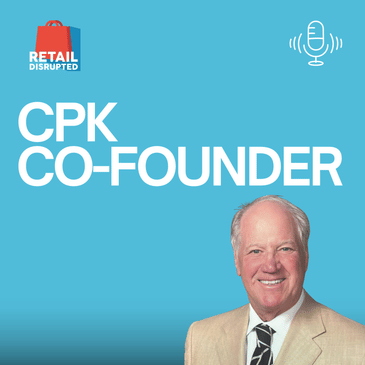

In 1985, two federal prosecutors walked away from their careers and mortgaged their homes to open a pizza restaurant in Beverly Hills. They wound up inventing an entirely new dining category.
Rick Rosenfield, co-founder of California Pizza Kitchen, joins Natalie Berg on Retail Disrupted to share the unfiltered story: the one menu hit that redefined casual dining, the culture that made CPK somewhere people genuinely wanted to work, how it beat the odds to survive bankruptcy and the reinvention chapter that followed.
Rick shares lessons from his new book: The California Pizza Kitchen Story: How Two Federal Prosecutors Changed the Way America Eats Pizza. https://amplifypublishinggroup.com/product/nonfiction/business-and-finance/leadership-and-management/the-california-pizza-kitchen-story/
This is a masterclass in innovation, differentiation, and ethical leadership for anyone building a brand, scaling multi-site retail, or navigating private equity-backed growth.
What retail leaders take away:
- How two lawyers created upscale casual dining at shopping centers with zero restaurant experience
- How BBQ chicken pizza became the brand's defining product
- Why CPK became the first national chain to go non-smoking — and what it reveals about culture-led decisions
- The private equity warning: what founders lose when new owners sideline the vision
- How CPK is diversifying into packaged goods and airport retail to future-proof the brand
Watch this episode on YouTube https://www.youtube.com/watch?v=p8WT_w571no&t=790s
ABOUT OUR GUEST Rick Rosenfield is a former federal prosecutor and defense attorney. He is the co-founder of California Pizza Kitchen, the restaurant brand that helped redefine how America eats pizza and reshaped modern casual dining.
Before entering the restaurant business, Rosenfield began his legal career at the U.S. Department of Justice in Washington, DC, where he worked on cases before the U.S. Supreme Court and the U.S. Courts of Appeals.
In the mid-eighties, Rosenfield and his partner, Larry Flax, made the unconventional decision to leave the law field and open the first California Pizza Kitchen in Beverly Hills. What began as a single restaurant grew into a global brand while maintaining a distinctive culinary vision and culture.
ABOUT THE PODCAST 🎙️ Retail Disrupted is a Top 5% Global Podcast with the leaders and disruptors shaping the future of retail. Hosted by retail analyst Natalie Berg. 👉 Subscribe on YouTube: https://www.youtube.com/@retaildisrupted 👉 Subscribe on Apple: https://podcasts.apple.com/gb/podcast/retail-disrupted/id1676107321 👉 Subscribe on Spotify: https://open.spotify.com/show/5H0TALn63ov2VAIJPNi3FM 👉 Follow on LinkedIn: https://www.linkedin.com/company/retail-disrupted/ 👉 Subscribe to our newsletter: https://retaildisrupted.substack.com
#CaliforniaPizzaKitchen #CPK #RestaurantStrategy #BrandBuilding #RetailDisrupted #RetailPodcast #FoodBrand #FounderStory
[00:00:00] We weren't really in the pizza business. We created something that's very different. Here are two lawyers, never been in the restaurant business, and we mortgage our homes and we borrow a quarter of a million dollars from the bank and all of a sudden we're in it. It was Beverly Hills. Our location had four failed restaurants in it and it was considered a restaurant graveyard. But we felt we could create a community feeling restaurant. One thing sold well. He created barbecue chicken pizza and that was a blockbuster.
[00:00:29] We were the first national chain to go non-smoking and we didn't have full alcohol and weren't trying to create a varsity. We became pioneers in upscale dining at shopping centers. And the most important was that our employees respected us and that we were ethical and that people wanted to come to work for us.
[00:00:57] Welcome to Retail Disrupted, a podcast that explores the future of shopping. I'm your host, Natalie Berg, and today I am sitting down with Rick Rosenfield.
[00:01:06] Co-founder of California Pizza Kitchen. However, before Rick set out to redefine how America eats pizza, he was a federal prosecutor and a defense attorney. He began his legal career at the U.S. Department of Justice in Washington, D.C., where he worked on cases before the U.S. Supreme Court and the U.S. Court of Appeals.
[00:01:27] In 1985, he and his partner Larry Flax made the unconventional decision to leave the law field behind and open a single restaurant in Beverly Hills. What started out as one location grew into a global brand. We're going to talk about brand differentiation, resilience, company culture, and so much more. But before we dive in, if you are finding value in these conversations, please do hit subscribe.
[00:01:54] We release episodes weekly and every subscription genuinely helps the channel to grow. Okay, on to today's episode with Rick Rosenfield. Rick, it's so great to have you on the podcast and great timing because you are just about to release a new book. It's called The California Pizza Kitchen Story, How Two Federal Prosecutors Change the Way America Eats Pizza. So I want to hear all about the book.
[00:02:22] But first, take us right back to the beginning and why you made that very unusual jump from practicing law to the restaurant world. Well, Larry, my partner, Larry Flax and I, who was my law partner, we were both formerly federal prosecutors and then we were criminal defense attorneys for 12 or 13 years. But we always wanted to be in the restaurant business.
[00:02:46] And we had one idea after another, but it never could pull the trigger because some client would come in with a big retainer and we'd be practicing law. But finally, after a long trial in San Francisco that went on for months, we both came back and said, and I had seen this pasta cafeteria concept in Chicago where I grew up. And we came back and said, yeah, let's do it.
[00:03:12] And that pasta cafeteria idea morphed into, in one day, into this new style of pizzas, California style pizza, which was in its early days. So we thought we had this great concept. This is what I often reflect on. Here are two lawyers, never been in the restaurant business, come up with something they think is a great concept. And we mortgage our homes and we borrow a quarter of a million dollars from the bank.
[00:03:40] And all of a sudden, we're in it. And just remind us, Rick, what pizza scene was like back then, because this is back in the 80s. And I imagine there wasn't anywhere near as much choice as there is now. So what was it like? Well, it was defined by Chicago pizza or New York pizza, or in your case, New Haven pizza. Every locality had a style. The biggest were New York and Chicago, really. Right.
[00:04:07] And so this emerging style of fresh ingredients and no tomato sauce started with Chez Panisse in Berkeley with Alice Waters, who's considered the mother of California cuisine. And she put goat cheese on pizza and fresh vegetables. And Wolfgang Puck made it very celebrity oriented down at Spago.
[00:04:33] And his two famous pizzas were duck sausage and the smoked salmon pizza, which they call the Jewish pizza. So that was the state of California pizza. We thought, let's bring this and make it accessible and fun. And that was before, however, we came up with our blockbuster. So it was just a concept. And then we ended up hiring the original pizza chef from Spago, who had left. And he created the original menu.
[00:05:02] And on that menu was duck sausage pizza and rabbit sausage pizza and lamb sausage and grape leaf, none of which sold. One thing sold well. He created barbecue chicken pizza. And that was a blockbuster change. Larry's and my thoughts. Now we understood it. It's because we weren't selling any of these others. If people could identify with barbecue chicken pizza. And we he only lasted a month.
[00:05:31] That was on a personal level. And Larry and I started creating the whole menu, which is what we always wanted to do. And then we started with the Thai chicken, you know, using chicken, using peanut saute and BLT. So Larry could get mayonnaise on pizza. And that exploded our idea, you know, sort of being the Baskin Robbins 31 flavors of pizza. Yeah. And I guess you weren't competing with traditional pizza chains. But you say, like, who was your competition when you started out? Well, that's a great point.
[00:06:01] So what we saw from the beginning is we weren't really in the pizza business. Right. We created something that's very different. We created a restaurant that happened to sell these very fun, innovative pizzas. But what our idea instead was we wanted a upscale, family oriented restaurant. And we felt that could play in every major market in the country.
[00:06:28] So this was before we started going in shopping centers. First one, first CPK was in a retail street on South Beverly Drive. Our location had four failed restaurants in it and it was considered a restaurant graveyard. But we felt it was Beverly Hills. I live six blocks away. We could create a community feeling restaurant that was upscale. Again, the ideal always was where could your parents and grandparents and kids all go to?
[00:06:57] And the pizza fit that format. But we didn't see ourselves in competition with the big pizza chains. We were really a full service, casual sit down restaurant. You know, in essence, because I've been to London many times. In essence, you know, we were sort of we're different than a Pizza Express because we didn't have that. But Pizza Express had, you know, was a casual is casual dining restaurant. Yeah, it's interesting.
[00:07:27] I think there's a clear lesson there for any retailer, any business, any brand, which is to be so clearly defined and to be really clear on your purpose and know how you're going to differentiate from the existing competition. You know, offering customers something new. I think that's just so important for any business starting out today because it is such a crowded market and consumers are fickle. And I think, yeah, I think there's lessons there for everyone. You described pizza as a canvas rather than a tradition.
[00:07:55] So where does that creative philosophy come from, Rick? Well, that's again what we what we learned, right, is that the other part that was very important is there were literally very few wood burning ovens in the United States. And we created the term wood fired pizza and it was displayed on our label, California on our logo, California Pizza Kitchen, wood fired pizza.
[00:08:24] So we started that wood fired pizza craze as well. So we that's exactly how Larry and I thought of it in the same context of a basket Robbins and kidding. Of course, we're the only basket Robbins, but but we saw this infinite possibility for flavors that people could identify with. They just hadn't had on a pizza. So we said it's a canvas you could paint on it.
[00:08:49] Anything that works well on good bread and cheese can be done with a pizza. Yeah, interesting. And also the branding. We should talk about the branding as well, because the word California, I think, implies a certain lifestyle, maybe a set of values. Do you feel that that helped to give you that point of differentiation and maybe the freedom to experiment and do things a little differently? You know, I told the story on myself in in my memoir. We didn't have a name.
[00:09:18] So this before barbecue chicken pizza, but before anything was just this idea of doing this style of pizza. And Larry calls me and we meet at the famous deli Nathan L's and Beverly Hills. He says, I've got it. I've got it. I said, what's that? He said, I've got the name. I couldn't sleep all. I couldn't sleep last night. I said, what's that? He said, California Pizza Kitchen. And my response was, Larry, that is way too pedestrian for Beverly Hills.
[00:09:46] I'm not going to open a pizza restaurant in Beverly Hills and call it California Pizza Kitchen. So Larry pouted as he's prone to do if you don't like his ideas. And then he stabbed me with, OK, I don't care what we call. We can pick one of the other names we've been talking about. But if we do that and then someone opens a competitor and they call it California Pizza Kitchen, you're going to be sick. And he hit me right in the gut with that one.
[00:10:14] And it didn't take another second. I said, you're right. I agree. You got me there now. So that night we met with some friends from Providence, Rhode Island. And a couple of names we were kicking around was Ciao and Primavera and these Italian names. And we said, what do you think of Ciao or Primavera or California Pizza Kitchen? And they said, in Providence, if you open another Italian restaurant, it's just another Italian restaurant.
[00:10:43] But if you open California Pizza Kitchen, we would want to go see what you fruits and nuts are up to. So that was it. That was our market research. I love it. But it was still their breakfast. And you're right. We really felt, you know, we originally started with pizza, pasta and salads. California gave us a halo, right? That we could expand the menu into other things that were California-like, California-ish in the early days of California cuisine.
[00:11:14] But the biggest thing, I think, from your context is what we did with retail centers. Right? Because to where we picked up that idea very early. And again, because we were family-oriented and we very, when you were talking about design, we very specifically created an environment where women would be welcome and comfortable. So our bar was a food counter. It wasn't a bar.
[00:11:42] And we didn't have full alcohol and weren't trying to create a bar scene. So women became our greatest customers. So our second location was a beverage center, an upscale shopping center. Third, Topanga Plaza in the Valley, which we were right next to in Nordstrom. And then Lenox Square in Atlanta, which was the premier mall in the southeast United States, came after us and offered us Center Court Wimbledon, where there are no walls.
[00:12:11] We had our restaurant and our colors right in the middle. Yellow smokestacks going straight up the mall. So for every floor you could see us, it was Center Court Wimbledon. So we were not only pioneers in this new style of pizza, we became pioneers in upscale dining at shopping centers. And then who is our core customer there? It's families, right? It's mothers and their kids and their families.
[00:12:39] So somehow it all came together. And then other people followed us in that, right? But we literally were the pioneers. And it worked out. You know, they say you can tell a pioneer by the arrows in his back. But in our case, it worked out well. Yeah. Yeah, that's true. You've got to experiment. You've got to be willing to accept failure, I guess, to ultimately find the thing that sticks.
[00:13:07] And I think it's really interesting to hear the origins of the name. And I think you're right. You know, having grown up in Connecticut and other New York style pizza, it isn't going to stand out, right? Whereas gourmet, California, freshness, that's pretty unique. So I guess my question to you on the back of that is, when you were starting out, did you think it was going to be as big of a success as it was? Did you think it was really going to scale nationally and then eventually internationally? We were so naive that we actually thought we would.
[00:13:36] Because when we borrowed money from the bank, the bank asked us to create a business plan. So I was the writer in our law practice. And that's my background. And I typed it out in the word processor. And I wrote out a business plan. And what I said was that California pizza will emerge as the third style of pizza in America, along with Chicago and New York.
[00:14:04] And it will always be defined by whatever California pizza kitchen says it is. And we expect it to be a global brand. And now we were so naive. Okay. Then here's what I reflect on. This is where I talk about our naivete. We thought we had this great concept. Now we open our first restaurant. And we have this problem that our chef and us do not get along at all.
[00:14:33] And we are clashing. And he does something that we need to terminate him after a month. Now we realize, and this is what I realized. Now I'm beginning to realize for the first time that a concept might open the door. It's not a business. Now we have a business. And what is a business dependent on? Dependent on people.
[00:14:57] And so we saw, unfortunately, we saw at that time, and it was, and felt endemic in the industry, the front of the house and the back of the house didn't get along with each other. And it was cultural. The back of the house in California and elsewhere was primarily Hispanic males. And the front of the house were primarily Caucasians. And they didn't respect each other. And that was just what we were thrust into.
[00:15:24] And Larry and I said, that is absolutely unacceptable. We can't have that. And we have an open kitchen, right? We can't have tension here. So before we created our ultimate culture statement, we call ROC, respect, opportunity, communication, and kindness, we didn't have those terms in those early days. All we said is, we've got to get along here.
[00:15:51] So what we said was, listen, CPK is religion blind. It's color blind. It's gender blind. It's education blind. We don't care. We need to respect each other. And if anybody needs to grow and we want to grow a business that people can thrive in, we need to get along. And we just did that. But that's what happened. Literally, we were so naive. I laugh when I say it seriously.
[00:16:19] But I do it to knowing what I know now, what I have done it. And I can't honestly say I would have because it was much harder than we thought what we got in. It all worked out in the end, I guess. Obviously, I would have done it. But I'm serious when I say we learned on the fly, right? That this business is a very tense people business.
[00:16:45] You are depending on delegating to other people and having them share your vision. Yeah, and so different to law. So I guess another question for you would be, was there anything about your previous career that you felt was helpful in terms of setting up a business and then moving into this very different sector of restaurants? I think in a lot of ways, particularly because we were trial lawyers.
[00:17:13] And trial lawyers learned that and also because we were both prosecutors and defense attorneys, you learn that no matter how thin a pancake is, it has two sides. So Larry and I, we didn't always come from the same start. He had one idea, I had another, but we debated them.
[00:17:36] And so our legal debates were vigorous sometimes, but we never walked away mad. We were partners for 45 years in business. But that ability to see that everything isn't black and white, it's gray. But then also to set an ethical standard. I thought in the end, in the end, what we would say was do the right thing. Right.
[00:18:04] So that was our guiding North Star. That was our principle. We could always come down. You know, we had the hard questions. One interesting one for us was we were the first national chain to go non-smoking. Oh, wow. And yeah, that's verified. We were, we were the first chain and we did it because we were at a management conference and a manager said to us, and this is at a time when restaurants were very concerned about
[00:18:34] having to build expensive, no smoking sections and ventilation systems. And the world was changing, but restaurants weren't eager to come along in this. And the manager said to us, we're having trouble finding servers that are willing to work a smoking section. And Larry and I walked out. We said, let's take a break here at this meeting. We took, walk out in the hall. Larry and I looked at each other.
[00:19:00] We said, how could we possibly, knowing what we know about the dangers of secondhand smoke, what right do we have to ask anybody to work in a smoking section? So we walked back in and we said, okay, we're taking another 10 minute break. Everybody called their restaurants. And, and we probably about 25 restaurants at the time around the country. And everybody called their restaurants and there is no smoking at California Pizza Kitchen. Said, how about the patio?
[00:19:29] Oh yeah, the patio is okay. Well, that lasted one day because then we got calls saying, if you're downwind of a smoker ahead of the smoking and on a patio, it's worse than anywhere else. Oh no. So that was it. And we, it, we became the first chain to do it. We, we didn't know if it was going to hurt us. We assumed it would hurt us. We never got a peep from a customer, right?
[00:19:55] And then dominoes fell in line and people fell in line and everything went non-smoking, but we did it for the right reasons, right? Not that we, we made a lot of decisions like that. You know, there, there are not close calls, you know, there is right and wrong. And for us, there was always do the right thing. And the most important was that our employees respected us and that we were ethical and that,
[00:20:22] and that people wanted to come to work for us. Yeah, that's super interesting. And making those kind of gut feel decisions as well about something that, you know, you feel, feel strongly about or that you feel the customers or your staff are going to feel strongly about. And yeah, that's super interesting. Now I'd like to talk about some of the things that you mentioned in your book around betrayal and resilience. And I know you touched on it already, the kind of constant tension between creativity and control.
[00:20:52] I know recent years for the business have been more turbulent, multiple rounds of private equity ownership. It filed for chapter 11 during COVID when everything had to shut. It came out the other side, which I guess is kind of unusual for a big restaurant chain, but emerged from bankruptcy. So Rick, I'd love to get your, your view on, you know, some of the pressures and consequences of private equity ownership. We ran the gamut. Well, reflecting on what we were, we started as private.
[00:21:20] Where Larry and I controlled it. After seven years, Pepsi, we were ready to go public. PepsiCo came along, convinced us they'd rather buy in. They ended up with two thirds of the company. When they got out of the restaurant business and spun off Pizza Hut, Taco Bell and KFC into Yum, we became owned by private owners, private equity.
[00:21:46] And that went hot and cold because we were no longer running it. Okay. And in fact, they only wanted us to be the face of the brand, the, you know, the PR of the brand, but not the operators. These two lawyers, what did we know? Right. After, you know, about 50 restaurants, that was difficult. So they, they, they took it public. We were chairman. Okay. But we were sidelined chairman.
[00:22:16] We were doing the cosmetic stuff. Then the CEO from that was messed it up. The board, now a independent board asked us to come back. We ran it as public. Larry and I ran it then for eight years as a public company. And then it, where we go now was, it was ultimately sold to private equity guys. They put in their new CEO.
[00:22:44] And despite the fact that we expected and had arranged to remain as co-chairman, the CEO that came in along with the private equity guys decided they didn't need us at all. So then that we've sat on the sidelines for 15 years, nobody reached out to us. Maybe, maybe one time, one of the later after, after the private equity lost it in bankruptcy,
[00:23:13] the new one they put in reached out to us that that was very cosmetic. Nobody asked for our advice on anything, which is interesting. You got, and then it was run by the banks for the last five years after, after bankruptcy. It wasn't private equity again. It was run by the, you know, the bankers and they put in their own management and basically caretaker. And finally, last December, it got sold to really, really good buyers. I believe.
[00:23:43] I believe that now you have people that have capital, that have experience and who understand this iconic brand. And we have talked to them and they're great. I mean, I'm very impressed that they, you know, are very welcoming of us and respect what we've done and want to get our opinion. So I think the brand has some, some greater legs ahead. Yeah, that's, that's very promising. And I wonder how much, I guess the business has changed.
[00:24:12] And, and I guess it must've been strange. It's probably an understatement, but being on the sidelines and watching things unfold and maybe not always for the best. So how, yeah, how, what's your, what's your take on, on the business today and some of the kind of strategic direction, if that's something you're able to share? Yeah. Just, yeah. Just the last sentence of agreement with you. Yeah. It was really hard to sit on the sidelines and watch the brand get disrupted, literally
[00:24:38] putting the new team, trying to put their own stamp on the brand, change what the brand stood for and what it looked like. Right. And none of it looked right to me, but that's very subjective. But what's not subjective is they ran it into bankruptcy. They over leveraged it and they ran it into bankruptcy. That's real. That happened. So what, what do I think today?
[00:25:04] I think these guys today recognize that there's different components to this brand. You know, we, we, of all the expansion opportunities, there are frozen pizza. You know, we made that deal with Kraft. They later sold their pizza business to Nestle. And there are more frozen pizzas, CPK pizzas being sold than there are in the restaurant. And there are more restaurants today.
[00:25:32] So, and now they're selling them in, in vending machines at airports. And that was another franchise deal that we made. It worked out great is putting CPK in airports where people could see them. And then the way they're viewing it today, the new consortium brands that owns it now is they have a whole separate division. They have restaurant portion, but they also have the package goods. So now they're getting into salad dressings.
[00:25:59] And they're getting into package goods in supermarkets. So they're taking, you know, the non, the non bricks and mortar part of the brand and expanding that. But they're also going to expand the bricks and mortar part, which is completely different than it was. We had 210 restaurants. I think they're down. I'm not sure a company owned. There's 100 or 110 or somewhere in that neighborhood.
[00:26:29] I'm not maybe 120. I'm not exactly sure. But they lost a lot of, they, they, they disrupted the relationships that we had with the major developers. That was our forte. We had relationships with the Simons and Taubmans and General Growth and Westfield and all, all the great mall developers. So we got great sites. Well, the buyers, private equity guys blew that up.
[00:26:55] They didn't have deals that were on my desk, 10 or 12 of them. They blew all of them up. And so, you know, in my view, and I've said it in the book, not a good idea to bite the hand that feeds you. Right. Yeah. Then when those leases came up and the best sites, they lost them. Right.
[00:27:16] And I remember one really top developer executive saying to me right after I, what happened, and I heard this from the beginning, said they will, we'll never, you know, they should only be so lucky as we, we let them renew their leases. And if so, they're going to pay a lot for it. Right. Right. So they set, they set, they set themselves up for that in a terrible way. Yeah. Yeah.
[00:27:45] Well, hopefully the future is bright for the brand. And interesting, as you say, to see it, I guess, leveraging the equity that is, you know, it's a brand with very strong equity. So leveraging that and diversifying into new products. And as we say so often on the podcast, following the customer, you know, it's about being where the customer is at the end of the day. So, Rick, it's been really great to have you on the show. Before I let you go, I'd love to ask, what advice do you have for any entrepreneurs that are tuning in today?
[00:28:14] Other than to read my book? Because I do, I actually do think seriously, right? The book was written for that purpose. There is so much in there about the trials and tribulations and what it takes. And it's perseverance, delegating to the right people, you know, to grow.
[00:28:35] And I think that one message for sure is, in order to grow, you have to trust other people. You have to delegate to other people, empower them, trust them, and make them want to work and share your vision. You know, there's ways to do that. But it's a challenge. It's a challenge. But there's so much opportunity in the food business.
[00:29:06] It's a never-ending opportunity. Yeah, fantastic, Rick. And I'll make sure to include a link in the show notes to the book as well. Thank you so much for your time and for joining us on the show. My pleasure, Natalie. Thanks for having me. Thank you for listening to Retail Disrupted. If you enjoyed this episode and would like to support the podcast, please leave a rating or review or share it with others. It really makes a difference.