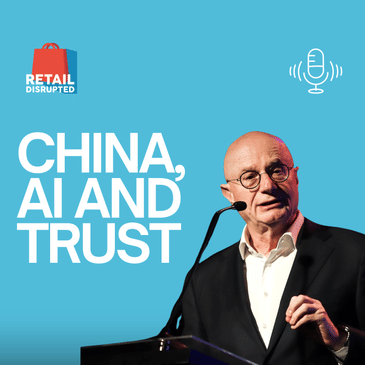

The trust crisis in retail is real — only 1 in 3 consumers today believe what brands say about themselves. Philippe Gelder, President & CEO of Voted Product of the Year Worldwide, reveals how consumer trust became retail's most fragile asset — and why Europe is uniquely vulnerable just as Chinese retailers enter their third wave of expansion.
📺 Prefer video? Watch on YouTube: https://youtu.be/v8HtbhYqpd0?si=shlaGT-KK7aoZ7PN
In this episode, Philippe and Natalie Berg explore: • Why social media and AI are eroding brand trust — and what replaces it • Europe's "perfect storm": regulation, energy costs, and no narrative • The third wave of Chinese retailers: JD/Joybuy and the Trojan Horse strategy • China's "involution" problem — why they need Europe • De minimis exemption: why blocking parcels won't work • Why "e-commerce" should disappear as a concept • The collaboration imperative for brands and retailers
Philippe Gelder is President & CEO of Voted Product of the Year Worldwide, the world's largest consumer-voted award for products, brands and retailers. Trusted by 4.5 billion consumers across 40+ countries.
Retail Disrupted is a top 5% global podcast.
👉 Subscribe on YouTube: https://www.youtube.com/@retaildisrupted
👉 Follow on LinkedIn: https://www.linkedin.com/company/retail-disrupted/
👉 Subscribe to our newsletter: https://retaildisrupted.substack.com
[00:00:00] What can Western retailers learn from the Chinese? They've got a narrative, they express it in a very simple way, and they've got a 10-15 years vision and they just go for it. What they completely do wrong is actually, we talk about involution in China. Something gets out and two months after there's 50 copies inside China because the competition is high, the scale is high, the density is high. So they don't produce margins really, they fight all the time.
[00:00:27] So they need to go and gain and grab margins. They cannot live out from their own market, they need to expand. And so Europe is certainly an opportunity. I think we've got a great asset, we can help them understand it and gain market shares and work together, not in a naive way. And not thinking we can just build the wall. It doesn't work. It didn't work with immigration, it's not going to work with goods.
[00:00:53] And I hate when politicians make it simple like, let's block everything. It's not possible. You're listening to Retail Disrupted, a podcast that explores the latest industry developments and the trends that will shape how we shop in the future. I'm your host, Natalie Berg.
[00:01:16] Hello and welcome back to Retail Disrupted. We're coming to you from Athens, Greece today, and we are going to be talking all about trust. Now, brands are meant to be a symbol of trust, a promise of quality to the consumer. However, only one in three consumers trust what brands say about themselves.
[00:01:43] So to help me unpack this, I'm delighted to welcome to the podcast, Philippe Gelder, President and CEO of Voted Product of the Year Worldwide. Philippe, welcome to the show. Thank you. Thank you for having me today. No, it's a pleasure to be here. It's great to be in sunny Athens. I presume it's sunny. I haven't been outside yet, but we'll find out soon. So Philippe, before we dive into this huge topic about consumer trust, tell us a little bit more about Product of the Year.
[00:02:12] What is it and what makes it different to other awards out there? I'm very happy to tell you about the Product of the Year because we are celebrating our 40th year of anniversary, which is another trust element in the logo. And our logo is actually present in over 40 countries around the world. And it's actually, yeah, it's a device. It's a marketing device.
[00:02:35] Let's be completely clear, which is made to help brands and product to promote their innovative aspect or trustworthy aspect in terms of brands by using the logo, which is exclusively voted by consumers. So it's 100% consumer, no specific expert or jury. And they actually vote in terms of perception, in terms of product testing. And they have either experience or product testing.
[00:03:03] And the whole process is actually a very independent one and supervised by Deloitte as a guarantee of, again, trust. Yeah. And it's a huge panel of consumers as well. It's a huge panel. They treat sometimes in some country 50,000 people like in France and in the US. It's about the same amount. So we absolutely want to reach most objective answers.
[00:03:29] I mean, this is never 100%, but I mean, that's what we're aiming to. Yeah. So it's really a social trust signal. And I think this is interesting because trust, as we know, it has to be earned, right? It's so easy for retailers and brands to lose trust. It really has to be earned in that first instance. So tell us a little bit more about what I mentioned right in the intro, which is just that consumers are becoming less trusting of brands. There's a lot of skepticism. What's causing this erosion of trust?
[00:03:59] Well, you said it's a social trust signal. And actually, since 1987, I mean, social trust was not even a word existing in the vocabulary. What's very exciting for us is that we have seen in the last two, three years because of social media, because of fake news, because of all these uncertainties in what you're seeing, you need reassurance and you need something you can hang on to.
[00:04:25] You need something you've been seeing as a trustworthy element. And the fact that we are in this market since 1987, the fact that we have this very controlled methodology is actually making it a symbol of trust in terms of, yeah, we know this brand. It's been there. And the major element is we do not have any links whatsoever with any retailer or brand.
[00:04:55] So we're completely independent. And hopefully, we will stay like that for long. And I think that's why. But I think that's just the environment that makes us even more successful today because, you know, and you know that I'm traveling quite a lot in China, for instance, where social media is huge. But they also really want you to be sure that the advice or the influencer is independent, which is more than one. And genuine, right? And genuine. Authentic. Yeah.
[00:05:23] And AI is actually bringing us a lot of great things, but also a lot of threats and uncertainty. So in these days of social, crazy overflow of information, I think more than ever, you need a symbol of trust. Yeah. And I guess we should clarify for our viewers and listeners as well that it is a red symbol that is placed on the package, which is visible both on the physical shelf, of course, but also digitally as well. Yeah, yeah.
[00:05:51] And that's something that also, you know, I took over the company 10 years ago and I remember it. People say, yeah, it's old fashioned, young people, et cetera. And actually, I see now more and more brands pure player online because if you're not known as a brand, you're online, you need reassurance. So the less emotional involvement from the consumer there is, the more our logo plays a role because it's reassuring.
[00:06:20] I mean, take a car tire. If you need to buy a car tire, most of the people don't care about the brand. They just want it to work, right? Yeah. They are some, you know, car lovers. But so you go and say, you know, what tire would you like? And you see 10 brands and then you see one with this seal of trust and you say, well, must be good. It's leading people to a wise decision, you know, voted by consumers.
[00:06:44] And online, it's absolutely crucial, paramount to have this trust. And it adds a lot. And to give you an example, in these recent years, it's sometimes difficult to manage. We have a lot of mattresses. There's a huge market of average price mattresses. They don't have a brand equity. And so they need something to demonstrate the consumer that you can trust it. Yeah. To make it really clear, because as you say, we're just surrounded by choice.
[00:07:14] There's so much noise in the market. I think it can be, it's amazing for consumers to have all this choice, but at the same time, it can be a bit overwhelming. And so I think anything to reduce that decision making burden is going to be a good thing for consumers. Absolutely. So if consumers don't trust brands, who or what do they trust?
[00:07:35] Well, I mean, I believe they trust other consumers as long as they are sure that it's real consumers. And I think that's the key today is how do you make sure that this advice or consumers evaluation of brands or products are real.
[00:08:01] And AI makes it very difficult to believe sometimes. So we are actually adding a layer which is actually certifying the consumer voice. And that's our job. Do you think retailers and brands are underestimating just how fragile consumer trust is? I don't think they're underestimated, but I think that they are overwhelmed by all the things that they have to do today.
[00:08:27] And they sometimes tend to forget that the essence and the priority should be the consumer. And they have a lot of things to take care of. Now you have the battle. I mean, personally, I think that there's not enough collaboration between brands and retailers. And there's now the private label is rising. And although it's not very easy for retailers to generate margin with that.
[00:08:55] So and then there's all the assholes of technology of I mean, it's a change of tectonic plates, really. I mean, it's earthquakes everywhere. Yeah, all the time. All the time. And I think that they've lost sides in taking care of consumers. Now, I know, for instance, I think you've made a podcast recently with the CEO of Morrison. I know you've met him.
[00:09:23] And I met the guy and he's a guy that is obsessed by the consumer. He's really in the shops. I think he delivers good results and doing both is essential. It's very difficult because it's very demanding. So, yeah, it's absolutely paramount to have these these consumer at the center of anything you do. Yeah, I think I think you're right. I think you raise a really important point around firefighting, because as we know, there's so much disruption happening in retail.
[00:09:49] And we're going to come on to the European landscape because I know there's I think what you describe as a perfect storm happening in Europe. So I want to come back to that. But first, you mentioned AI really early on in the conversation on my podcast. We used to wait till the end to talk about AI and the future. But actually, it's happening now. Right. So we have to just weave it into every discussion. I think it's really relevant here.
[00:10:11] And I'd love to get your thoughts on whether you think AI is helping to solve the problem around consumer trust or is it actually doing the opposite and kind of accelerating the erosion of trust? I really love AI as a support to what you do. But I hate AI in the fact that it's going to soon, I guess, be a not trustworthy element in the decision process.
[00:10:37] Because if you have someone choosing for you, I mean, the question is why, how, who's actually taking this decision? And that's frightening, actually. I believe, I mean, I'm not an expert, but I believe that the human being is going to be looking at AI with suspicious minds sometimes and it's going to change the relationship. It's going to remain a very useful tool.
[00:11:06] But I think that human is going to tend to want for different kind of advice, objective advice. So it's going to evolve, certainly. Yeah. And I think you're right. I think we're all using it. We're embedding it into our everyday lives. But we're also very skeptical because we know it hallucinates and it's not always right. But it's like internet. When internet came, I remember, you know, 20, 25 years ago, I was with some of my clients and they say, you know, on internet we'll never buy this and that. And everything was wrong at that time.
[00:11:36] It's a revolution. It's something we didn't expect. But it changed the habits, but also internet changes as well. So there's going to be a lot of evolution. And I'm really sad that for the moment there are people thinking that they can control it and they can manipulate you to that extreme. At the end of the day, I mean, they're always going to be a consumer's reaction. And that's what we stand for is to, you know, evaluate and feel them to help brands to navigate through that. Yeah.
[00:12:06] And I guess when we think about search and discovery, I mean, that's already been massively disrupted with social media, social commerce, being able to buy directly, you know, without leaving TikTok or whatever platform you're on. So that funnel has already collapsed. And now obviously the shift to buying inside ChatGPT or Gemini. Do you feel that this, agentic commerce, do you feel that this is the next layer of that displacement?
[00:12:33] Or is this going to be a fundamentally new thing for consumers? Well, it's a new thing for consumers. But I believe that those new things will create new habits and new… I don't want to be too technical, but I'm seeing with some, you know, take artists or video makers. I mean, 10 years ago you needed to have a whole staff and you need to build a video company, you needed people.
[00:13:02] Now actually you can do it on your own basically. But you need to do this one person with more craftsmanship. So actually it's going to create some changes in making things that were not valuable anymore, becoming valuable. So there's going to be a lot of change and we need to adapt.
[00:13:21] The only fear I really have is the younger generation, which is actually educated with those machines that don't have the, you know, the capacity to look back and you say, you know, am I manipulated or not? I don't know if they don't have it, but we need to make sure as older people that we actually give them the right tools to evaluate and not to be lobotomized by…
[00:13:45] So it's more a social, philosophical, even political aspect, which is not something we're taking care of. But I strongly believe in the strength of the human being to counter or to have a sort of acting on this. Yeah. It's a very philosophical debate, I guess. It is. And it's a fun debate because I would disagree on one thing you said.
[00:14:11] I would argue that the younger generation is probably more skeptical because they're growing up with it and they know they can't trust it. So, to be seen. Yeah. If I may say, I mean, the flow of information they get is manipulated. I mean, I don't know if you've seen that. I mean, I don't watch the news anymore because it's bullshit. But the young generation, they have specific people telling about their own news and they see the podcast or whatever it is.
[00:14:40] And some are very political tinted. So, the manipulation already in the way they think is there. So, that's what I mean. It's this… We did in the past, we did take two or three papers to have a sort of counter opinion. A lot of young people don't know that a certain thing is actually manipulated by a political party. That's what I mean. It's looking behind the scenes. Yeah. That's something we've learned at the university or whatever. And today it's a bit compromised by this.
[00:15:08] But I'm totally ready to follow your enthusiasm. I'm a glass half full kind of girl. So, let's move on to talk about Europe because I know you've described Europe as being in this sort of perfect storm about to hit Europe or has hit Europe in terms of regulation, energy costs going up. There's so many things that retailers are dealing with.
[00:15:33] We've obviously got the big Chinese retailers moving in, which we will come on to because I know it's something you have a lot of thoughts on. But firstly, I want to get your take on this perfect storm. How serious is this pressure? I think the pressure is extremely serious. I'm sorry to say, but I think a lot of people are lost in the sauce and they see it as it's too much. I think most of them know.
[00:15:57] I mean, observing China, as you say, or seeing, you know, cost of energy in the perma crisis. But it's more like we're not really helped in Europe in finding a solution or having the means to do it. First of all, because there's a social pressure and, you know, Europeans, they don't want to work anymore, basically. So they want to, you know, homeworking and whatever, you know, for shops and retailers are difficult.
[00:16:25] Then the administrative, legal and, you know, environmental, everything is a hassle. There's a lot of things and politicians are also in between, you know, keeping the people happy and then having the industries going on, plus the ecological. There's too many things and it's a lot. So the danger is that you give up.
[00:16:49] You give up and then you accept to maybe cooperate with Chinese, which might be a good thing, as long as you keep the momentum and keep the leadership. So my fear is that there will be no more retailer or happy to do this business because there's no more margin or it's too difficult. So we need these guys. I mean, it's absolutely important, but there's a lot of challenge. And Europe, political Europe, if I may say, it doesn't help.
[00:17:18] I mean, too many countries, it's a mosaic of administration, it's a mosaic of culture. It's very difficult. While USA and China, they have one single market. I know USA is a bit more complicated, but one language, etc. So, yeah, I mean, it's a huge challenge that I believe we do not address in the right way for the moment. Yeah.
[00:17:41] I mean, I hope there will be some, you know, I heard about, you know, UK wanting to come back to work together with Europeans, whatever the way. But on the other end I hear that the election, we're going the other direction. So you see, that's very complicated. You need to have faith in your vision. Yeah. You need to have faith in your leadership. And then, I think that's key, you need a good narrative. Europe has no narrative anymore. That's the problem.
[00:18:10] America is a narrative, whether you like it or not. China is a narrative. Europe lost the narrative. I mean, we had, you know, Europe was good for peace. I mean, peace is apparently not fashionable anymore. But so what's the narrative for Europe? And because each country has its own narrative. That's the problem. Yeah. Yeah. And at the same time, we were now in this sort of second wave of Chinese retailers moving over.
[00:18:39] I guess if we just back up, the first wave was, you know, the Timus and the Sheeans and very low priced value proposition. Now, we've got JD, for example, coming over, buying a majority stake in Media Mart's huge electronics business. They've launched Joybuy. They didn't buy it yet, but they blocked by it. They've been blocked by a lot of countries, haven't they? I know there's been a lot of pushback. But the intentions are there and they've launched Joybuy in the UK, but also across Europe.
[00:19:06] And that's not, you know, cheap stuff, just the slow delivery, cheap stuff model that we saw with the likes of some of the earlier entrants. That's, you know, same day delivery. It's selling big brands, Apple, et cetera. So clearly there's a shift happening. And I wonder, based on what you've just said about Europe, do you think European retailers are ready? I think I know your answer to that. And what can they be doing? What should they be doing?
[00:19:35] I think European retailers are pragmatic. But again, they're facing a lot of constraints. In China, I heard Chinese say, you know, actually Europe makes it difficult for Europeans. And that's true. I mean, now coming back to China, I mean, China is definitely not, I don't believe in the second, but third wave, which is actually, they're really conscious that they need to go for quality and service in the European way.
[00:20:04] I mean, delivering shitty product is still happening, of course, and it will continue to happen everywhere. But, I mean, they're really delivering good quality. Think about car. And they're really good quality. I mean, nobody five years ago would have bought a BYD in Germany or France. But, you know, they're selling quite well. So, the thing is, I believe, and as you know, I've been many times in China and I'm a good observer of this.
[00:20:30] And I'm a fan also of a lot of things because they've got these systems, they've got this vision, they've got this leadership and the culture there makes it possible. But they've got a great weakness, which is they can't cope with our market, which is completely impossible to manage. So, I think we've got a great asset, is we can help them understand it and gain market shares and work together.
[00:20:57] But we need to work together, not in a naive way, and not just blocking everything that we do in Europe and letting everything come in. I mean, there's a lot of examples recently with attacks over the small packs and so on, which is actually not working. I want to ask you about that, actually. So, we'll come back to that. Yeah. But, so, I strongly believe that, for instance, the MediaMark case, I was visiting the new stores at GED and so on.
[00:21:22] There's a lot of learnings from China and retailers know that, that we could import, but not in the same way. I mean, we can't pay the people the same way. We can't have so many people in the shop. I mean, there's many, many things. So, adapting to Europe, you need the retailers that know that. But on the other hand, retailers need this capacity to deploy, to have this scale. So, we can help them in Europe and they can help us in China. And that's the way you need to look at it.
[00:21:50] Don't try to, you know, 20 years ago say, we go to China and grab this market, that's a huge market. No, that's not possible. You leave the market to them, but you take the experience and you do, you know, a balanced trade-off. Take those synergies back to those reverse synergies. Yeah, as they did. You know, we went there and we thought, you know, they're so stupid. We can do the produced everything there for low cost and they never go, they copied, they made it better. Fine. They have the system, they have this vision.
[00:22:19] So, let's learn from that, but not in a naive way. Let's keep the control in Europe. They need us. How can a Chinese deal with a Belgian, a Dutch, a German, a French consumer system laws? It's impossible. And it's not going to change overnight. Yeah. So, I think we've got a great asset. Let's embrace the capacity to work with them, not in a naive way, and fight back, you know, with what we learned. There's another thing to learn from that. Yeah.
[00:22:48] And speaking of learnings, as you said, you just returned from a trip to China. What are they doing right? What can Western retailers learn from the Chinese? I mean, the very, very obvious thing is whether you look at the last 15 years for Belt and Road visions, they've got a narrative, they express it in a very simple way, and they've got a 10, 15 years vision and they just go for it. Okay.
[00:23:13] What they completely, you know, do wrong is actually, we talk about involution in China. Something gets out and two months after there's 50 copies inside China, because the competition is high, the scale is high, the density is high. So they don't produce margins really. They fight all the time. And it's the entrant and then a new one and then fight and price are going low.
[00:23:41] So they need to go and gain and grab, you know, margins. So their weakness is they cannot live out from their own market. They need to expand. And so Europe is certainly an opportunity because America for the moment is a bit more difficult. It is also a very important market. And certainly… And also very fragmented, not as much as Europe, but it's still a series of different markets. Of course, of course.
[00:24:11] It's more fragmented than people think. But what I mean is they need those markets and retail. Most of the brands or the initiatives are actually non-strategic. I mean, it's not possible to think about cooperation in terms of ammunition or, you know, telecom or things like that because it's very controlled. But there's many… I mean, look at Antasport. Antasport is coming at the level of Nike worldwide.
[00:24:40] It's a huge group. They've just both Salomon, they've just both Puma. I mean, they've got many, many brands. They're using what I call the Trojan horse strategy. They're just going to work when they're taking 20%, 28%, 30% stake in the company. And they will come. They will do it. And that's not bad.
[00:25:02] If you keep control and if Europe or America think of a way, administrative and legal way, to make it happen in a way where we are not being the naive part of the game. So let's go back and talk about the de minimis exemption, which you just touched on. Because this summer, we're going to see the end of this across the EU. I think it's from July. Parcels that come in that are under €150 in value will now be subject to duties.
[00:25:32] But previously, they weren't, which allowed the likes of Timu and Xi'an to reach the European consumer in a very cost-effective way. It's going to impact around 5 billion parcels, 90% of which were coming from China. So this feels pretty seismic. I'd love to get your take because I know some other countries have already done this individually. What does an EU exemption mean for retail and brands?
[00:25:57] Well, you know, Italy and France already had this tax and it didn't work because it went to another country. I mean, another element that I didn't speak about is China's speed and Europe is slow. If Europe takes a measure, it's a strategic plan, it was going to take five years. In China, it's going to take five weeks. And I'm not kidding. It's incredible. And that's where it's also difficult because in five weeks, we have 10 different competitors coming in.
[00:26:26] So today, China already, the Tammuz and the Xi'an, they have a solution for that. They are going to import things and then the PACS is going to be intra-euro. There is already a warehouse being, they exist in, I think it's in Poland, I've seen that. And they're ready for it. They will always be, you know, again, we need to work together. But we need to let them do and let them have what they want, but we need to keep what we have.
[00:26:54] And not thinking we can just build the wall. It doesn't work. I mean, it didn't work with immigration. It's not going to work with goods. And by the way, I mean, look at everything we produce, even what we produce in Europe, probably 10, 15, 30, 50% of what we produce is coming, parts are coming from China. So you also, you cannot kill your own, you know, source of revenue. So it's very complicated.
[00:27:20] And I hate when politicians make it simple, like, let's block everything. It's not possible. France lost a lot of money by having no more planes coming in Paris because they went to Belgium and Liège. And still found the consumer eventually. Always, always. It's complicated. They're always going to be a European guy to say, ah, I'm going to buy and then resell it and so what. And, you know, you're always losing at this game of trying to stop. It's like with water, huh?
[00:27:50] I mean, you can never stop water. So, again, let's look at it in a pragmatic way, not a populist kind of, you know, saying things. And there's been in France, there's been this Shein problematic with… And that's very interesting because now the shop that welcomed the Shein is completely empty. It's almost bankrupt. It didn't work. Because, yeah, I mean, it was probably other intention.
[00:28:18] But I think we have a huge strength. Let's look at our strengths. Let's not… You know, defense is not good. You need to… You need to have a vision and narrative. Just be on the offense, yeah. Absolutely. Yeah. So, let's talk a little bit more about e-commerce more generally because I know you've described e-commerce now as the backbone for many businesses. It's, as we all know, it's not just another channel. The physical and digital worlds are rapidly converging. And I think AI is only going to accelerate that.
[00:28:45] But what does all this mean for how brands think about the customer relationship? Well, first what I want to say is I'd love to see e-commerce disappear in the way that it's commerce. I mean, saying e-commerce is like, you know, it's like saying, you know, we need gender equality. I mean, let's not talk about it. It's just… It just needs to be it. I mean, there's human beings and that's it. Woman, man, and, you know, e-commerce says… No, it's commerce.
[00:29:12] And commerce today needs to be absolutely multi-channel. And it goes through social media, your phone, whatever. It's commerce. And commerce is now very complicated because it integrates digital or digital is actually supporting commerce in general. So that's there. I just read a McKinsey report on what the influence of digital will have on, you know, the retail business in terms of infrastructure, in terms of, you know, concrete.
[00:29:42] And that's the big hassle. When you look at the infrastructure in Europe, I mean, capital-wise, it's huge. So that's the nightmare, actually. We need to stop thinking about e-commerce. We need to only think about commerce, consumers, and the way he wants things to be delivered, the way… He's always going to be right. I mean, whether you want a coffee to be delivered within 25 minutes or, you know,
[00:30:11] want to pick something at the shop because you want to look at the shop for something else. It's your decision. And by the way, I think that's what I observed recently when I was in China. It's actually… you understand that their obsession is the consumer. And the e-infrastructure, if you want, has been built, you know, through WeChat Pay, through Alibaba, and the mini-program. I mean, you don't have apps here and there.
[00:30:37] It's all embedded in the system for many reasons, because the government is backing it up and there's no choice. That's it. But it's working like that. So let's do commerce, integrating digital… I mean, I don't know. I don't even know why I'm saying that. It sounds crazy that you have to say that. And yet AI… Because as you say, it's just shopping. Yeah, yeah. And AI, again, AI is not going to be the single solution. I don't believe in that.
[00:31:06] It's going to be a part of the way you want to buy things. But, you know, when you go and buy, shop a new dress or something, you have these salespeople say, oh, it suits you well. And you have people who want her to tell you that you're so good. I don't want people to tell me, you know. I mean, just leave me. It's my way to do it. You probably have different one. So that's the beauty of it. Human being is diverse and that's going to be it, I believe.
[00:31:33] And you're going to reject, you know, like AI, this and that. It's dictatorship. We have dictatorship of the shelves today. You go in a shop and you get what there is. And tomorrow we have dictatorship of Google, ChatGBT, TikTok. No. I want to be the master of my purchase. Yeah. And you're right. I think the same shopper in different mindsets, different missions will want different things, right? Sometimes you want that interaction with a member of staff. You want a little bit of help or advice.
[00:32:03] But sometimes you're like, just leave me alone. I want to shop. I want to get in and get out. I don't want to talk to anyone. So I'd love to get your thoughts on collaboration. Because you've talked a lot about how competitive things are and how much complexity there is from a channel perspective and many different ways of shopping. How important is collaboration? What does this look like in practical terms? I think collaboration is the thing.
[00:32:30] Actually, the digital structure is collaboration. I think that's what people don't understand saying it is digital, it is this and that. No. I mean, it just leads us the way to anything works in a system and an ecosystem. You cannot win all alone. I think there's too many ego aspects on that. So whether it's China versus or Western East-West or private label against brands and so on, you need to collaborate.
[00:33:00] Because consumers really want, you know, choice and they really want their choice. You need to have it available. If you have an only private label store, you're going to lose consumers and vice versa. So we really need to step into looking at the consumer and looking at him while developing anything that makes its life easier.
[00:33:29] And collaboration is absolutely necessary. Why? Because, you know, I was really shocked when I saw all these companies saying we launched your AI. I mean, today you launch your AI three months after it's outdated. It goes so fast. It is three months, isn't it? I mean, I discovered Claude a month ago and I said, wow, ChatGPT is dead. And then after three, four weeks I came back and I said, wow, they improved it. It's a constant fight.
[00:33:58] And by the way, you know, Western or USA looks at AI as an investment, stock exchange, money. And again, in China they look at it as a consumer centric element. It's completely different. So once again, collaboration, you need to work with these guys. Then, yes, politicians should do their job.
[00:34:19] How do we limit the dictatorships of those companies that actually have big assets by, you know, changing the algorithm of whatever it is today? So that's the big question. So I've never been like that, but I'm so disappointed about politics in general, but I'm so clearly thinking that we need them. So, yeah, I mean, that's probably collaboration is a must.
[00:34:47] Also collaboration between politicians and people. I mean, not dividing, but just trying to, again, narrative, leadership, long-term vision. It's absolutely not what democracy is giving us for development. But we are in Greece. Demography was invented here. Yeah. Democracy, sorry, not demography, democracy. And I think that's all this. And we were talking about young people.
[00:35:12] Maybe we need a new, young, clever, I don't know, Gandhi or, you know, to just need to- To guide us. Yeah. Let's hope for that. Exactly, exactly. Great. Philippe, one final question for you. For any retail or brand leaders that are tuning in today, what's one piece of advice you have for them?
[00:35:33] I think that brands, industrials and retailers need to have decent margins to cope with what's coming, with this chaos and this earthquake. And the only way they can do that is collaborating. So forget ego. Think of consumer and together you can make much more money. Because, you know, brands, and you've seen the movement with Unilever, they concentrate on what they can do best.
[00:36:04] Because they want to keep the dividends for the shareholders and the money they do. Retailers need to concentrate on what they do best. Sometimes they can do very good private label, but they cannot do all categories. I mean, and they need to improve the experience in the shop and they need to make the shop moment a great experience. So it can only work with working hand in hand. It's much too many fights and we don't need that.
[00:36:32] And then last but not least, there will be consolidation in the retail business in Europe, or America, or the Western world. And there will be some huge attempt from Chinese companies to grab the part of the cake. So work together. Maybe sound naive, but it's not. It's really, let's go back to a narrative, which is a positive one, and towards making the life of the consumer easier.
[00:37:01] That's what I would say. Yeah. Because at the end of the day, it's all about the consumer, isn't it? Well, it's first all about margins. Well, yes, yeah, of course. But, and that's the problem. But you don't get the margin if you don't get trust with your consumers. When you're lost and you don't know, you need a new direction or you need actually to set the direction and go for it. Hopefully this will happen. Not without damages, of course.
[00:37:30] But I'm confident a thing will happen. You were talking about MediaMarkt and JD. MediaMarkt has been through a lot of difficulties. And it's a crucial moment. Hopefully politics will understand that. You know, we see now that some decision that we're taking 10 years ago by Europe to stop concentration of two European companies to make it a worldwide champion has consequences today, which are devastating,
[00:37:59] because they didn't see it coming that it's going to be a world fight. So let's take the right decision today. It's absolutely crucial. Philippe, it's been so great having you on the podcast. Thanks so much for coming on. Thank you for your time. And I'll be glad to listen to next podcast. Fantastic. Bye bye. Thanks again. Thank you for listening to Retail Disrupted.
[00:38:24] If you enjoyed this episode and would like to support the podcast, please leave a rating or review or share it with others. It really makes a difference.