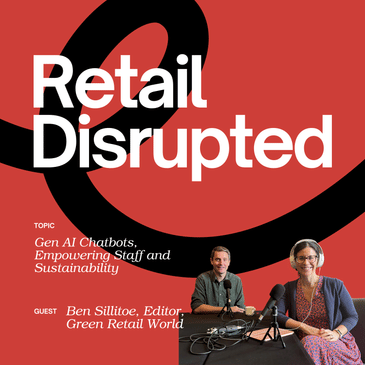

Live from Barcelona, Green Retail World's Editor Ben Sillitoe joins Natalie on the podcast to share what they learned at Manhattan Exchange this week. They explore how generative AI chatbots are going to revolutionize customer service, why the days of frontline staff being told to "sell, not think" are over and what sustainability looks like for retailers in 2025.
If you missed the episode with Manhattan Associates' Pieter Van den Broecke, you can catch up here.
Links:
[00:00:05] You're listening to Retail Disrupted, a podcast that explores the latest industry developments and the trends that will shape how we shop in the future.
[00:00:15] I'm your host, Natalie Berg.
[00:00:30] We are live once again from the Manhattan Exchange in Barcelona.
[00:00:34] Joining me on the show to break down all that we've learned over the past couple of days is Ben Sillito, editor of Green Retail World and friend of the pod.
[00:00:43] Ben, thanks for being here and welcome to the show.
[00:00:46] Hello, Natalie. Thanks for having me on again. Good to reconnect.
[00:00:50] Last time you came on, we were in Cannes at the Manhattan Exchange last year and now we're in Barcelona.
[00:00:56] We seem to only be meeting and recording this podcast in very glamorous European locations.
[00:01:01] Absolutely. A whole lot more glamorous than my Kent home office and looking forward to where it's going to be next year.
[00:01:08] Yeah, yeah, definitely. So the conference is coming to a close now.
[00:01:11] There's literally just a couple of sessions left.
[00:01:14] So we wanted to take some time out and share some of the learnings with our listeners because there is so much to talk about.
[00:01:21] It's been a jam-packed few days here in Barcelona.
[00:01:24] So for me, there were three key themes that sort of permeated throughout a lot of the discussions.
[00:01:29] The first one is unification.
[00:01:31] We hear a lot about this sort of natural evolution.
[00:01:36] We've gone from omnichannel to, well, we're going from omnichannel to unified commerce.
[00:01:43] What does unified commerce actually mean?
[00:01:46] How do retailers get there?
[00:01:48] These are big questions.
[00:01:50] And so it's been really interesting to hear firsthand from retailers how they're connecting the physical and digital worlds,
[00:01:57] how they're connecting the dots, and they're doing this in real time.
[00:02:01] And I think that's the distinction.
[00:02:04] The second thing for me was something that CEO Eddie Capel said on the main stage.
[00:02:09] He talked about how technology is making the impossible possible.
[00:02:14] Consumers are driving a lot of this change, and Eddie reminded us that 15 years ago, seven-day delivery was the norm.
[00:02:21] Now, it's more like seven-hour delivery.
[00:02:24] Customer expectations are rising exponentially.
[00:02:27] They want more convenience, more choice, more control.
[00:02:31] And I think a really important point here is that innovation doesn't have an end date.
[00:02:38] We talked about this on the last episode of the podcast, and Eddie was very clear.
[00:02:42] He didn't mince his words here at all.
[00:02:44] He said, when you stop innovating, you die.
[00:02:47] Now, I know a lot of you will have heard me use the phrase retail Darwinism.
[00:02:52] I've been talking about retail Darwinism for years now, and it very much is a case of evolve or die.
[00:02:57] Retail is perpetually evolving, and it's very clear that Manhattan, as a service provider, also has to be relentlessly innovating.
[00:03:07] Shattering the status quo is how they put it.
[00:03:09] I like that phrase.
[00:03:11] So the last thing for me is the growing need for real-time responsiveness.
[00:03:17] And this is essentially a case of let's talk about Gen.ai without saying the words Gen.ai.
[00:03:24] We are going to come on to Gen.ai, but just as a brief introduction, I think this need for real-time responsiveness is growing.
[00:03:31] And this could be an employee in a store or a call center who's dealing directly with customers, but it could also be a warehouse worker dealing with some disruption.
[00:03:40] Time is money, right?
[00:03:41] From an operational perspective, the more efficient you can be, the better it is, of course, for the business.
[00:03:48] It's better for the customer.
[00:03:49] Freeing up staff time to focus on those more valuable tasks, and that's something we're going to touch on.
[00:03:55] But also as consumers, our patience levels are minimal.
[00:04:00] Our tolerance for slow or clunky service is gone.
[00:04:03] So I think it's just going to be really interesting to see how AI is going to help to tackle that.
[00:04:10] So, Ben, sorry, I've thrown so much at you.
[00:04:13] Would you agree with these, or is there anything else that stuck out for you?
[00:04:16] That's a very intellectual take on what we've seen over the last couple of days.
[00:04:21] Really, really interesting.
[00:04:21] I think I completely agree, and I'll perhaps shape it slightly differently.
[00:04:28] So, big theme that I've seen emerge from the retailer and brand sessions, as well as what the Manhattan senior team was saying,
[00:04:39] is that whole idea of man and machine in harmony.
[00:04:45] So, that kind of is another way of saying some of the bits that you just picked up on there.
[00:04:49] But just putting that into practice and giving you some examples of what I mean there.
[00:04:54] There's obviously a big fear about technology, automation, robotics, taking people's jobs.
[00:05:01] But I think what we're seeing here is a kind of an alignment where businesses, retailers, the general supply chain are finding ways,
[00:05:14] realizing that technology brings opportunity rather than threat.
[00:05:18] And, you know, from the retailer sessions we've seen, from the likes of Adidas talking about putting robotics and automation in the warehouse,
[00:05:27] making their workers' lives easier, to co-op's big Manhattan implementation that they're going through at the moment,
[00:05:34] where it's as much a people process as it is a technology process.
[00:05:37] It's not like tech's coming in to replace people.
[00:05:40] It's, you know, working hand in hand.
[00:05:42] And two, the tools and solutions and offerings that Manhattan have announced this week and unveiled this year,
[00:05:49] where it's, you know, Gen AI.
[00:05:51] I've mentioned it.
[00:05:52] Sorry, you said not to mention it.
[00:05:53] But, you know, that is what we're talking about.
[00:05:55] Now, that is a big theme.
[00:05:56] The Gen AI-powered technology that is helping both retail workers, warehouse workers and consumers.
[00:06:04] So, I mean, I'm sure you've picked up on it, but the Gen AI stuff, the chatbot, the Maven chatbot that Manhattan have released,
[00:06:15] that's going to transform how consumers interact with brands.
[00:06:19] It's real-time interaction.
[00:06:20] It's based on real-life data.
[00:06:22] It's going to answer questions a lot quicker.
[00:06:25] It's going to, you know, make things a whole lot more efficient and a customer experience much better.
[00:06:28] And that's man and machine working in harmony to improve retail operations, right?
[00:06:33] Let's talk a little bit more about AI because Gen AI has been a hot topic over the past few days.
[00:06:40] And I think, for me, that's what's been most interesting is hearing the developments and also seeing what's possible.
[00:06:46] So there was a lot of focus on chatbots.
[00:06:49] And we're not talking about the chatbots that exist today, which everyone here is, you know, is in agreement that those chatbots are awful.
[00:07:00] There's no way around it.
[00:07:01] It's an awful experience.
[00:07:02] The shoppers today will go to a chatbot.
[00:07:05] They can only ask really basic questions.
[00:07:08] It's very clear you're talking to a robot.
[00:07:10] You've got to enter all your information, all your details, explain the problem, only to then get reverted to a real-life human being and have to reenter all of that information.
[00:07:21] So it's just not a good customer experience.
[00:07:24] Now, this is where Gen AI can come in and completely change things.
[00:07:30] So we are now seeing this new wave of Gen AI chatbots like Manhattan's Maven.
[00:07:36] And as a customer, firstly, it's much more intuitive.
[00:07:41] You can ask it more than just where's my order.
[00:07:45] You can ask it things like what size or what color was that shirt that I ordered last May or how much tax did I pay on that?
[00:07:53] And you can have more of a conversation with the chatbot.
[00:07:56] After you've made the purchase, you can change your mind.
[00:08:00] So if you decide, you know, sometimes we've made a mistake.
[00:08:03] We've bought impulsively on Black Friday or whatever it might be.
[00:08:06] And we want to cancel that order.
[00:08:08] Or we want to modify that order.
[00:08:10] Say, you know, you're driving by the store tomorrow and you think, actually, I'd rather collect it in store than wait for it to be delivered to my home.
[00:08:16] Well, that's an option as well.
[00:08:17] So you can do that through the chatbot.
[00:08:20] You can access the chatbot through text, email.
[00:08:24] Emails are still a really important channel.
[00:08:27] And also on social media like Instagram and TikTok where, you know, shoppers are increasingly not just browsing and discovering products, but also they're buying products through these platforms.
[00:08:38] But email is, you know, Manhattan's email is a very important channel still when it comes to customer service queries.
[00:08:45] And Gen.AI chatbots can save contact center employees time by writing a reply to the customer.
[00:08:52] The employee can then tweak that reply if they need to.
[00:08:55] And this is an important point.
[00:08:56] And I know you touched on this, Ben, around the need for human intervention.
[00:09:01] Because a lot of this technology still does require some type of human intervention.
[00:09:06] But the employee can tweak the email.
[00:09:10] Then they can sign it off and send it back to the customer.
[00:09:12] But it saves them time.
[00:09:14] Now, traditional chatbots, not the Gen.AI ones, but the traditional ones, they can handle around 20% to 30% of inbound queries without any human intervention.
[00:09:26] With Gen.AI chatbots, it's over 50%.
[00:09:29] So now you can start to see how these chatbots are really going to drive efficiencies for retailers.
[00:09:39] They're going to free up employee time to focus on those more valuable and often customer-facing tasks.
[00:09:45] And one last thing I'll say about Gen.AI is I thought it was really interesting.
[00:09:49] Manhattan said that one of the biggest reasons shoppers get in touch with a contact center is because they forgot to add a discount code to their basket.
[00:09:57] So they've gone ahead, they've made the transaction, and then they thought, oh, no, I had a 20% off discount code and I forgot to use it.
[00:10:04] But this is the perfect use case for AI, right?
[00:10:08] I mean, this is exactly how retailers should be using artificial intelligence.
[00:10:14] Absolutely.
[00:10:14] The costs and efficiencies that that can save are incredible.
[00:10:23] And it's a sustainability thing as well.
[00:10:25] So I'm always chatting about sustainability.
[00:10:28] That's my area.
[00:10:29] So there is an element there that you can talk about.
[00:10:32] If you're a good retail customer service operation and a customer gets in touch and says, I didn't add my discount code, but the process, the order process is already part way through.
[00:10:43] You will cancel that order process and start a new one with the discount code.
[00:10:48] But that effectively means you're sending that order twice.
[00:10:54] So the speedier that you can resolve that issue using chatbots, new technology, then the better it's going to just stop things that don't need to happen happening.
[00:11:03] Yeah, exactly.
[00:11:04] So it's good for the customer.
[00:11:05] It's good for the business, the retailer, and it's good for the planet.
[00:11:08] I mean, it's a win-win-win, isn't it?
[00:11:10] Absolutely.
[00:11:12] One other thing on the technology, it's not Gen AI related, but we've seen lots of really interesting stuff about the in-store tech,
[00:11:20] the in-store software that Manhattan offer.
[00:11:24] And something that really struck me is from one of the fashion brands that was speaking during the course of the conference.
[00:11:30] They said that, and it fits in with my whole, sorry to keep banging the drum on the whole man and machine in harmony thing, but it fits in with that.
[00:11:40] They basically said shop workers used to be told to sell, not think.
[00:11:47] But now you want your shop workers to pretty much dictate how your shop operates.
[00:11:52] You want to get those thoughts on the ground influencing how the retailer serves its customers.
[00:12:00] The shop assistant and the shop manager is a really important part of the whole piece.
[00:12:04] And through the use of technology, whether it's mobile point-of-sale software, cool clienteling tech that can really serve customers better,
[00:12:16] but also means that shop staff can contact head office much easier.
[00:12:22] That's going to put the power in the hands of the shop staff.
[00:12:26] So yet again, man and machine in harmony, but a slightly different way of stores operating to the way they've done in the past.
[00:12:34] Yeah, yeah, it is.
[00:12:35] It's really interesting.
[00:12:36] I definitely get the sense that there is a need to empower store employees.
[00:12:42] And, you know, they have heard this throughout the conference that the store employees are the most valuable asset.
[00:12:49] They are the front line.
[00:12:51] And if you want to have a good customer experience, then you have to have a good associate experience.
[00:12:58] And how technology, again, to your point about what I often refer to as tech-enabled human touch,
[00:13:05] putting that technology into the hands of your staff, I mean, that's really powerful.
[00:13:09] That's when I think, you know, you're onto something really good.
[00:13:12] But of course, it's not just, you know, empowering your employees through technology,
[00:13:17] but it's also about, you know, giving them the autonomy to make those decisions.
[00:13:22] That certainly came through in a lot of the retailer presentations that we heard.
[00:13:26] You know, employees need to feel valued.
[00:13:28] They also need to have flexibility.
[00:13:30] And it's not just a case of, you know, blanket pay rises,
[00:13:33] but there are other things that are motivating staff these days.
[00:13:38] And it's about really understanding that.
[00:13:40] And, you know, there's a lot of talk about the labor shortage and the importance of retaining talent
[00:13:44] and also, you know, again, becoming more operationally efficient.
[00:13:48] And just one more point about Gen AI here,
[00:13:51] because I'm really interested to see how Gen AI could be used in physical stores.
[00:13:57] And we heard that from a couple of retailers,
[00:13:59] how they are using Gen AI now to quickly ask questions, you know,
[00:14:03] where is this item or, you know, the things that, you know,
[00:14:07] if you're working in a shop, you don't necessarily have time to get out your phone.
[00:14:10] I mean, you do it.
[00:14:11] It's easier to ask a quick question with voice rather than having to get out your phone and type and look things up.
[00:14:18] So I thought that was interesting.
[00:14:20] And then the other sort of related point is from a customer experience point of view,
[00:14:24] how some retailers are testing something that's more popular in Asia,
[00:14:30] but is starting to be tested here in Europe,
[00:14:33] where shoppers can scan the QR code of a specific employee in store
[00:14:39] and carry on that conversation with them after they walk out the door.
[00:14:43] And I think that's really interesting.
[00:14:44] And a recognition of the fact that it's not just about online and offline anymore.
[00:14:49] It's just, you know, the channels are blurring and retailers are having to adapt to meet those customer needs.
[00:14:56] That's the beauty of these conferences.
[00:14:59] You get little nuggets like that that you realize interesting things are happening all over the world
[00:15:04] and you feel like they're gaining momentum.
[00:15:06] Yeah, I think that shopper and shop staff connection post-shop experience,
[00:15:12] I think it's going to work in certain scenarios, isn't it?
[00:15:15] I'm not quite sure I'm going to be scanning the grocery checkout staff's QR code anytime soon,
[00:15:22] but in that kind of upmarket fashion and more sort of personal luxury lifestyle type brand interaction,
[00:15:30] huge value for sure.
[00:15:31] I think Curry's in the UK is a great example because they've done a great job of connecting online shoppers with in-store staff.
[00:15:39] And that was something that was born out of the pandemic, but continues to exist today.
[00:15:44] And I just think that anything you can do, especially for those bigger ticket, more considered purchases,
[00:15:51] anything you can do to make life easier for the customer,
[00:15:55] understand that often when a customer walks into the store,
[00:15:57] they probably know more about the product than the store employee.
[00:16:00] So you really do have to equip your staff with the right digital tools and training to meet those customer needs.
[00:16:06] Ben, I wanted to get your thoughts on home delivery.
[00:16:09] Now, I touched on this at the beginning of our conversation when I mentioned Eddie's comments about delivery going from seven days to seven hours.
[00:16:19] And he also gave a personal example of ordering an air mattress at 8.32 p.m.
[00:16:25] and that air mattress arriving the next morning at around 5 a.m.
[00:16:29] And again, bearing in mind market variations and, you know, that's he himself said that was probably more of an anomaly than kind of the norm.
[00:16:38] But this was standard shipping.
[00:16:40] This wasn't expedited shipping.
[00:16:41] So it just kind of shows what's possible when everything is joined up and connected behind the scenes.
[00:16:47] What are your thoughts on this, Ben?
[00:16:48] Do you think it's maybe a little bit dangerous for retailers to offer customers so much convenience?
[00:16:55] Yeah, I think there is a bit of a danger.
[00:16:59] I think there are certain things you need very quickly.
[00:17:02] Some emergency purchases where that's going to be absolutely crucial.
[00:17:07] But you don't need everything that quickly.
[00:17:09] There is a bit of a danger.
[00:17:10] It's kind of what Amazon have done over the years, isn't it?
[00:17:13] They've just changed expectations of the customers beyond, you know, what you can possibly believe, really.
[00:17:20] It's not every retailer needs to offer that quicker service.
[00:17:25] And it's probably going to only cause more complications to their operations than is necessary.
[00:17:30] They're going to end up perhaps over-promising and under-delivering.
[00:17:35] But it's, yeah, I think there's a, you know, going to get on my green soapbox again and say,
[00:17:45] is it that necessary to get things to customers that quickly in terms of the, you know,
[00:17:50] the damage that might be doing to the planet and the unnecessary carbon miles that are racking up for such speedy delivery
[00:17:58] when something that you don't need necessarily in 24 hours or less could be brought together in a more consolidated delivery a week later.
[00:18:07] So lots of things to think about for retailers there.
[00:18:09] It's not something just to jump straight onto just because you can.
[00:18:13] It definitely needs some considered thought for sure for those various reasons.
[00:18:18] Do you think, as we look into the future, that retailers might push for slower delivery?
[00:18:24] Because I think we've seen some retailers testing the waters there.
[00:18:27] But I personally don't feel that retailers do a good enough job of explaining the environmental benefits.
[00:18:33] And I think this is the, you know, the age-old question.
[00:18:37] I mean, will shoppers pay more?
[00:18:39] Will they sacrifice convenience for greener purchases?
[00:18:43] I mean, that's a thing.
[00:18:45] Everybody says they will, but when it comes to actually doing it, there is this gap, isn't there?
[00:18:50] Really interestingly, a press release popped into my inbox this morning, Natalie,
[00:18:56] talking about that very thing from one of Manhattan's partners, Enshift,
[00:18:59] who were on the show over the course of this week,
[00:19:04] saying, focused on festive spending and peak period spending,
[00:19:08] saying shoppers would spend more for a more sustainable product
[00:19:15] and potentially for more sustainable delivery as well.
[00:19:19] But once again, shoppers say one thing,
[00:19:22] and then their actions don't necessarily back that up.
[00:19:25] And time and time again, you have a conversation with retailers,
[00:19:28] and they say exactly the same thing.
[00:19:29] And I don't know what the answer is.
[00:19:31] People keep asking what the answer is, and I don't know.
[00:19:34] I think we just have to keep talking about it until the message gets through
[00:19:39] and some kind of change happens.
[00:19:41] But yeah, I don't think retailers have their eyes closed,
[00:19:45] nears closed to change, and they all do want to be more sustainable,
[00:19:50] and there is real kind of motivation to go in that direction.
[00:19:53] But yeah, they're kind of pulled a bit by what consumers do,
[00:19:56] and what they say they're going to do isn't necessarily what they actually do.
[00:20:00] Yeah, and I think it also takes scale, doesn't it, for this kind of change?
[00:20:03] And I think a good example of this is when Zara a few years ago
[00:20:07] started charging for returns, and then everybody kind of thought,
[00:20:11] ooh, that's risky.
[00:20:13] Like you're taking something away from the shopper in a world
[00:20:17] where things are just, you know, the customer is king,
[00:20:20] and we do everything we can to roll out the red carpet for shoppers,
[00:20:23] and now you're taking something away,
[00:20:24] and that's a competitive disadvantage, et cetera.
[00:20:27] And actually what we saw is that everybody's following suit,
[00:20:30] and suddenly if that becomes the norm,
[00:20:34] and actually, yeah, if I want to return a product,
[00:20:36] I can go into the store, and I'm not going to get charged,
[00:20:39] and then while I'm in the store, I'm probably going to buy something else,
[00:20:41] so there's a benefit for the retailer there.
[00:20:44] But I just wonder if maybe collaboration is, you know,
[00:20:48] how important, Ben, is collaboration when it comes to sustainability?
[00:20:52] Oh, everyone needs to talk to one another, don't they?
[00:20:54] Retailers need to talk to the technology suppliers,
[00:20:56] and then we need to talk to the brands that the retailers are saying.
[00:20:59] Everyone needs to talk about this together,
[00:21:02] and thankfully there do seem to be a lot of, you know,
[00:21:07] gatherings and collaborations and groups
[00:21:09] that are trying to tackle these issues on a grand scale.
[00:21:12] Also, going back to what you said about the returns issue,
[00:21:18] sometimes I think retailers and brands can be a bit scared of customers.
[00:21:22] Obviously, their business relies on consumers spending money with them,
[00:21:26] so you don't want to upset them at any opportunity,
[00:21:28] but consumers aren't silly.
[00:21:30] If you communicate what you're doing in a really clear, concise,
[00:21:35] and non-patronizing manner,
[00:21:38] then they'll understand what you're doing,
[00:21:40] and I think that is the secret to,
[00:21:42] I know we're not just talking about sustainability here,
[00:21:44] we're talking about general operations,
[00:21:46] but from a sustainability perspective,
[00:21:48] if you tell your story and explain why you're doing things,
[00:21:50] consumers will come along with you for sure.
[00:21:53] And I think sometimes retailers and brands are a bit scared to do things
[00:21:57] that's going to upset the status quo,
[00:21:59] but they forget that they've got a huge number of tools available
[00:22:02] to keep that message front of mind
[00:22:05] and make sure that they make changes in a way that consumers will understand.
[00:22:11] Yeah, yeah, no, that's really interesting.
[00:22:13] And I know that, you know, we touched on collaboration,
[00:22:15] and I know that you're hosting a roundtable with retailers on this very topic soon.
[00:22:19] Can you tell us a little bit about that,
[00:22:21] and maybe just to wrap up what you are seeing,
[00:22:25] or what you're hearing from retailers,
[00:22:27] what's on their mind when it comes to sustainability as we move into 2025?
[00:22:32] All very topical, Natalie.
[00:22:34] Yep, hosting a retail roundtable at the start of November
[00:22:37] with, at the moment, 15, 16 retailers in the room,
[00:22:42] sustainability and ESG directors.
[00:22:45] It's relevant because supported by Manhattan Associates as well,
[00:22:49] which is fantastic.
[00:22:51] And it's too right that they should be in the room
[00:22:54] because all of these retailers are telling me
[00:22:56] that the main focus for them in terms of making progress
[00:23:00] with the sustainability agenda
[00:23:01] and taking carbon out of their operations
[00:23:05] comes down to supply chain.
[00:23:06] And that's where, you know,
[00:23:08] the vast majority of carbon emissions are,
[00:23:11] where huge change needs to happen,
[00:23:13] where that collaboration needs to take place,
[00:23:16] and all the different parties need to be talking to each other.
[00:23:18] So that is, yeah,
[00:23:21] it all comes back to supply chain, doesn't it?
[00:23:23] Retail is, you know,
[00:23:26] retail is only as good as the supply chain behind it.
[00:23:29] And all of these changes that we're talking about
[00:23:31] rely on a different way of thinking
[00:23:33] within that long-tail supply chain.
[00:23:35] Ben, thanks so much for being here.
[00:23:37] As always, it's been a pleasure to talk shop with you
[00:23:39] and hopefully you come on the podcast again soon.
[00:23:42] Thank you very much, Natalie.
[00:23:43] See you again soon.
[00:23:49] Thank you for listening to Retail Disrupted.
[00:23:52] If you enjoyed this episode
[00:23:53] and would like to support the podcast,
[00:23:55] please leave a rating or review
[00:23:56] or share it with others.
[00:23:58] It really makes a difference.