
70% of whiskey shoppers in Germany start on Amazon — even if they don't buy there.
It's a powerful reminder that digital commerce is about more than the transaction; it's about discovery, inspiration and brand-building - important for a category like alcohol where just 6-7% of sales take place online.
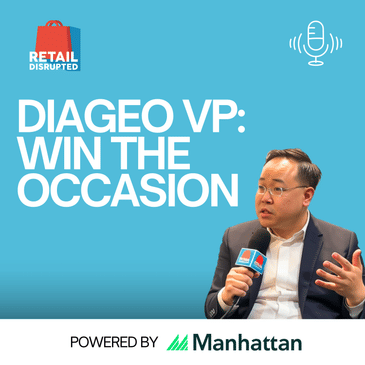
In this episode of Retail Disrupted, Natalie Berg sits down with Danson Huang, Global Vice President of Connected Commerce at Diageo, to explore how AI, quick commerce, retail media and digital discovery are reshaping the consumer journey.
📺 Watch this episode on YouTube https://www.youtube.com/watch?v=TS1z5pMKVAg&t=239s
Danson and Natalie discuss: • Why consumers are prioritizing occasion-led thinking over product-led search • How brands should optimize for recommendations from LLMs and shopping agents • Why agentic commerce may make sense for some purchases (the weekly Guinness order) but not others (the single malt whiskey gift) • How quick commerce can turn live moments — from football wins to Eurovision — into real-time, relevant shopping occasions • The role of retail media in quick commerce and why brands needs to improve relevance here • The foundational data and organizational challenges holding AI projects back and why businesses should focus on outcomes — not "AI for AI's sake"
💡One of the key takeaways from Danson: "Consumers don't live in their CHANNELS. They live with their NEEDS."
🤝 This episode is part of our Shoptalk series, sponsored by Manhattan Associates. https://www.manh.com/
ABOUT OUR GUEST Danson Huang leads Diageo's global B2C digital transformation across pure-play, e-grocery, quick-commerce, D2C platforms, and brand ecosystems. With over 20 years of experience spanning China, Singapore, the US, France, and the UK, he has built and scaled digital commerce, innovation, and omnichannel growth capabilities across global consumer brands. Danson is recognized for his work in connected commerce, MACH-enabled transformation, and the integration of technology, data, and consumer experience to drive sustainable growth.
ABOUT THE PODCAST 🎙️ Retail Disrupted is a Top 5% Global Podcast. Every week, retail analyst Natalie Berg speaks with the leaders and disruptors shaping the future of retail.
👉 Subscribe on YouTube: https://www.youtube.com/@retaildisrupted
👉 Subscribe on Apple: https://podcasts.apple.com/gb/podcast/retail-disrupted/id1676107321
👉 Subscribe on Spotify: https://open.spotify.com/show/5H0TALn63ov2VAIJPNi3FM
👉 Follow on LinkedIn: https://www.linkedin.com/company/retail-disrupted/
👉 Subscribe to our newsletter: https://retaildisrupted.substack.com
[00:00:00] Consumers didn't really live in their channels. They lived with their needs. We can really leverage those live celebrations. For example, Chelsea win Arsenal, Arsenal win Chelsea. We can push them in notifications through retail media to say, hey, let's have a beer to celebrate and you can just deliver that within 15-20 minutes. And those will bring the very clear relevance to that celebration location. This is the value of the channel. So I don't take it as just a sales channel, but I take it as a way to serve the needs of consumers.
[00:00:27] Hello and welcome back to Retail Disrupted, a podcast that helps you navigate the rapidly evolving retail sector. I'm your host, Natalie Berg, and today I'm speaking to Danson Huang, Global Vice President of Omnichannel and Digital Commerce at Diageo. Danson leads the transformation of Diageo's global B2C digital landscape across pure play, e-grocery, quick commerce and e-specialist channels, as well as D2C platforms, brand websites, and digital commerce.
[00:01:05] And broader digital ecosystems. This episode is part of our Shop Talk series, which is being sponsored by Manhattan Associates. So before we dive in to the main episode, a quick word from our sponsor. While customer expectations continue to rise, consistent execution is now the real differentiator. Manhattan helps retailers deliver on the promises they make to their shoppers across stores, e-commerce, fulfillment, and customer service.
[00:01:33] From AI-driven operations to unified commerce, Manhattan works with many of the world's most recognized retail brands to help them turn every customer interaction into a moment of trust.
[00:01:45] Now, one final request from me. If you haven't already subscribed, we would love for you to follow the show. Every week, you'll hear from the leaders and the disruptors shaping the future of retail. You can find us on Apple, Spotify, YouTube, or wherever you get your podcasts. and I should say, we have some very exciting episodes coming up.
[00:02:08] You are going to hear from the CEO of The Body Shop, the head of retail at TikTok, the chief growth officer at Kraft Heinz, and so much more. So please do hit that subscribe button. Okay, let's get on with today's episode with Danson Huang. Danson, welcome to the podcast. It's great to have you on the show and to be here in Barcelona at Shop Talk. I know you've been on stage a lot over the past couple of days.
[00:02:38] Before we dive into all things digital, can you just give us a little bit of an intro and tell us more about what you do at Diageo? My name is Danson. I'm in charge of, we call it the kinetic commerce at Diageo in the global team. So basically, I'm looking after all the direct-to-consumer channels, the B2C channels, the digital shelf experience, and also a physical brand home experience as well. And how important is digital to Diageo? And I guess my other question to you is, how has that evolved over the years?
[00:03:05] For alcohol beverage industry, I would say the digital business online is not so big compared with the other FMCGs. So we are like around 6% to 7% of the total business that is online compared with, let's say, look at beauty, look at, you know, pad, look at the others that is probably more than 20, 25. That's massive. But I think the role that digital that we have at alcohol beverage is more than just a commercial channel, but evolving to a digital inference channel, right?
[00:03:33] So that we see, for example, take example in Germany, 70% of the consumers for whiskey category starts their journey from Amazon. So they search, they browse, experience the brand. They may not purchase online because of multiple reasons, but the Amazon plays a role in terms of overall brand discovery journeys. So this is not just as a commercial channel. It is an overall end-to-end brand building channel as well.
[00:03:58] Yeah. And I want to come back to search and discovery because we know that's being disrupted with AI, with social media. But first, let's talk about the customer. There's so much change happening in retail, so much change happening within your category. So how have customer expectations evolved? So just to clarify, when you say customer here, you're talking about consumers, right? Yeah, I know. Sometimes customer can mean retail. Exactly, exactly. So look, I think here, like a spirits and beer category, I would say consumers in this category are not looking for specific product.
[00:04:26] They're looking for the celebration occasions. They're living in occasions. So they may not ask the question of, I want a Johnny Walker Black Label. I want a Bailey product right now, but I want to understand what kind of drink I want to have to host my dinner party. What kind of whiskey I should bring to my father's celebration occasions and milestones.
[00:04:45] So this makes us really think about what we should build in terms of the relevance of our products with our consumer, no matter in the past if that is on trade with food pairings, or if that is off trade in the grocery shops to be relevant for take-home occasions, or if that is in digital commerce, you know, that is to drive for a startup or drive for a better convenience.
[00:05:08] And this is also true in the world of AI. I mean, look, the consumer previously is asking, and they have to ask actually only the keywords in the search bars in the retailer platforms. And now they can ask the questions. And then it suddenly appears that you want to have the traditional way of the SEO logic to win in the AEO and GEO. It's just not working because they will ask questions about those kinds of questions of occasions. And you need to make sure that yourself are ready for that era to come.
[00:05:37] Yeah, I'm glad you brought AI up really early on as well, because it's interesting what you just said. I spoke to Kingfisher, a big DIY retailer earlier. I've spoken to Helen and Barrett. And I think what's interesting, very different categories, all three of these, but there seems to be this trend where people are looking to AI. And we're all doing it, right? It's something we're doing day in and day out. But we're going to AI, we're going to chat GPT or Gemini or whatever tool we may use. We're getting advice and inspiration.
[00:06:03] We then maybe go into a retailer and speak to a store associate and get more advice, more inspiration. And I think it's just this journey of discovery and search and education and inspiration. All these things are being really disrupted. And I guess my question to you is, to what extent is storytelling and emotion part of that whole experience in your category? Yeah, the way how we use the AI from a brand manufacturer side versus the retailer side is just so different.
[00:06:30] So retailer want to use the AI or engine and commerce just to get faster, right? Get that directly to checkout. But as a brand manufacturer, as we don't really own the transaction except for our D2C channels, the role we're going to play is to build inference. And this inference is starting from make sure that your foundation is machine readable, which is really not yet the case for most of CPGs as we have those PIM, DAM, whatever, kind of those foundational datas.
[00:06:59] And those need to be ready. And then this is the first step. The second step is build those data relevant to locations, relevant to the context. So as the LAM is not like, you know, the traditional shelf or digital shelf, you don't really have a lot of kind of space and you don't really have the sponsor ads. It's just one recommendation or one or two recommendations. You need to really make sure you earn the recommendation through an emotion first, context led, occasion led approach.
[00:07:25] And if you are still trying to just describe your product functionalities, you are not winning those occasions. You need to describe what is your product for? What's the purpose? I think this is where we can win with the consumers. We can win with retailers and we can win with the LLMs, right? And also here, I think the way how we use the AI is also for our internal use, right?
[00:07:47] That is for, could be like for marketing, the content creation, for inside generations, personalizations, or if that is for commercial team, for like planning, forecasting, productivities, or for like the other functions. And everything is connected for the large language models. So think about if you don't have the relevant content, then it can not be captured by LAM.
[00:08:10] If you don't really have the right availability of your product, then the LAM don't want to, you know, recommend you for a purchase, et cetera, et cetera. No matter if that is living with CharityBT or if they live with, you know, Amazon Rufus, that's the same.
[00:08:23] So the question now becoming is about not about the agent itself, but it's about whether you can leverage a standardization agent interoperability across those functions, make sure they can serve better as a kind of foundation interface for the things I just talked about to win with consumers. So those things are connected, right? It sounds like what you're talking about now is more consumer to agent, which is just kind of the next step, right?
[00:08:48] But then if we start thinking about agent to agent, which, you know, is something that I'm hearing from a lot of retailers, and they need to start thinking about how you not only sell to humans, but you also sell to agents. I still feel like a lot of retailers have their heads in the sand that this is coming. It's not futuristic. It's not dystopian. It is happening. So how does that work in your category if an agent is choosing for the customer? It depends really across the different categories and different products to use.
[00:09:13] It would be really sad, you know, we're going to have all the shopping experience, shopping journey that is agent to agent. For myself, I still enjoy, you know, some of the selections of the product to experience this, especially for some of the high value products. Let's say if I talk about I'm going to get a very special bottle of whiskey, single mouth for my father. If that is just an agent to agent talk, you know, it's just becoming meaningless. And I think this is value we should continue to keep.
[00:09:41] But at the same time, you know, if I'm just drinking Guinness every week and I'm a super fan of it and I want to just get it to start up, and this could be done by agent to agent. So I think this is more like back to what is your business strategy around that and how you can really bring and build those distinctiveness around that so you can win with the right consumer. Yeah, I totally agree. It's really nice to hear your view on this because I feel like for certain categories and even within your category, as you've just given such a great example, sometimes, you know, you know what you want.
[00:10:11] It's habitual. You buy the same thing week in, week out, which is why I feel that in grocery more generally agentic is going to be a real game changer. But also you then have categories where you do want a little bit of inspiration and advice. So it's going to be interesting to see how this kind of bifurcates in the future. Sure. Let's keep with the AI theme, but I want to ask you about what you were talking about on stage earlier, which is how a lot of AI projects tend to get stuck in pilot mode and how difficult it can be for retailers to justify the ROI when it comes to AI.
[00:10:41] So I'd love to get your take. Yes. The problem today is that AI is a problem that we don't know where to start or in another way, AI is now starting everywhere. Right. So as I mentioned that, you know, each function that is trying to solve its own version of some of the problems. So there's no very clear owners today in most of the big enterprise. I think, you know, if you look at some of the other companies, there are no proven playbooks.
[00:11:09] There are no proven successful use case stories. I think the only thing that we need to, you know, we focus on right now is not talk about AI, not talk about agent, but it's talk about what is the outcome we want to drive and what is the barrier and problem that help you to deliver those outcomes. And then so how this will be orchestrated across different agents.
[00:11:29] And the second, I think this is probably something that you need to really work very closely from a technology perspective, because if you build an agent without a standard, without a semantic understanding of your kind of KPIs, your words, your languages within the company, they just cannot talk with each other. It's not about agent to agent purchase, but it's about agent to agent workflows. Right.
[00:11:51] So you need to have a workflow. You need to make sure that they understand the same in the same way so they can really work closely, but time to time together. And this is where I see a lot of failures in the CPGs today. And we really need to figure that out. The ownership, the way of work, the standardizations across. I completely agree with you on identifying the problem or what outcome you want first and then, you know, not doing tech for tech's sake, because I think a lot of businesses are still guilty of that.
[00:12:19] And there is pressure. It feels like, oh, AI going to, you know, rewrite the rules of commerce. We need to be doing something. And I think it's difficult for businesses to know, you know, how much, how quickly. You don't want to be a digital laggard, but you also, you know, it needs to be outcome-based. I also wanted to ask you about the proliferation of channels that we're seeing when it comes to digital commerce, because e-commerce, you know, as a customer, it's amazing today. We have so much choice, but we've seen the rise of quick commerce, for example.
[00:12:45] And I know I would imagine in your category, that's probably really relevant for customers to be able to order their beer or their alcohol and get that delivered in 30 minutes or whatever it might be. Any thoughts on sort of quick commerce or how you see channels evolving in the future? Yeah, look, quick commerce is growing so fast in the past years. And we have seen that in the U.S., in the China market, and also now in Europe as well. The most important thing is to make sure that you are building your portfolio strategy, category strategy relevant to that channel.
[00:13:15] So, for example, in China, we are working very closely with the biggest last-minute delivery company called Meituan. And the way how we do that is not just putting our product there, but to make sure that we have those small bottles of the spritz. And then to partnership with the retailers to put that together with some juice, with some other, you know, stuff, and then the ice bottles to make a recipe at home. But this is what they need. They don't need the spritz. They need a cocktail, right?
[00:13:44] And at the same time, also, as Last Mile gives you kind of the convenience and the efficiencies, this can be connected very well with some of the sports events. For example, in London, we partnership with Premier League. We partnership with, you know, Eurovision. If you heard, actually, Eurovision just realized it's much bigger than Premier League from an audience perspective. And Bailey is a sponsor of that. And Guinness is a sponsor of Premier League. So we can really leverage those live celebrations.
[00:14:11] Or, like, for example, if in the area of Chelsea, in the area of Arsenal, and Chelsea win Arsenal, Arsenal win Chelsea, we can push them notifications through retail media to say, Hey, let's have a beer to celebrate. Or, hey, let's have a cocktail to celebrate. And then you can just deliver that within 15, 20 minutes. And those will bring the very clear relevance to that celebration location. This is the value of the channel. So I don't take it as just a sales channel. But I take it as a way to serve all the needs of consumers.
[00:14:40] So consumers didn't really live in their channels. They live with their needs. Yeah. Right? A hundred percent. And I love that example, that kind of real-time hyper-personalization, reaching customers wherever they are. They don't have to be home. They don't have to be on a screen. But it's about those moments, reaching them in those moments, which is, I think, really interesting. As we look to the future, I mean, we've been talking about the future with AI and QuickCommerce. I mean, the future is kind of happening now. But if I ask you to look ahead to the next two to three years, what are you most excited about? Yeah.
[00:15:09] I think no doubt that an agentic commerce is there. So it's not a question, full period. Right? And also, I think there's a lot of foundational work we need to focus on that keeps us busy. We will still have a job. Don't worry. AI will not take our job away. What gave me kind of more excitement around this is that we can get better relevance, trust with our consumers. We can bring more experience closer to their real needs.
[00:15:36] So, as an example, as I mentioned earlier, those days, if I go to some retailers, and because of the boost of retail media, when I search something, I just found something as a sponsor ad that has nothing to do with my needs. This is a pity. This is a waste of my time. And we will go for a more efficient approach, powered by AI, no matter if that is in the physical world or in the traditional e-commerce world or in the internet commerce. I think we're going to all benefit from those approaches.
[00:16:05] Beyond those excitement, I just feel like there's so many jobs to be done within the team to get that right. So, yeah, keep busy. Yeah. Yeah. Keep moving, for sure. Amazing. Danson, thanks so much for coming on the podcast. Thank you. Thank you for listening to Retail Disrupted. If you enjoyed this episode and would like to support the podcast, please leave a rating or review or share it with others. It really makes a difference.