

AI deployed into fragmentation does not create intelligence; it amplifies complexity.
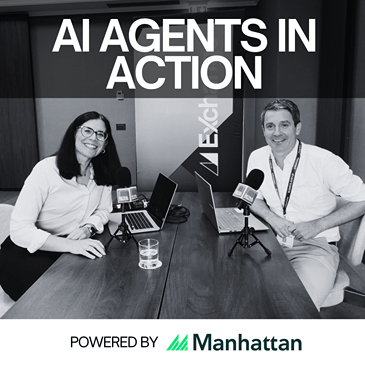
Recorded at Manhattan Exchange in Milan, this episode features regular guest Ben Sillitoe to break down what retail leaders shared on the ground about moving beyond AI pilots.
Exchange is Manhattan Associates' flagship European event. Last year, the emphasis was on "unleashing the agents". 12 months on, what have we learned?
The focus in Milan was on AI agents inside existing workflows: transportation planning agents. Omnichannel specialist agents. Shipment tracking agents. Tools that identify problems and proactively resolve them.
But an AI agent is only as useful as the information and rules available to work with. Solid foundations are everything. For example, pulling inventory from one system, customer details from another, fulfilment from a third and carrier data from a fourth creates multiple versions of the truth — and an agent that can confidently give the wrong answer, fast.
The takeaway from Milan: the aim is not to create smarter machines, but smarter organizations — powered by people, unified by technology, accelerated by AI, and unburdened by complexity.
Featuring examples from JD Sports, Asda, L'Oreal, Co-op, Bauhaus, Foot Locker, CIA Conad, and more.
📺 Watch on YouTube https://youtu.be/c08ExOWFl90
For more, visit https://www.manh.com
ABOUT THE PODCAST
🎙️ Retail Disrupted is an award-winning Top 5% Global Podcast. Every week, retail analyst Natalie Berg speaks with the leaders and disruptors shaping the future of retail.
👉 Subscribe on YouTube: https://www.youtube.com/@retaildisrupted
👉 Subscribe on Apple: https://podcasts.apple.com/gb/podcast/retail-disrupted/id1676107321
👉 Subscribe on Spotify: https://open.spotify.com/show/5H0TALn63ov2VAIJPNi3FM
👉 Follow on LinkedIn: https://www.linkedin.com/company/retail-disrupted/
👉 Subscribe to our newsletter: https://retaildisrupted.substack.com
[00:00:00] Matt Lemon, Head of Supply Chain Technology at JD Sports, he said they have checkpoints in place so that they're able to manually validate the decisions the agents make. That doesn't water down the power of the agent, that just makes sure that they're using it properly right. He also said they wrap around a support agent that is basically an audit agent. So they have got a technology that is logging and tracking all of the decisions that they're making through their agents. So it's kind of like an agent that guides them all. Master Agent.
[00:00:26] Master Agent that keeps the other agents in line. They're using the technology to monitor the technology. You're listening to Retail Disrupted, a podcast that explores the latest industry developments and the trends that will shape how we shop in the future. I'm your host, Natalie Berg.
[00:00:57] Ben, always great to see you. Welcome back to the show. Thanks for having me on again, Natalie. It's becoming a regular thing, isn't it? I think we should do this more often, you know? I think we should, yeah. It's always fun to natter and we're in the same space. So it's good to share ideas and talk about what we see. Definitely, definitely. And we should probably explain that this is our Manhattan Exchange recap episode, something we do every year. But this year we're doing it a little bit differently because we're being filmed as well as recording audio. Excellent. Extra pressure.
[00:01:27] No pressure, Ben. Yeah. Manhattan Exchange, for those who aren't familiar, is the annual European event from Manhattan Associates, where we dive deep into modern supply chains, unified commerce and agentic AI. This year we're in Milan. And I know, Ben, we've both been busy sitting in on the sessions. You've been speaking to retailers on the ground. I've been recording episodes for the podcast. And so I guess the purpose of today is to reconvene, discuss what we learned and bring those learnings to our audience.
[00:01:56] Sounds like a good idea. The keynote speaker on Tuesday, Peter Hinson, he's a bestselling author, you know, lecturer, business expert, technology expert. But I think he frames what this event is like in two sentences, really. He spoke for a long time, but two sentences really stood out. Technology has become mainstream drama. Mainstream drama? Mainstream drama. I love that. Yeah, just with everyone's an expert in AI now.
[00:02:24] Everyone's looking for the new thing, the next big thing. And so it's now mainstream. Used to be the preserve of, he said, the geeks in the basement. They were the ones getting excited about technology. Now everyone's excited about it, which means business is excited about it, which means there's so many different avenues to explore. And he also said there's a joke in Silicon Valley at the moment. No one goes out to lunch anymore in Silicon Valley because by the time you come back, the industry has already changed. And I feel that sort of neatly encapsulates some of the stuff we've been getting our heads around over the course of these few days.
[00:02:54] Definitely. Yeah, speed of change, the pace of change. I interviewed Georgia Palazza from Chia Conad, which is a big Italian grocery retailer. And she was saying she's been in this industry for over 30 years and she's never seen change happen in such a short space of time. So I know we always say that as analysts and as observers and journalists, but it's interesting to hear directly from the retailers themselves just acknowledging how much change is happening.
[00:03:20] So one thing I wanted to talk about, I know we've each kind of prepared a few thoughts that we wanted to discuss for today, but I thought it was interesting that at last year's exchange, Manhattan talked about unleashing the agents. I distinctly remember that phrase. This is very visual, this idea of like letting them loose in a controlled way. So 12 months on, I think it's fair to say that they have been deployed.
[00:03:44] There have been so many conversations both on stage and on the sidelines about AI and specifically agentic AI. But one thing I found really interesting was that when we think about AI agents, we tend to think of sort of the customer service or customer facing side, or maybe we think about how associates are using it in the store.
[00:04:03] But actually we heard about transportation planning agents, appointment scheduling agents, shipment tracking agents, omni channel specialist agents, backorder monitoring agents, and I can go on and on and on. So I thought this was really interesting because it just shows that AI is being woven into the day to day running of businesses. It's quietly making decisions and it's actually taking actions as well behind the scenes.
[00:04:29] Well, yeah, and there was a panel debate with JD sports, Kiva logistics and L'Oreal, all talking about how they piloted some of the new Manhattan agentic technology. As you said, it was all announced in bright lights 12 months ago. But yeah, now there's actually evidence of it out in the field. And yeah, I know you've got a good focus on the in-store stuff and the customer facing stuff.
[00:04:57] But for some reason my focus always goes back to that back end of the retail supply chain. It comes up time and time again. And I was fascinated to hear some of the ways that these retailers are piloting the technology. One area in particular that seems to be getting some traction is the workforce management. So the labor, I guess that's one of the biggest costs in a business. So you want to be using it in the right way.
[00:05:21] And it feels like lots of these retailers that we've seen talking over the last few days are focusing in on that area and using this agentic technology to make decisions about labor, deploy them at certain times in certain places and take action when's necessary, slightly autonomously, but with a human in the loop to have that final say. And yeah, lots of them are using Manhattan's in the pilot stage.
[00:05:48] But then JD and L'Oreal talking about building their own as well and then combining them as part of the kind of Manhattan community that we've heard a lot about as well. Lots of the retailers, so the UK ones that I've been talking to over the last few days, the co-ops and the Asdas of this world, they're not agentic ready in the warehouse yet, but they are honing in on labor workforce management.
[00:06:11] And you can see once they have all the ducks in a row, then that's once again potentially where the agentic technology is going to come in and make a real difference. But they're talking about, you know, massive hour savings and people saving, you know, time savings by using this technology. So I think after the unleashing, there's some real positivity in the reality of what those agentic agents are doing out in the field.
[00:06:39] Yeah, yeah. I think it's been interesting as an analyst over the past couple of days just to see how, you know, really kind of get under the hood of the operational side of retail and, you know, the importance, especially in today's climate with all the cost headwinds and the broader sort of disruption that we continue to see. There was a lot of talk about complexity on stage yesterday and how simplicity is actually becoming a competitive advantage.
[00:07:03] So just to go back to the point about how AI is being used in store, because this for me is something that is really interesting. You know, as consumers, we're all using AI, you know, maybe we don't even realize we're using AI sometimes, but we're all relying on it more and more. And, you know, we've always been pretty informed when walking into a retail outlet. But I think with AI, we are just hyper informed. We've got, you know, access to absolutely everything right at our fingertips.
[00:07:30] And I think there is this need for store associates to also be just as informed as the customer. So that was a question that I put to some of the leadership team yesterday. And I thought it was interesting to hear how they talked about the huddle card. So if I just back up, basically the way that a lot of retailers operate is that they huddle the teams a few times throughout the day. They check in on sales updates, what's selling, what's not.
[00:07:57] And what Manhattan has done is they've built all of this into AI. And now store associates have access to that information right at their fingertips. So they can see what's selling, what's not, what's selling in stores in other regions, but not in their store. And then also, interestingly, what's selling online. And maybe that could impact how a store is merchandised or how, you know, teams want to think about how they engage with shoppers. So really interesting stuff.
[00:08:22] This idea of store associates being hyper informed, have access to that information in real time and ultimately giving customers what they want. Yeah, there's real, real actionable insight, isn't it? That's what this new strand of AI is, is, is giving retailers. And you talk about that in store example. I remember when I worked at Sainsbury's pre university. Yeah, we had those huddles and it was all a bit convoluted.
[00:08:46] But now if you've got actual actions ready to go, then it's going to, it's going to make the operations a lot smoother, isn't it? Another theme that has cropped up over the course of exchange this year is the idea of putting AI where the people are. And so it not being this kind of, you know, strange concept that is going on within a retail business like Manhattan are making sure that their chatbots are in the products, in the, on the interfaces that the warehouse staff are using or the store staff are using.
[00:09:16] And it's just sitting there and intuitive and, you know, ready to use. So it just becomes part of the normal. And I think that's important. And I think most of the retailers we've been talking to are thinking that is the right way to go. And that actually brings up another point from yesterday, which is around these tools being really intuitive for store associates. And we think about retail and it's a sector where there's a lot of turnover and things just need to be easy.
[00:09:42] It needs to be as easy as, you know, taking out your mobile phone and swiping and looking through that. So I think that intuition is really important. The chief digital officer, Johan Veschler of, I think I've got that pronunciation right, of Bauhaus, the DIY chain, European DIY chain. He was on stage on Tuesday and spoke passionately about his business. But one of the things that did come up was he mentioned they have got, you know, AI is beginning to play a role in that customer service through chatbots.
[00:10:10] But he did allude to the fact that more needs to be done and it needs to be better. And there are ideas of how the new strands of agentic and AI may improve that process and that service entirely from this Manhattan sessions where they were talking about their agents and how they could be used. Obviously in the solution, in the platform that staff are using very clearly, but they had these kind of prompts.
[00:10:37] So it gave you an indication of what questions you should be asking the technology. I saw that. Yeah. Which is really useful if you're working in a retailer because it's like, okay, so we know the kind of things this can answer. So let's just go with what it specializes in rather than maybe asking something too complicated or asking the wrong thing that won't get you the right answer. But it's just that extra bit of information that perhaps gets them to the answer quicker.
[00:11:00] And I was thinking that sort of thing could work very well in the customer facing side of chatbot technology and, you know, the kind of customer service tools that we've been talking about as well. If you guide the customer a certain way, then they're not going to get frustrated because they know what the parameters are. Yeah. Yeah, definitely.
[00:11:18] And also one of the retailers I spoke to was talking very passionately about the digital divide, this growing digital divide between those who are embracing AI, championing AI, championing, championing, that's a hard word to say, championing AI and kind of embedding it in their everyday lives. And then there's also, I think this is kind of a broader sort of societal issue, not specific to retail, but those maybe who don't understand it, that's one challenge.
[00:11:48] But then also those who don't challenge it and those who sort of accept what is given at face value and then that whole risk of cognitive complacency. So there was a lot of talk about the importance of humans and all of this and how businesses need to be accelerated by AI. That was a phrase that came up a few times yesterday. But the importance of the human, human ingenuity and also instinct.
[00:12:15] That was something else that I thought was interesting to hear from Manhattan CTO Sanjeev Sioda, who talked about intuition and instinct and just, you know, challenging it where things go wrong because you still need a human in the loop for certain occasions. Oh, I think for most occasions, don't write us off. But Matt Lemon, head of supply chain technology at JD Sports, was speaking a little bit about this. I just need to check my notes.
[00:12:45] But I think he was talking about how it's all a bit unclear, the journey with Argentic and, you know, taking it cautiously, et cetera, et cetera. All this new technology, new applications of the technology can feel a bit uncomfortable. But, yeah, he said they have checkpoints in place so that they're able to manually validate the decisions the agents make. And, I mean, you know, that doesn't water down the power of the agent. That just makes sure that they're using it properly right.
[00:13:10] And especially in pilot stage, it might get to a stage where they're happy to automate and make things more autonomous. But that was interesting. He also said they've got, not quite sure what to make of this, but they wrap around a support agent that is basically an audit agent. So they have got a technology that is logging and tracking all of the decisions that they're making through their agents. So it's kind of like an agent that guides them all. And, yeah, a kind of master agent that keeps the other agents in line.
[00:13:40] I mean, he only spoke about that very briefly on stage. And so I'd like to go into more detail and find out exactly what that means. That's my understanding of one of the guardrails they've got in place as well as the human in the loop. They are using the technology to monitor the technology. Wow, that's super interesting. I didn't know that was a thing. So super interesting. I also want to share an analogy that CEO Eric Clark shared on stage, which I thought is just especially for a podcast. I think for those who aren't watching and those who are listening, I always think visual examples are really, really helpful.
[00:14:09] So Eric said that 75 years ago, you needed five pilots to fly a commercial plane. By the 70s, the technology got better and you only needed three pilots. And today you only need one or two. And his point was that it wasn't because flying got easier. It was the technology that changed. And he talked about the instruments absorbing the complexity instead of displaying it, systems that are recommending instead of reporting, and how the plane now anticipates instead of reacts.
[00:14:39] So I thought that was a really good analogy to describe what's happening in retail and this sort of transitionary phase that we're in in wider businesses as AI becomes more embedded. Yeah, it's another good analogy, isn't it? I think you spoke about that increasing complexity and the need for technology to do the heavy lifting. And that makes a lot of sense. And funnily enough, Tim Heisman, vice president supply chain in the EMEA region for Footlooker, he went on stage talking about their deployment of Manhattan's warehouse technology.
[00:15:10] And yeah, basically, they've basically changed their whole operating model due to their digital transformation using Manhattan. They used it as an opportunity to change everything they do. But yeah, spoke about the need for technology to do the heavy lifting, cut out some of the manual processes that are unnecessary, that are taking up too much time. And they're seeing some real big results from it. Awesome. Well, Ben, I think that's everything for me. I mean, I know we could be here for hours, but I think those for me were the main takeaways. Was there anything else that you wanted to add?
[00:15:40] Really interested in what Rob Wilkes, senior engineer manager at ASDA, said. And I kind of suspected it for a while. I think there's an opportunity for you and I here and Natalie as well. But he basically said, we work in the supermarket business. In the past, we sometimes weren't even allowed to go to meetings if certain people from other businesses were going to be there. And we weren't even allowed to mingle with other grocers. I think everybody needs to accept that the world has moved on. In today's tough environment, we all need to try to help each other out. I think we're much more into that space now.
[00:16:10] No boundaries to who you speak to and where you speak to. I just thought that was fascinating. It kind of sums up the mystery and the potential of this new era we're in. And everyone's going to have to work a lot closer and learn a lot from each other. And we're in that space now, right? Yeah, yeah, definitely. I think that has been a theme throughout. And it's just about working through and figuring out all this technology and AI and how we can thrive in this sort of digital era that we're in. Absolutely.
[00:16:40] And that's what Exchange is all about every year. Yeah, exactly. Well, Ben, as always, thanks for joining me on the podcast. It's been great to see you. I'm going to go and check out Milan now. There you go. Enjoy. Thank you for listening to Retail Disrupted. If you enjoyed this episode and would like to support the podcast, please leave a rating or review or share it with others. It really makes a difference.