
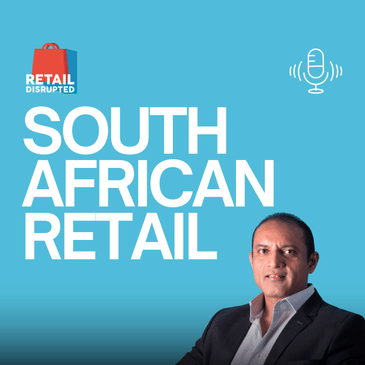

Nazim Cassim is a retail veteran who served on the Massmart board during the Walmart acquisition. Today, he splits his time between South Africa and Dubai in his current role as CEO of QVWi Retail, MEA. Nazim is also a Founding Member of the Retail Institute of South Africa (RISA), whose mission is to empower the country's retail workforce through professionalization and training.
Nazim joins Natalie to discuss:
- The Walmart acquisition and why the retailer is doubling down on Africa.
- Why some businesses fail in South Africa.
- The broader state of South African retail and what last year's Amazon launch means for the industry.
- Nazim's views on retail transformation and the critical role of technology in shaping the future of retail.
- QVWi Retail and retailing in the Middle East.
- RISA's mission, what led to its creation, and the importance of investing in skills development to attract the next generation of talent.
Bio:
Nazim Cassim is a highly respected figure in the retail industry with over 34 years of experience. As the Founding Member of the Retail Institute of South Africa (RISA), Nazim is at the forefront of professionalizing South Africa's retail sector through competency-based training, micro-credentialing, and industry-recognized qualifications. Nazim served on the Massmart board during the landmark Walmart acquisition in 2010, a defining moment in South African retail history. He played a pivotal role in the turnaround of Massmart's ailing DIONWIRED business when he served as MD. Nazim previously served as VP for Gen Merch, Food and Liquor. Post his tenure at Massmart, he launched the global appliances brand BEKO brand in partnership with Arcelik Group in SA.
Nazim is also an advisor on the University of Johannesburg's Academic Board, contributing his expertise to the advancement of retail education. He serves on the executive Steerco of the Wholesale and Retail Sector for Education and Training (W&R SETA). He is currently the CEO of QVWi Retail MEA, A Skyworth Digital Company. A doctoral candidate, Nazim's academic pursuits further underscore his commitment to the growth and evolution of the retail industry. As sought-after keynote speaker, Nazim is widely recognized for his thought leadership and his ability to inspire innovation in retail. His dedication to workforce development and strategic partnerships continues to shape the industry's future. On the outside, he is an open water advanced scuba diver and loves exotic locations for an adventure dive, and an avid reader of Philosophy.
Connect with Nazim on LinkedIn.
Learn more about the Retail Institute of South Africa (RISA).
[00:00:07] You're listening to Retail Disrupted, a podcast that explores the latest industry developments and the trends that will shape how we shop in the future. I'm your host, Natalie Berg.
[00:00:19] And welcome back to Retail Disrupted. I'm delighted to welcome Nazeem Qasim to the podcast. I've known Nazeem for a number of years. He is a highly respected figure in the South African retail sector with over 34 years of experience.
[00:00:43] Nazeem is the founding member of the Retail Institute of South Africa, or RISA. And he's also currently the CEO of QV Retail, which is a Skyworth digital company with offices in Dubai and South Africa. Through his work at RISA, Nazeem is at the forefront of professionalizing South Africa's retail sector through competency-based training, micro-credentialing, and industry-recognized qualifications.
[00:01:12] Nazeem also served on the Massmart board during the Walmart acquisition in 2010, which was, of course, a defining moment in South African retail history. He played a pivotal role in the turnaround of Massmart's ailing Dion Wired business when he served as managing director, and he was also previously the vice president for general merchandise, food, and liquor. Nazeem is also an advisor on the University of Johannesburg's academic board.
[00:01:40] And in his spare time, he is also completing his doctoral degree with a master's in research. It's a pleasure to be able to welcome Nazeem to the show. So without further ado, let's dive in. Nazeem, it's great to have you here on the show. Nazeem, you are my first guest from the Southern Hemisphere, which is super exciting. Now, we know each other, of course, but some of our listeners may not.
[00:02:08] So can you share a few words about yourself and your background? Yeah, thanks, Natalie. Well, firstly, thanks for inviting me on the show, and I really appreciate the time that you've taken to get me on. A little bit about me, you know, I'm a retailer at heart. I've spent the last 34 years in the retail industry, specifically in South Africa. You know, and I want to chat a little bit about that later in the show, hopefully, as we get into it. But yeah, so, you know, I've been in the corporate retail side,
[00:02:36] having spent time at the Massmart Group, which was subsequently acquired by Walmart on about 2021. You know, after about 30, 32 years, I think it was at Massmart, I kind of decided to spread my wings a little bit. And I'm now on the supply side of retail and Massmart's still one of our customers. Yeah, and I'm very much involved in the retail space, both from a professional point of view in terms of, you know, trading with all the retailers.
[00:03:04] And then from an academic point of view, you know, I sit on the wholesale and retail sector for education and training steering committee in South Africa, which is a government body, you know, that is vested in skills development in the country. And, you know, because of that relationship, I end up spending a disproportionate amount of time with various retailers in the sector. We first met about 12 or 13 years ago. And as you just said, you were at Massmart at the time.
[00:03:32] Walmart had just acquired a controlling stake in the business. I had just written a book about Walmart, which I co-authored with Brian Roberts. Can you share what that time was like for you having the largest retailer in the world not only enter your market, but choosing your business as its acquisition target? Yeah, I think, you know, if I reflect on it, it was certainly an interesting, you know, part of our business. You know, at the time I was with the Massmart Group.
[00:04:00] Our company was really performing quite well, you know, early 2010, et cetera. And this conversation had started. We were certainly overwhelmed, you know, by the opportunity to work with the largest retailer in the world. You know, and I was fortunate as well because I was also in the business development team and I got an opportunity to work alongside some of the Walmart guys, you know, through that process.
[00:04:25] And again, you know, one of the one of the interesting things that happened for me was that I got to be the first one of amongst one of the first guys that traveled to Walmart's head office in Arkansas, spent some time there trying to better understand the, you know, the merchant programs. Walmart had this advanced merchant program and was very insightful. And I must admit, it was certainly a great time for our business. Yeah. And Bentonville is an interesting place, isn't it?
[00:04:55] Yes, it certainly is. Yeah. And now before we move on from Walmart, because I know we have a lot to talk about, I'd love to get your perspective on how the business has evolved. Walmart is still present in Africa today. It has over 300 stores across eight markets, the bulk of which are in South Africa. It's been a little bit of a bumpy ride for Walmart, but instead of walking away like the retailer has done here in the UK and probably most notoriously in Germany,
[00:05:24] but instead of walking away from the market, they seem to be doubling down on Africa. So a few years ago, just for the sake of our audience, which of course is very international, but they might not be so well versed in all things South African retail. A few years ago, they took full control of Massmart. About a few years ago. And just, yes. Yeah. And just last year, another disruptor that we are very familiar with on this podcast launched in South Africa. And of course, I'm talking about Amazon here.
[00:05:51] So from my perspective, it's really interesting to see these two global giants, two retailers that I've written books about as well, Amazon and Walmart. So fascinating to see them going head to head in the Southern Hemisphere. What do you make of this, Nazeem? And what does this tell us about the current state of retailing in South Africa? Yeah, I mean, it's an interesting question that you're asking, Natalie, because I think, you know, Walmart entered South Africa through the acquisition of Massmart.
[00:06:20] They've certainly seen failures in other parts of the world, you know, having gone there as a Walmart company, the likes of Brazil, South Korea, Germany, as you've mentioned, Japan, funny enough, and also in the UK, you know. So I think, you know, the entrance into South Africa through an acquisition of Massmart was, you know, certainly tactical for them.
[00:06:41] We also, or at the time and to this day, Massmart still maintains its identity as a Massmart company trading under the banners and the various banners, because Massmart is a conglomerate of different, you know, retail brands that sit under its umbrella. And none of those retail brands are operating as a Walmart South Africa company, albeit that it's owned by the company.
[00:07:03] And I think, you know, just taking, maybe just teeing off a little bit from that, if we look at some of the other major retailers in South Africa that sort of ventured across the South African borders into Africa, you know, they've certainly seen some level of failure, the likes of, you know, Woolworths pulling out.
[00:07:21] And, you know, there's been various instances of a lot of our South African retailers, the ShopRite group, et cetera, that sort of, you know, ventured in and try to maintain course and course correct as they proceeded.
[00:07:35] But I think the big learning there is certainly understanding that as you, you know, as you go into foreign territories as an international retail brand, you've got to start to contend with the cultures in that country, the ways of working, you know, the economic environment, you know, the society at large and how consumers respond to the brand.
[00:07:57] And I think that's been a huge challenge, perhaps for a lot of retailers, whether they're in, you know, in different parts of the world coming to South Africa or South African retailers venturing out. And, you know, you ask about Amazon and I think Amazon is seeing, you know, the similar taste of that.
[00:08:17] You know, South Africa is not, you know, we're a large thriving retail industry in South Africa, probably not amongst the world's top 10, you know, but certainly we're a large economy. You know, we do 1.2, 1.3 trillion rands, which is about $80 billion, you know, retail footprint. You know, e-commerce, we're not at the level of, you know, China and U.S. market just yet, but we're kind of in the 6%, 7% on e-commerce.
[00:08:44] And for Amazon to enter South Africa, you know, there's a lot that they have to contend with, you know, challenges in logistics, infrastructure. Also, there's a well-established local competitor in South Africa, the likes of Techalot, which is a huge giant on their own. They have at least 30% of the e-commerce market here in South Africa. You know, South African consumers like things tailored for the South African consumer. And I don't think Amazon quite, you know, figured that out yet.
[00:09:11] You know, I recall when Amazon made their debut, we were able to shop on Amazon Global site and still purchase products a little bit cheaper than what Amazon was doing here in South Africa. We've also got a, you know, we've got a limited range. But I think, you know, don't be mistaken, Amazon's a giant of its own. And like a Walmart company, I'm sure they'll get it right. Yeah, you can never underestimate the likes of Amazon and Walmart, I'd say. You know, huge global giants.
[00:09:39] And they have the, you know, the deep pockets and the luxury of long-term thinking to wait it out and make sure they address any of those initial niggles. So it's really interesting. Interesting. Let's zoom out of South Africa for a moment and look at the wider retail industry, the global retail industry. And it feels like a good time to ask you about this because I know in your current role as CEO of QV Retail, you spend a lot of time in Dubai. I know you're based in South Africa, but you spend a lot of time in Dubai.
[00:10:08] You report into China. We're going to come back to QV in just a second because I want to hear more about your role. But first, I'd love to get just to continue with the theme of retail evolution. I'd love to know in your 34 years of retail, what's been the biggest transformation that you've witnessed? Yeah, well, that's I mean, that's a deep, interesting question.
[00:10:29] And I think, you know, maybe if I sum it up through observational and key learnings, and I think if I look at it from a global perspective, this kind of equally holds true for retail as an industry. And the way I would sum it up and the way in which I see it is, you know, I kind of see retail as this triadic relationship, I call it, between the consumer technology and retailers.
[00:10:55] You know, and it's kind of how consumers adapt to technology and what they're doing with it in their daily lives. And then, therefore, how retail is responding to consumers' changing behavior through this very pattern. And we've seen it throughout, you know, the evolution or throughout the revolution of retail. We go all the way back to the first industrial revolution kind of thing, you know, and just to, you know, kind of put everything into context.
[00:11:21] Here we see the rise of machines and the beginning of retail sort of, you know, the turn of the 19th century. You've got departmental stores emerging and, you know, retail starting to gain life and sort of a momentum on its own. And then we kind of, you know, we kind of get that up and running and then we enter sort of, you know, World War I.
[00:11:42] You come out of World War I, you've got, you know, this era where you've got mass production and you've got, you know, technology playing a role here as well around how consumers now can get products cheaper and how retailers then kind of respond to it. Also, you've then had sort of electrification taking place, telecommunication coming on board and retailers starting to think about how they would respond to this.
[00:12:07] And you'll probably remember back, you know, telemarketing and all those type of things. And this was just retail responding to how consumers shop. I sort of entered, you know, perhaps in the third industrial revolution. Here you've sort of got the dawn of digital. You know, you've got kind of analog converting into digital. You've got end of World War II. And, you know, all the big things are happening in retail. Probably the most exciting era in retail, I would imagine.
[00:12:36] Again, I mean, you know, therein you've got the launch of the World Wide Web. When we think about it, the internet's officially been available to consumers since around 1990, really. You know, you've got about 30, 35 years worth of technology at play. And coming back to this notion of how retailers respond to technology and what they're doing about it. Because, you know, you know, retail, you know, it's important if you go back in time and look at how many retailers are considering. Do they enter the e-commerce market?
[00:13:05] And should they be doing it? And should they not be doing it? And, you know, big boardroom meetings around capital investment in technology, et cetera. And, you know, you could probably go back in time and some of the boards were applauded for not having spent in the technology. And later on, you see the demise of those, you know, the kind of the shortfalls of their thinking at that point in time. Again, it's tech. It's consumers. How are they utilizing it? And what are retailers doing about it?
[00:13:32] You know, and I think, you know, there's something in that formula that a lot of retailers are not, in my personal opinion, at a global level, not paying attention to. You know, they're focusing on the consumer specifically. They may be ignoring technology or they may be focusing on technology and ignoring the consumer. But these things work in tandem, you know. Yeah. The only constant is change. I feel like that's something I say a lot on this podcast.
[00:13:57] You know, technology is accelerating and retailers cannot accelerate change faster than they're willing to adapt to technology. Yeah. Yeah, absolutely. And at the end of the day, it is about following the customer and ensuring that, you know, you're staying relevant to your customers, whether that's through the use of technology or meeting them when it comes to things like sustainability or local or convenience. So really, really interesting to get your views there. We're going to stick with the technology theme.
[00:14:25] And I alluded to this in the last question. But Nazeem, can you tell us more about QV Retail, about your current role? And maybe if you have any observations on the retail scene in the Middle East, that would also be interesting here. Yeah, I think, I mean, there's a huge dichotomy between how we trade. You know, having experience in South African market, I've spent, you know, I'm fortunate that I've kind of seasoned globally. I've traveled throughout the world in terms of, you know, visiting different retail formats, et cetera.
[00:14:55] The Middle East is quite an interesting space to be trading in right now. So QV Retail, who are we? So we're part of, you know, Skyward Global is an ODM company. We are the largest Google partner. We manufacture set-top boxes for most of the broadcasters across the globe. You know, if we look at our region, which is South Africa and Middle East, you know, we have, in South Africa, we have a broadcaster called MultiChoice. And they stream content to consumers' homes.
[00:15:24] We manufacture all of their hardware. And the same in the Middle East. You know, we've got big partners like, you know, Redoo and Etty Select and NBC, et cetera. And we, by and large, manufacture for them. Skyward, as I said, historically has always been an ODM company. We've got different divisions that focus on different segments of the market. I joined the Skyward team about three years ago. We're in South Africa.
[00:15:50] We've got a huge manufacturing company, you know, manufacturing for some of the biggest technology partners in South Africa. They're like sort of multi-choice. And we also do TV manufacturing here in South Africa for various other brands. But we didn't really have a retail division inside of digital. And we are the largest manufacturer as a set of streaming devices and set-top boxes in South Africa.
[00:16:15] So we launched a retail division that was really focused on, you know, digitizing, you know, taking digital solutions to consumers' homes. You know, kind of creating this digital lifestyle environment for customers. And we've had huge success. You know, we launched QV as a new brand, as a new consumer brand. It's spelled with the letters Q-V-W-N-I, but it's pronounced Q-V. And really, it's a consumer digital brand.
[00:16:41] We entered the streaming market in South Africa around about March last year. And, you know, we managed to get support all across South Africa from our retail partners. And, you know, in almost most of our retail partners, we took the number one position, you know, in terms of share of shelf and share of volume. And similar to what we did in South Africa, we launched a partnership with Todd in the Middle East.
[00:17:09] You know, Todd is part of the Bean Group, where we took, you know, a streaming solution to retail consumers. And I can tell you, I mean, the retail market is very different in the Middle East. You know, as a supplier, you pay a huge amount of fees to get listings done in the Middle East. And retail is managed very differently.
[00:17:31] You know, you've got the traditional business model, where you've got what they call traditional retail, which is sort of your informal retail, which is, by the way, formalized in some way, formal shape. And then you've got your mainstream, you know, national formal retails, the likes of Yulu, Colorful, Virgin Mega Stores, et cetera, et cetera. So, yeah, I mean, it is a challenge. We certainly try to understand and navigate our way through it.
[00:17:56] But it's been an interesting journey as we've been able to launch product in that region. Nazeem, you wear a lot of hats these days because you are also a founding member of RISA, which is the Retail Institute of South Africa. So can you tell us a little bit more about RISA? What inspired its creation? And what gap did you see in the South African retail sector that led to its founding? My time at MassMart was quite interesting.
[00:18:20] You know, retail, and it's probably, you know, this may hold true for a lot of people that are sitting in the retail industry globally. Retail typically is a fallback career. Well, certainly in South Africa it is. Where, you know, when you finish your schooling career or finish your academic career, you aren't necessarily thinking about retail as an industry that you aspire to, you know, go work in. It's not, you know, it's not like you plan to become a nurse or a pilot.
[00:18:48] I was fortunate because I joined retail kind of on the floor, on the shop floor and sort of worked my way from the back door to the front door and from the shop floor to the boardroom. And during that time it was quite interesting. This was kind of pre-South Africa going into democracy, you know, before 1993. And retail was really a very different place.
[00:19:09] And certainly I think, you know, retail is perhaps one of those industries and one of those organizations where you've got the opportunity of having multifunctional parts of the business all operating together. You know, you've got your back-end HR and finance and logistics, et cetera, et cetera. You've got the front part, which is operational and, you know, customer-facing, et cetera. And, you know, having spent all of that time in retail and, you know, kind of eventually getting to the board, et cetera.
[00:19:38] And it wasn't when RISA came to mind, you know, one of the things we did in MassMart was we moved one of our businesses, which was our game discount retail business. We moved it from, it was located in Durban, which is, you know, part of South Africa. And we moved it up to Johannesburg. And through that relocation process, we ended up losing a lot of our corporate team, our head office team.
[00:20:03] And, you know, when I got to head office, we started to look for people, look for skill, look for buyers and planners and merchants. And to be honest, there's just such a shortage of that skill set in the country. And, you know, when I left MassMart, this kind of, you know, it stayed with me for a while. And we started to think about how we could have, you know, an impact in creating some type of a solution.
[00:20:27] And certainly there already existed a lot of, you know, companies that were providing training, et cetera, for, you know, retailers to utilize and get people skilled. And the more we sort of, you know, spend time on this, it started to make sense that there was something major missing. So what was it that was missing? Is that something that you can elaborate on? You know, one of the other roles I have, and I've sat on this board for almost a decade now, which is the wholesale and retail sector for education and training.
[00:20:57] And what we really do there is we put, you know, senior leadership that are inside of retail organizations. We put them to specific training programs with universities and, you know, one of them is a retail development program. The other is an international leadership development program. And over the years, you know, one of the roles that I play on that committee is interviewing candidates that want to come onto our programs.
[00:21:20] And over the years, I started to see this huge drop off in the kind of caliber and the level of people we were getting and also the level of people in retailers we're sending through. And the more we started to think of, you know, what's missing, the more it started to make sense as you compare it to industries around the world is professionalization was missing. In other words, the industry wasn't recognized as a profession and therefore people were not necessarily being drawn to enter that industry.
[00:21:50] And they entered that industry purely because they couldn't find a job or they also may have gone to study tertiary education, whether it's HR or finance or IT. And then those specific skills do get used, you know, in specific functional areas in retail. But by and large, there was a tremendous shortage of merchants, as I would call it, you know, buying, planning, et cetera. And to this day, there still is.
[00:22:14] And it's sorry to interject here, but this is a global issue as well, which I think is an interesting thing to call out. It's, you know, it's it's something that retailers around the world are grappling with. How do they continue to attract and retain talent? How do they make this an attractive career? But it is absolutely, Nati, and you're on point, you know, and I think that's exactly where the idea of Lisa was born.
[00:22:38] You know, and I was fortunate, my co-founder and I, my co-founder, Basha, she's a law person. She holds an honors in law degree. We started to really think about how this could, you know, work. And we moved away from thinking about it purely as training to thinking about it as institutionalizing the industry and creating a professional body. And hence, Lisa was born.
[00:23:05] What we ended up designing was a framework that would ultimately lead to the professionalization of the industry. And that framework is very synchronized in terms of creating retail as a profession. Now, Nazeem, before we wrap up, what advice would you give to the next generation who might be considering a career in retail? For me, retail futures not, you know, I mentioned it's about technology, et cetera. But the reality, it's about people.
[00:23:29] You know, if we don't invest in skills and we don't invest in professionalizing the industry, all the AI, all the automation won't save us. You know, the retails that survive, in my opinion, are the ones that will adapt the fastest and develop the people the most. Nazeem, it's been wonderful to have you on the show. Thank you for sharing your insights. And I look forward to staying in touch. Natalie, it's been awesome.
[00:23:57] Thank you for listening to Retail Disrupted. If you enjoyed this episode and would like to support the podcast, please leave a rating or review or share it with others. It really makes a difference.