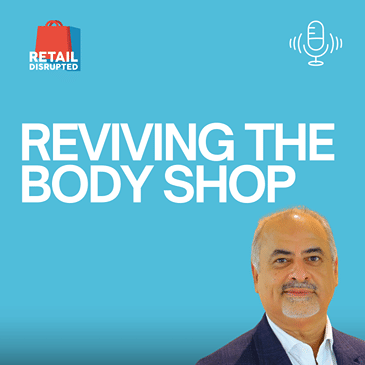

The Body Shop is in transformation mode. Two years after its rescue from administration, the globally renowned ethical beauty business is moving from stabilization to its next phase of growth under Mike Jatania - Co-Founder of Aurea Group and CEO & Chairman of The Body Shop.
Mike joins Natalie Berg to discuss what it takes to revive one of the world's most recognizable and purpose-driven brands.
📺 You can also watch on YouTube: https://www.youtube.com/watch?v=ZRM5IbolyHw&t=1s
Retail leaders will learn:
Why loyal customers were never the problem and how to win new customers in a disrupted market.
The 5-pillar turnaround: brand positioning, meeting shoppers where they are, data-led decisions, speed to market, and operational focus.
Why stores still matter: creating relaxed, personalized, experience-led spaces and a seamless online to in-store journey.
The digital growth plan: growing D2C e-commerce from 15% to 40% of sales within the next 3 years - and getting the assortment right for marketplaces and quick commerce..
How The Body Shop returned to the US exclusively through e-commerce and Mike's plans to selectively return to bricks & mortar in the future.
The opportunity in wholesale and travel retail. One of The Body Shop's best performing stores in Germany? A railway station in Cologne.
How The Body Shop is using AI across marketing, supply chain, demand planning, legal, and more.
What Gen Z really wants: purpose plus performance, backed by clinical proof.
ABOUT OUR GUEST
Mike is CEO & Chairman of The Body Shop and Co-Founder of Aurea Group, a specialist private equity firm focused on beauty, wellness and longevity. A seasoned entrepreneur and a visionary leader in the beauty and personal care industry, Mike previously served as CEO of the Lornamead Group where he played a pivotal role in transforming the company into a global powerhouse, managing a portfolio of more than 30 personal care brands distributed across 50 countries.
In 2021, Mike Jatania co-founded Aurea Group with former UBS Vice Chairman, Paul Raphael. In September 2024, through Auréa, Mike led a consortium of investors to acquire The Body Shop, where he now serves as Executive Chairman and CEO. Mike aims to usher in a new chapter for The Body Shop, driving growth and enhancing its global presence while preserving its core values and ethos.
ABOUT THE PODCAST
🎙️ Retail Disrupted is an award-winning Top 5% Global Podcast. Every week, retail analyst Natalie Berg speaks with the leaders and disruptors shaping the future of retail. 👉 Subscribe on YouTube: https://www.youtube.com/@retaildisrupted 👉 Subscribe on Apple: https://podcasts.apple.com/gb/podcast/retail-disrupted/id1676107321 👉 Subscribe on Spotify: https://open.spotify.com/show/5H0TALn63ov2VAIJPNi3FM 👉 Follow on LinkedIn: https://www.linkedin.com/company/retail-disrupted/ 👉 Subscribe to our newsletter: https://retaildisrupted.substack.com
[00:00:00] Our challenge isn't loyal customers. They are die-hard loyal customers. But our challenge is, how do we win the new customers in a very disrupted environment because you've got founders who are able to rapidly develop product, bring in innovation, think out of the box, and they are speedboats. And you've got to ensure that you do not become a big tanker. That takes a long time to turn because you've got these speedboats all around you and they are becoming billion-dollar companies very, very quickly. There's disruption going on.
[00:00:28] And that's exciting. You're listening to Retail Disrupted, a podcast that explores the latest industry developments and the trends that will shape how we shop in the future. I'm your host, Natalie Berg.
[00:00:56] Hello and welcome to Retail Disrupted. Today, I'm delighted to be joined by Mike Jatania, co-founder of Araya Group and CEO and chairman of The Body Shop. Mike, welcome to the podcast. Thank you, Natalie, and thank you for having me. It's a pleasure.
[00:01:11] You know, I'm very pleased to have you on the show because it's such an important year for The Body Shop. It's celebrating its 50th anniversary. It's a business that's undergone significant transformation over the past couple of years. I want to get all the details about the strategy, how you're evolving, how you're meeting customers where they are. And also, I know a lot of our listeners and viewers would love to get your take on the wider sector. So, so much to unpack, Mike. Absolutely. Absolutely. Looking forward to the conversation.
[00:01:38] Great. So, let's dive in. And I think just to kick us off, can you tell us more about Araya Group and the wider portfolio? Sure, sure. Araya was set up close to four years ago together with my partner, Paul Raphael, who's had a lifetime in the banking industry, in M&A. And we both felt that there was an opportunity to create a highly focused specialist in the private equity world. Why did the world need another private equity is where we started.
[00:02:07] But we felt that, one, the sector focus would differentiate us. Our focus is on beauty, wellness and longevity. The second thing was highly operational approach to private equity investment. As you mentioned, I'm CEO and chairman of the body shop, but I'm also the GP of Araya.
[00:02:26] So, it's fairly unusual, I would say, for a GP to be a chief executive of a portfolio company. But that actually demonstrates the key differentiator of Araya, that we are really an operationally focused. And our alpha is created by that operational focus and support to our portfolio companies.
[00:02:50] You asked about the portfolio. We have fully deployed our first fund across a portfolio of six companies. We have chosen sort of macro themes that we believe in. We believe in farm to face, beauty tech, inside out wellness, science-backed beauty, longevity.
[00:03:12] So, these are the big themes that we build personalization. We feel these themes are going to shape the future of beauty, wellness, longevity. Strategy on geographic focus is the U.S. and Europe. So, all our companies are headquartered by the U.S. And at the moment, we've got 50%. So, three of our companies are based in the U.S. and three of them based in Europe. We have a beauty tech company called Decipher, which we're super excited about.
[00:03:41] It is where we're using technology to personalize your beauty product. And in this case, we're talking about foundations. So, with Decipher, we use technology that, through your phone, captures your face, tone, color, texture, and then personalizes and makes a foundation for you. 100% personal. Oh, wow. That doesn't sound like an easy thing to do.
[00:04:09] It's not an easy thing to do. Many companies have tried to do it and not succeeded. But we have been working on this company for now over two years, and we believe we've perfected it. It's been launched a year ago, a soft launch online. We're now going into bricks and mortar stores as well. It will be rolled out in the John Lewis stores over the coming months. So, we're super excited about that company. We have two companies in the hair care space.
[00:04:35] We're believers in hair care, and especially in terms of the changes that consumers are experiencing with the onset of GLP-1, with longevity, etc. So, how do we give longevity to hair? And we've got two companies in the premium hair care sector. One, Scandinavian Biolabs, based out of Denmark. Another one, NRI, based out of the U.S. And both those companies are really about hair loss prevention.
[00:05:04] We have a first sort of what we would call medical aesthetics meets Uber. And that is a company called Persimmon. It's based in the States. And it allows you to, just as when you're ordering a car, you use Uber. This allows you to meet your nurse who will come and administer Botox, IV drips, non-invasive medical aesthetic treatments at your convenience.
[00:05:33] So, they meet you where you are, whether you're at your spa, whether you're at your home, or you're, you know, a bunch of friends together and you want somebody to come over. So, that's another company in that space. We then have, of course, the body shop. And I'm sure we'll go into the body shop, which, you know, we've been now involved in the body shop for close to two years. And then finally, herbivore, which is based again in the U.S. Its positioning is cleaner than clean beauty.
[00:05:59] It won the Sephora, you know, cleaner than clean beauty award. Great founders. And, you know, we're really looking to deliver through botanicals performance of products on skin that match peptides, basically. So, that's currently the portfolio. Wow. And it's quite diverse, but it's all focused on beauty, wellness, and longevity. It's an interesting mix, isn't it? Because you have some really established businesses like the body shop. And then you also have some really disruptive businesses as well.
[00:06:29] So, I know you kind of touched on the investment criteria, but I'd also love to know, are there sort of any synergies or learnings that can be applied, like, across the businesses, and especially in relation to the body shop? Yeah, there are learnings, key thought leadership sort of aspects to it, which we share with between the CEOs, the CMOs, et cetera, technology side of things. What we try and avoid is to have any integration because we want to keep the sanctity of each of those companies.
[00:06:57] And as you can imagine, as a private equity firm, we want to have clean exits and exits at some future point. We want to ensure that the synergies do not hinder, you know, the exit of single company. But there are many, many learnings that we share, especially in the digital space, disruption, technology and the role that's going to play.
[00:07:20] I would say marketplaces as well, Amazon, Meta, in terms of how that affects, you know, user-generated content. So there is a lot that all our CEOs, CMOs, and key leadership teams learn from each other whilst maintaining their independence. Yeah. Yeah, that makes sense because, as you say, there is so much disruption, and that's exactly what this podcast is about. So let's talk about the body shop. Sure. 20 years ago, Dame Anita Roddick sold the body shop to L'Oreal.
[00:07:51] It's since changed hands a few times, most recently when you rescued the business from administration. Tell us, we're going to get into the strategy and transformation, but just tell us about the numbers, Mike. What was it like when you bought the business, and what kind of shape is it in now? When we bought the business, of course, it was in administration, so it was really quite disrupted in that sense. In terms of numbers, we're talking about almost 2,000 stores around the world.
[00:08:20] We built a, I would say, billion-dollar retail sort of brand, so big in terms of sales, very established. But what we acquired was a company that had lost its way a bit. Technology wasn't working for it, to be quite honest. Supply chains were significantly disrupted.
[00:08:41] And the consumer was uncertain as to whether their most loved brand, ethical brand, was going to have a future. So that's what we inherited. But fortune favors the brave, and we were brave, and we got to work. And for Araya, which has an operational mindset, when we looked under the hood, we were not put off by that.
[00:09:08] We recognized that it's a significant task ahead, but it needed really a heavy operational lift. And so we went with eyes wide open in terms of the opportunity and some of the challenges that would come with that turnaround. Yeah, because you've already sort of alluded to it, but the body shop is an iconic brand. It was a pioneer in ethical beauty. It's a brand that's loved by consumers.
[00:09:34] It's a brand that's very clear on purpose and how it differentiates in a very crowded, busy market, which I think is so important in retail right now. But I think for any retailer, any brand, no one is immune to the challenges and changes facing the industry right now. There is so much change. There's so much disruption. And I think you've already sort of answered my next question because I was going to ask you about, you know, to what extent do you feel like the body shop's problems that you inherited were self-inflicted? And, you know, you kind of touched on this already about it losing its way.
[00:10:02] But I guess, yeah, I guess if there's – is there any more that you can add from that? Sure. I mean, the body shop has been around for 50 years now. Anita Roddick, who set the body shop up, was a clear visionary. And she was talking about sustainability, plastics, ethical sourcing, diversity at a time when it wasn't the trend. Yeah. So she was a real pioneer. She had passion, which I think is critical to any founder-led business.
[00:10:28] And she truly believed in her values and then executed on them, which was, you know, despite the challenges and the headwinds that I'm sure she would have faced. But she really stayed on course.
[00:10:43] And as a result today, body shop is a purpose-led brand that has shaped the beauty industry, I would say, that has really got larger multinational firms, strategic players, all focused on the importance of diversity, sustainability, ethical sourcing and supply chains. That was the positive part. The world is changing. And you said there's a lot of disruption going on.
[00:11:08] And if we look at, you know, our future consumers and what they're going to want, I think purpose is very important to them. But they're also looking for performance. And Gen Zs especially, they want to know that a product they're buying is, one, going to deliver on the promise. Two, that it's backed, I would say, by clinical, you know, proof that they're relying on. And they're unforgiving.
[00:11:37] So they will give you one chance. And if you satisfy them, yes, they will. But they will keep you on your toes. And I think that's a great thing. As we say, this is a fast-moving consumer sector. And I think that a demanding consumer is actually your friend, not a foe. It will keep your innovation, your technology, your product performance at its sharpest because they're going to demand that. Yeah. Yeah. And if you're not doing it, your competitors are, right? Absolutely. Absolutely. Yeah.
[00:12:07] It's so interesting hearing your take on it because I think the way that we discover products is changing. The way that we buy products is changing. The way we consume products is changing. So I think it's a challenging time to be a retailer to make sure you're keeping up with the customer. And as we said right at the start, meeting them where they are. And I know you're doing a lot on that front in terms of channel diversification. Tell us a little bit more about your digital strategy and how you're diversifying into new channels. Sure.
[00:12:35] I think today's consumer wants you to meet them where they shop. They don't be forced into coming to your mono store effectively. So they like, you know, multi brand stores. Second, of course, we're living in a digital world where they want to have the convenience that all of the online shopping offers. But they still want to have really high class experience when they're on your website or on a marketplace.
[00:12:59] So the strategy that we're adopting, and this is for the first time from a body shop perspective, is actually to recognize our strength that we do have our own retail stores, almost 2,000 spread across 70 countries around the world. And that is a strength. And we believe that there is a future for bricks and mortar. However, you've got to really also provide the product and to them in other channels.
[00:13:27] So how do we really embrace and build our online sales? And I've set the target, the business to target that within the next three years, I would like to see 40% of our sales in terms of D2C online. What is it now? I would say it's around, it varies by market, but on average, it's about 15%. But if we look at South Korea, which I recently visited, we're over 45, I think around 45% there. Oh, wow.
[00:13:55] But there are other markets that really we see a lot of growth potential. Then wholesale. We believe there's a role for wholesale relationships. And so we will take the body shop into the appropriate wholesale partners. And I would say relevant examples, and this is not where we've got conversations going at the moment, but Marks & Spencers, John Lewis. Then, of course, travel retail, which is very important as we all travel.
[00:14:25] I was recently in Germany, and I visited one of our stores. And we have a number of stores at railway stations in Germany and Cologne. Superb store. I mean, one of the highest taking stores in Germany, but happens to be at a station. And so whether it's airports, stations, other forms of transport, we want to, again, show up there as well with products that are curated for that channel. And I think the curation, the range, we've got to be very thoughtful.
[00:14:55] For example, I was recently in India, and there, quick commerce is something that is rapidly growing. Now, it's astonishing that within 10 minutes, your blanket that you order, and within 10 minutes, wherever you are, and I tried this. I was in a hotel, and we were talking about it, and I said, I'm going to try this. And I tried it. 10 minutes later, the courier shows up with your product. Amazing. Amazing.
[00:15:20] Now, when we look at a channel like that, we've got to be really thoughtful in terms of what's the range? Why is somebody ordering? What do they need in 10 minutes? And it's like, it's, of course, going to be an impulse purchase, either out of necessity. So is it a shower gel that I've run out of, or a product that I, you know, regularly, daily use that I've run out that I quickly need? Or is it a gift? I'm going to go somewhere. I need to take something, and I want to have the convenience of it being delivered to me within 10 minutes.
[00:15:50] So I think channel strategy is a very important part of our growth strategy going forward. And we have to be thoughtful about how we look at each of those channels. Yeah. And you're also moving into marketplaces as well. I know you've got the partnership with Look Fantastic here in the UK. And Uber Eats as well here in the UK for on-demand delivery. And also, we should mention Amazon in the US.
[00:16:16] So it might be a nice time to kind of segue into what you're doing in the US, because I think this was pre-acquisition. There were stores. So the US had stores. I think we had over 100 stores, company-owned stores. It wasn't a profitable business in the past. Of course, a lot has changed. And we consider the US is part of one of our key markets going forward, a growth market.
[00:16:40] And the approach we've taken for the US is first digital-first approach, so through our brand, .com. So we launched that six months ago, and we're supporting that. Amazon, of course. Amazon is such a huge player in the beauty sector. We have really put investment effort into that channel. And so Amazon will be a big part of our US strategy. Then we'll look at wholesale.
[00:17:09] It's previously existed in Ulta stores. So again, we will look at whether it's Ulta or another wholesale partner that we work with. And finally, we will have a handful of stores, experiential stores, in key US opinion-forming cities. So that's the strategy for US. But we're looking at building a 100 million business in the US. It's very much core to our growth strategy going forward.
[00:17:37] And there's great awareness of the brand. I was just about to say that. You can do that because people know and love the brand, right? Yes, there's been great awareness. And it's been even when the company was in administration and had pulled out of the US market, product has continued to flow through there through resellers. And again, for Amazon as a channel to be strategically developed and maximized, you really have to have the gating. So we are now in premium, which means the body shop product can only be supplied by the body shop, not resellers.
[00:18:07] So that allows us to really capture all of those sales directly and also ensure that the customer is getting products that are part of the core of the body shop proposition. Yeah, it gives you more control, I suppose. More control. More control to really satisfy a very demanding consumer. Yeah. Yeah. And they are demanding, aren't they? Sure they are. Sure they are. This is a nice segue into trust because this is very fragile at the moment.
[00:18:36] Trust, transparency, purpose, all these things are so important. But I think if we look specifically at trust, it's very difficult for retailers to earn and retain trust with their customers because of the world that we're living in. With AI, it's really difficult to know if something is real, if it's genuine, if it's accurate. With social media, this can be amazing for trust building, but it can also be detrimental, especially if the authenticity isn't there. And then you've got all the misleading claims. You've got greenwashing. You've got bluewashing.
[00:19:06] So I'd love to get your take on this because I think consumers, myself included, are rightfully skeptical today because there is so much noise and complexity. But how can they earn and retain consumers' trust today? I think it's a great question. I think it's really one of the fundamental challenges that a lot of brands, not just in the beauty sector, but across all sectors and consumer-facing businesses, are currently challenged with.
[00:19:32] At the end of the day, I think you have to be true to your purpose. And for Body Shop, we've been doing that for the last 50 years, even through the ownership changes. Of course, we had that founder-led passion with Anita Roddick. But when L'Oreal took it over and then Natura, this continued to be a very important part. And we are continuing that legacy with passion and with investment as well.
[00:20:01] Post our acquisition, we conducted an independent survey across the world to have what we call a brand health check. And we came out of that independent research as being one of the most trusted ethical brands in the world. Now, that's a great strength. And I think it's taken 50 years to earn that trust.
[00:20:27] And I think it is incumbent on the leadership of the Body Shop today and for the future to make sure that we continue that legacy with authenticity, with investment, with clarity and transparency across all aspects of the business. So whether it's our content, you know, we talked about AI. And of course, it's hugely tempting to use AI to create content.
[00:20:55] I think AI has a role to play in creating content. But I think you've got to be clear with the customer that this is AI-generated content and this is authentic, real content. In the future, it's going to be accepted as part. I think it's going to become the norm, AI. And, you know, when I talk to young people, including my daughter, for example, she's 16, the way they look at AI is it's part of life. This is what, you know, you're not kind of cheating me with AI. I know it's AI.
[00:21:26] I think as there is a transition going on at the moment, we have got to play the role in making sure that those that cannot spot AI straight away are actually told in a very frank and open conversation that this is what you're seeing is not real. It's AI. And there's regulation coming in. And there's regulation coming, which I think is great. Look, I think regulation, one should welcome it. And we shouldn't go, you know, into over-regulating anything. But I think fair regulation is important.
[00:21:53] I think the other area of transparency is supply chains. And there again, you know, we are an ethical source supply chain company. We have fair trade partnerships in many countries around the world. And I think that that has an impact on cost of goods. You know, it is more costly to have purpose.
[00:22:20] But there you've got to resist the temptation that when you have margin pressures or you have cost of living crisis, et cetera, which, you know, we are all facing at the moment, that you do not compromise those values. And so we're being very transparent with them. And we are being very strategic with that positioning and that purpose.
[00:22:42] Then you've got, you know, in terms of your supply chain has to themselves be standing up to the highest scrutiny in terms of child labor, you know, modern slavery act compliance, et cetera. And you've got to hold them accountable. But I think that when you take long-term positions there, you can get partnership along with that.
[00:23:09] And I think that's a really important word, I would say, is we want to have partnerships with our supply chain. We want to have long-term partnerships with our consumers, long-term partnerships with our international partners. I don't call them franchisees. That's a word which was inherited. I inherited a company where the normal term was this is our international franchisee. I banned that term. I said, no, they are our international partner. And once you take that partnership approach, I think you have a different mindset.
[00:23:38] That's longer term. And I hope that that will continue to stand us in good stead as we turn around this great brand and as we build growth and as we engage new customers. We've got plenty of loyal customers. Our challenge isn't loyal customers. They are diehard loyal customers. But our challenge is how do we win the new customers in a very competitive environment, a very disrupted environment?
[00:24:03] Because you've got founders who are able to rapidly develop product, bring in innovation, think out of the box. And they are speedboats. And you've got to ensure that you do not become a big tanker. That takes a long time to turn because you've got these speedboats all around you. And they are becoming billion-dollar companies very, very quickly. And you will have seen many, many in our space that have done that. So, again, I think there's disruption going on. And that's exciting.
[00:24:32] It's interesting, isn't it? Because I think the competitive landscape in beauty has evolved significantly, certainly over the past 50 years that the body shop's been trading. But even if we just look over the past five years, and I think the barriers are very low now. It's very easy for a new brand to pop up and with social media to, you know, connect with consumers, gain that trust, as we talked about.
[00:24:54] So, I guess a question to you would be, how do you make sure that your original purpose stays a competitive advantage, but you continue to evolve and disrupt and stay relevant to customers? All our new product development and innovation starts at its core in terms of are we developing this product and the ingredients that we're using and the sourcing and the claims that we're going to do? Do they meet our charter?
[00:25:20] Do they meet our promise to the consumer in terms of our brand position? And that's where it all starts. But then we have got to embrace speed to market innovation. This is one of the things that we really, the leadership team at the body shop is really driving a big change in terms of quickly developing products and bringing them with speed, but without compromising the values.
[00:25:45] As you've seen, the founder-led brands are working very quickly. They're nimble. Their decision-making is very quick. And also, they've got now third-party manufacturers that support them very quickly, you know. And if for a moment we diverge to K-Beauty, which is another big disruptor, you see new brands coming.
[00:26:07] But also, on my recent trip to Korea, I just saw how well they have structured the supply chain to help founder-led brands that really don't see these new brands as a small part of their business. They see them as a core to their business.
[00:26:31] And so, I think that's going to facilitate more disruption, more innovation, and the barriers are just not there. So, you've got a very, very different marketplace, global marketplace, than where the body shop started. Yeah. And I think that means we have to evolve with the times. We have to embrace these, you know, the new world that we're living in. Yeah. Yeah, absolutely. Absolutely.
[00:26:58] I have a couple more questions for you because I know we talked about AI a little bit already. But I'd love to know how you're using AI as a retailer, as a brand. How are you using it within your business? And where do you see the biggest opportunities for retail? Yeah. Look, I think AI is going to definitely play a big role. It starts off with data. For example, one of our key pillars, we've got sort of five key pillars of growth. One is the brand and the brand positioning, which we've talked about and being authentic and true to it, building on it.
[00:27:27] Second is, you know, channels of distribution. Again, we've talked about meeting the customer where they shop. Third is being a data led company, data driven. All our decisions are being made and we want them to be made with almost 70% data, 30% gut feel, which I think is important to have. So technology is going to play a big role.
[00:27:49] Now, AI, we are using it at all levels and across all the functional areas because AI is also developing into agentics. And I think it's a friend, not a foe. I think there is concern. And look, I think we have to be realistic. People with jobs do get concerned that is my job going to be taken over by AI or an agentic? That concern is well-founded.
[00:28:14] However, I don't think that that's going to actually play out in the same way that people are expecting. Look, new jobs are going to be created. You wouldn't have considered influencers as a job, a full-time job, earning money. But the way digital came in, it created a new classification, a new job description, a new job title. And I think AI will do that as well.
[00:28:39] So we're using it in marketing in terms of translations, for example. We have a lot of countries we deal with where language translation, which used to cost us a lot of money and take time. Today, with the help of AI, we can do that at lightning speed. Formatting adverts and digital content for the different marketplaces, again, used to have agencies, used to take time and cost money.
[00:29:09] We're now adopting AI there. In terms of content creation, thoughtfully, we're starting and we're at the moment actually developing an AI studio that will allow us to do pack shots, that will allow us to do adaptations quickly and cost effectively. So that's in the marketing area.
[00:29:34] In terms of supply chain, we are using and investing in software that helps us with data to predict demand. So demand planning is an area that we've partnered with a leading software. And that will have an impact where Agentix will start giving you on new products what your forecast is going to be. Of course, we'll have humans checking that.
[00:30:04] Still need the human in the loop. You have to. But there's a role to be played. So supply chain is doing that. In store, we are using AI to create experiences where you walk into a store and you can have your facial analysis or your skin analysis done with the help of AI that will then recommend products to you and ingredients. So there's a communication aspect that we're using AI.
[00:30:31] So AI, I see as something that we're all going to be living with and we have to embrace it. And that's the, as a leader in the body shop business, I'm encouraging all my colleagues to adopt, to embrace and use AI as a friend and not a foe. So including, you know, day-to-day work that you do, administrative work, where AI is going to be amazing. Our legal side, you know, they're using AI because it can review contracts at speed.
[00:31:00] And AI is becoming very, very effective in terms of reviewing contracts, leases, etc. So it brings in efficiency, productivity. It needs training. It needs a culture change. It needs a partnership within the organization and with your partners. But it is very effective. Yeah. It really is rewriting the rules of retail. Absolutely.
[00:31:24] Just hearing the use cases you've just explained, it just shows how many aspects of retail across the entire value chain where AI can have an impact. Whether that's the back end and operational efficiencies or the customer facing side and deeper personalization and more seamless experiences. And working for home, for example, you know, again, meetings. And we use Copilot, for example, that now takes the minutes of the meetings. You know, we don't need administrators to do that.
[00:31:51] It really very effectively and efficiently puts down the action, the meeting. Somebody can view them later or somebody can view the meeting itself at a time of their convenience. So, you know, there's real positives and benefits for everybody who adopts AI. Yeah. Yeah. And it's moving at such a pace, too. It is. It is moving. And it's being driven by the consumer. I think that's something I always call out when we talk about AI.
[00:32:16] That, you know, businesses, retailers especially, any consumer facing business really needs to keep up because the consumer is driving the change here, the pace of change. Before we close, there will be a lot of retailers listening and watching today who are undergoing their own transformation, trying to navigate all this disruption. What advice do you have for them?
[00:32:37] I would say that they should look very carefully at what role the retail plays in their brand or business, how they're going to create experiences within their retail formats. Footfall is a challenge for everybody.
[00:32:59] And today, I think one has got to, as a retailer, think very carefully about why is that consumer going to come into my store as opposed to shop online? Especially when you think about cost of living crisis and fuel and, you know, time and all of those commodities that are rare and expensive. Somebody coming into your store is a privilege that retailers have. And you cannot waste that opportunity.
[00:33:26] And I think so, clarity of the role that retail plays, the experience that it gives them, and also ensuring that it is a seamless connection between an online customer and an in-store customer. So, when they walk through, your store staff have got to know that they are already a customer. They might be part of your loyalty program, what they bought last time.
[00:33:54] And so, all of this has got to happen seamlessly. And I think if a customer has a disjointed journey, they will be unforgiving.
[00:34:03] And so, I think retailers have got really, and we are spending a lot of time on how our store formats communicate, what is the customer experience, what is the visual merchandising that's in store, how it facilitates a buying decision, and also at the same time provides an environment that is relaxed, that's not hard selling.
[00:34:29] Because in today's world, no consumer wants a very hard sell. I think they come into your store, they want to be assisted, and they want to have a great experience. And so, I think the emphasis for my advice, and look, I've spent a lot of time hanging around stores and first time into the retail world myself with the body shop. But it brings a new perspective, and I think you've got to be really, really thoughtful about why they're coming into your store and how you're going to get them in your store in the first place.
[00:34:58] Yeah, fantastic. Mike, it's been a pleasure having you on the podcast. Thank you so much for coming on. Thank you for having me. It's been a pleasure to have this conversation. Thank you for listening to Retail Disrupted. If you enjoyed this episode and would like to support the podcast, please leave a rating or review or share it with others. It really makes a difference. Thank you.