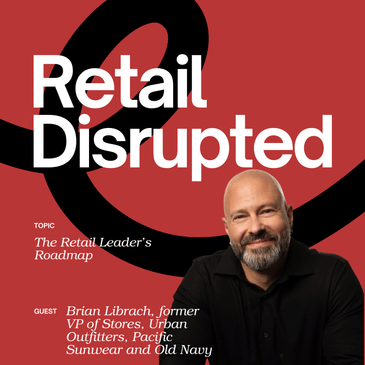

Brian Librach, former VP of Stores at Urban Outfitters, Pacific Sunwear and Old Navy, joins Natalie to discuss his new book: The Retail Leader's Roadmap. They explore:
- Why retail leaders get stuck and how to rewrite your career outcome.
- The evolution of bricks & mortar retail – what is the future of stores and how should we be measuring success?
- Which brands does Brian admire and what are they getting right?
- How can retailers ensure their staff are motivated and engaged?
- Cultural shifts: digital transformation journeys and the importance of taking your people with you.
- Upskilling and investing in digital competencies.
- Squiggly careers: why the path to success isn't always linear.
- Natalie and Brian debate the key traits of winning retailers.
Brian's bio:
Launching his career at the young age of 21, Brian quickly established himself as a District Manager, rising to become a Regional Director by 25, a Director of Stores by 35, and the VP of Stores for Urban Outfitters at 38, running operations in the US and Canada. Since then, he also served as VP of Stores and Operations at Pacific Sunwear, as well as most recently running stores internationally in Canada for Old Navy.
Links:
Brian's book on Amazon UK
Connect with Brian on LinkedIn
Register for Natalie's live webinar with Rethink Retail and Diebold Nixdorf on May 28, 2024
Learn more about Natalie's services: NBK Retail
[00:00:06] You're listening to Retail Disrupted, a podcast that explores the latest industry
[00:00:11] developments and the trends that will shape how we shop in the future.
[00:00:16] I'm your host, Natalie Berg.
[00:00:19] I am thrilled to have Brian LeBrock joining me on the podcast today.
[00:00:34] Brian started his career in retail at just 21 years old and quickly worked up the ranks
[00:00:39] to become Vice President of Stores for Urban Outfitters.
[00:00:43] Since then, he's also served as Vice President of Stores and Operations at Pacific Sunware.
[00:00:49] And most recently, he ran Stores internationally for Old Navy.
[00:00:54] Brian is passionate about helping retail teams to improve their performance and he has
[00:00:58] a new book out on this very topic.
[00:01:01] It's called the Retail Leaders Roadmap.
[00:01:04] Take control of your career, unlock your potential and drive toward retail leadership success.
[00:01:10] Now, we're going to welcome Brian onto the podcast in just a minute.
[00:01:14] But before we do that, I wanted to let you know about a live webinar that I'm hosting next
[00:01:18] week.
[00:01:19] It's a rethink retail webinar with the retail technology company, Deepold Nickstorf.
[00:01:25] We're going to be talking about retail mobility and how brands are embracing this technology
[00:01:30] not only to elevate the customer experience, but also to solve problems, things like
[00:01:35] addressing the workforce shortage or improving productivity.
[00:01:39] So we're going to be looking at mobile self-scanning trends.
[00:01:42] We're going to talk about some of the challenges, things like retail theft.
[00:01:46] That's a hot topic as we all know.
[00:01:49] And we're also going to be looking at the opportunities and where we see things moving
[00:01:52] in the future.
[00:01:53] So things like direct payment, for example, as in you won't even need to visit a dedicated
[00:02:00] tail in the future, but we'll be making payments within the device.
[00:02:06] Because like real-time personalization, that is very much the direction to travel.
[00:02:10] And also, you know, maybe using these devices to help retailers become more transparent
[00:02:15] with their ESG data.
[00:02:17] So there are a lot of opportunities.
[00:02:18] There's a lot of different aspects for us to explore.
[00:02:21] I think it's going to be a great conversation.
[00:02:23] It's a free webinar and we want it to be interactive.
[00:02:27] So if you want to join us and get involved in the conversation, the webinar is going
[00:02:32] to be on Tuesday, May 28th at 3 p.m. UK time or 10 a.m. Eastern time if you're in the
[00:02:39] US.
[00:02:40] I'll include the registration link in the show notes or you can head over to the Rethink
[00:02:44] retail website for more information.
[00:02:47] Okay, without further ado, let's get on to our main conversation today and welcome Brian
[00:02:53] LeBrock to the podcast.
[00:03:00] Brian, it's so great to connect with you and have you on the podcast today.
[00:03:04] You have been all over my LinkedIn feed over the past few weeks.
[00:03:07] So it's great to get you on the show and hear firsthand about your new book, about your
[00:03:14] retail experience and also to get your general observations on what's happening in the industry.
[00:03:20] So we have a lot to get into.
[00:03:23] But first tell us a little bit more about you and your background in retail.
[00:03:27] Yeah, Natalie.
[00:03:28] Thanks for having me on as well.
[00:03:29] I'm excited.
[00:03:30] Yeah, so I'm 35 years in the business.
[00:03:32] 3.5 decades, you know, I started at the age of 12 years old working paying taxes in the US,
[00:03:37] which I shouldn't have been able to do.
[00:03:39] But I did and been doing it ever since.
[00:03:42] You know, my father was a retailer.
[00:03:43] My grandfather was a retailer.
[00:03:44] So it's it's lineage.
[00:03:46] It's in my DNA.
[00:03:47] It wasn't an accidental career choice.
[00:03:49] I knew what was what I was going to do and I had a clear roadmap.
[00:03:54] You know, and that's why I wrote this book 35 years later is because I don't believe
[00:03:57] the roadmap exists in the way that it did for me 35 years ago because I knew exactly how
[00:04:01] to get where I needed to get to based on my father and based on my grandfather.
[00:04:04] So that's what this book is about.
[00:04:06] Retail lose roadmap is a way for me to share those three and a half decades and
[00:04:11] you know, make sure that it's very relatable for folks so the people can realize what
[00:04:15] their potential is and get to where they want to get to.
[00:04:18] So let's talk some more about your book.
[00:04:20] The first thing I want to say, Brian, is congratulations because I know it is no easy
[00:04:25] feat to write a book, right?
[00:04:27] So yeah, congratulations.
[00:04:29] It's a labor love for many of us that have fit for in books and I hope that you're
[00:04:34] taken some time to celebrate the launch and all the hard work that I'm sure it took
[00:04:38] to get you to this point.
[00:04:39] So congrats.
[00:04:40] Thank you very much.
[00:04:41] So let's talk a little bit more about the book.
[00:04:43] What led you to write the book and what do you want the industry to take away from
[00:04:47] it?
[00:04:48] Well, I mean, I've been in the business like I said three and a half decades and things
[00:04:51] have changed, right?
[00:04:52] Evolution things have evolved and the generalist in a lot of cases has a lot more on their
[00:04:58] plate than they once used to have and a lot less support.
[00:05:01] And so I believe that maybe 20% of leaders out there take the time to actually invest
[00:05:06] in people and that's not a good number.
[00:05:08] Some cases it's because they don't care but a lot of cases it's because the scope is
[00:05:12] gotten so big that they're just doing the best that they can to keep their heads above
[00:05:15] water.
[00:05:16] And so I believe that the employee, whether you're a specialist or a generalist or a leader,
[00:05:22] now is a bit more of an independent contractor.
[00:05:24] It's the loyalties that used to exist don't exist anymore.
[00:05:28] And so an independent contractor has to build their own brand and they have to learn and
[00:05:32] develop the skill sets themselves and they have to use resources to be able to do that
[00:05:37] mentors.
[00:05:38] They have to follow the right people and they have to use internet whatever it might
[00:05:41] be that's going to help them get what they need.
[00:05:43] And so that's what this book is meant to do.
[00:05:45] It's a way for me to hopefully not hopefully it's a way for me to positively impact
[00:05:49] more people than I could working for one organization, whether that was Gap Ink or whether
[00:05:54] that was Urban Outfit or Pack Sun.
[00:05:56] And like what we're doing here, impact folks in multiple different countries.
[00:06:00] And I believe that anybody who reads this book, cover to cover will understand what it takes
[00:06:06] and then use this book as a diagnostic tool when they're struggling to get on stuck.
[00:06:11] I believe the information is in there and over the next few years as new information becomes
[00:06:16] available, we'll update it to make sure that it's current as well.
[00:06:20] Right.
[00:06:20] And I want to ask you specifically about upscaling.
[00:06:23] Do you think retailers today are doing enough to invest in their staff both in terms of
[00:06:28] kind of general training but also in terms of investing in digital competencies?
[00:06:33] No, I don't.
[00:06:34] I don't.
[00:06:34] I think, you know, my wife and I run a company called The Well Wish or Company and we
[00:06:39] like to refer to ourselves as we're in the people productivity business and there's no
[00:06:43] conversation about people productivity.
[00:06:44] It's all about gender, AI.
[00:06:46] It's all about tools.
[00:06:47] It's all about resources.
[00:06:48] It's finding ways to do more with less.
[00:06:50] Again, I'm an operator.
[00:06:52] I completely get it and I think it's going to help because I think what's going to happen is
[00:06:56] as these tools evolve, the small minor things that people are spending a ton of time on.
[00:07:01] They won't have to anymore and they can really lean into solving problems but people aren't
[00:07:06] paying attention to the productivity that simply people being engaged can deliver.
[00:07:11] And I believe people are given 60% right now, maybe 70%.
[00:07:14] It's not because they're not working harder than not trying.
[00:07:18] They're just not emotionally connected to the work any longer in most cases and so they're
[00:07:22] rationally committed to the work.
[00:07:24] They get a paycheck and they give the very best that they can at the time but they're just
[00:07:28] not embracing it the way that they need to.
[00:07:31] So to me, it's about finding a way to engage people and teach them the technology that's
[00:07:38] needed because obviously we're all going to have to continue to learn more about that.
[00:07:41] But spending time on really knowing how to communicate with folks and how to influence folks
[00:07:45] to be the very best that they can be.
[00:07:46] I think that's going to be a game changer and that's what I'm sitting out to try to
[00:07:50] influence the best that I can.
[00:07:53] Now, why think one of the brilliant and probably very unique things about this industry
[00:07:58] is that you can legitimately start out on the shop floor, stocking shelves.
[00:08:02] And then with enough hard work and determination, you can go on to become CEO of a business.
[00:08:07] And I think that is pretty special about retail.
[00:08:10] But as you say, retail has become less attractive as a career option and it is a problem
[00:08:15] for the industry.
[00:08:17] So I think retailers are having to work really hard to attract and retain talent.
[00:08:21] And I'm curious to know, maybe you've addressed it in the book or maybe you just have some thoughts
[00:08:25] on it more generally, but aside from financial incentives, which is a good place to start.
[00:08:31] How else can you ensure that you got a motivated workforce?
[00:08:35] Is it granting more flexibility?
[00:08:38] Is it giving store managers or staff the autonomy to make decisions at the local level?
[00:08:45] Is it about being rewarded in different ways?
[00:08:48] What can you do to ensure that your staff are feeling empowered and engaged?
[00:08:52] Yeah, I think everything you just mentioned is important.
[00:08:54] I think pay is of course important, but it's never the main reason why people leave jobs in every survey you take.
[00:09:00] You hear that?
[00:09:01] The number one reason I think and what I notice in every survey that I've ever been a part of is it's their leader.
[00:09:07] If you're leading well and you're observing and you're paying attention and you're giving feedback.
[00:09:12] If people are growing, they're going to be engaged.
[00:09:16] And to grow people, it's not easy.
[00:09:19] If it was easy, everybody would be doing it.
[00:09:21] You have to pay attention, you have to observe, you have to get out of the office.
[00:09:24] You have to be in front of people.
[00:09:26] You have to witness what they're doing so that you can give them examples of what they are doing well
[00:09:30] so that they do more of it or examples of what they're not doing well so that they can course correct it.
[00:09:35] But that's not happening at the rate that it should be.
[00:09:38] From what I can tell, people have followed me when they're growing, when they're developing
[00:09:43] and they feel like they're doing their very best work.
[00:09:47] And I know that that's who I've worked for, like when I'm developing it, when I'm growing.
[00:09:51] So to me, that's the key. Yes, flexibility is important.
[00:09:54] You know, letting people make sure people own the business.
[00:09:57] You know, the whole conversation around Gen Z and Gen Alpha is they need to feel like they have a hand in the way the company operates.
[00:10:03] So I think all of those things are important.
[00:10:06] But at its core, people need to be present.
[00:10:09] Leaders need to be present and they need to be paying attention and they need to be able to
[00:10:12] in the book I talk about, like see it say it, both positive and negative.
[00:10:16] And negatives, maybe I shouldn't say negative. Criticism or corrective criticisms,
[00:10:21] they have to be willing to be on the floor whether that be walking around the office and talking to folks.
[00:10:26] Now, that's a whole nother challenge because nobody's back at the office either.
[00:10:30] But I think the new way that we're operating today is going to require people to think differently about how they can observe and get feedback.
[00:10:37] That's so interesting. You've touched on a lot of points that I want to come back to,
[00:10:41] including this idea of execs on the shop floor and getting closer to customers and experiencing what they experience.
[00:10:48] And all that's what we are going to come back to that.
[00:10:50] I want to touch on something that you mentioned,
[00:10:53] though, which you sort of alluded to, this idea of squiggly careers,
[00:10:57] which I have had a squiggly career.
[00:11:00] You know, I worked really hard in my 20s and 30s.
[00:11:02] I then very predictably had a baby, took some time off in the UK.
[00:11:07] You get a whole year off, so I took a lot of time off.
[00:11:10] And then kind of came back to work and tried to work part-time
[00:11:14] and then have one day a week writing a book, I was writing my Amazon book
[00:11:18] and then have one other day a week, so we're at a third day now.
[00:11:21] And then on Fridays, I had a day off to be with my son.
[00:11:25] Now, I wasn't doing anything particularly well when I was trying to do all of those things
[00:11:30] and it actually brings up an important point. So I want to come back to focus and how it relates to retail
[00:11:35] in a little bit, but I guess just this idea of squiggly careers.
[00:11:39] I know you've been very open about making lateral moves throughout your career
[00:11:43] and even accepting emotions in order to ultimately get ahead.
[00:11:47] So can you talk us through this and what you've learned along the way?
[00:11:51] Yeah, I mean, the biggest, the one-demotion I took,
[00:11:54] I took a huge pay cut and went from running 100 stores to run an eight stores,
[00:11:58] I think, and moved 3,000 miles away, but it was because it was for a company
[00:12:01] that I wanted to work for and a person that I wanted to work for.
[00:12:03] And I had confidence that if I, if I basically did the pillars that are in this book,
[00:12:08] I knew I'd be right back where I needed to be in a relatively short period of time.
[00:12:11] It thankfully I was. But the whole idea of like, you know, talk about like focus and whatever it might be,
[00:12:18] you know, whatever you're doing at that present moment and I know that's kind of a kitschy phrase.
[00:12:22] You have to give it its attention. So even like you just mentioned,
[00:12:25] if Thursdays all about your son then you have to put the phone away and that's it.
[00:12:28] I'd be phenomenal at Thursday with your son and be phenomenal at Friday with whatever that might be.
[00:12:34] I found that to be the way that I can prioritize. I talk a lot about prioritization in the book,
[00:12:39] because people have a hard time doing it because if you prioritize something,
[00:12:43] you have to depriorize something and that's what people don't want to do.
[00:12:47] So when I decided to make the change or take the emotion or take the ladder removed,
[00:12:53] I had to feel confident that I would do the work necessary to get back to and then further along.
[00:13:00] And put my ego and check my ego with the door, which is not an easy thing to do.
[00:13:06] But what I'm finding at least in the industry today, so many more people are
[00:13:11] taking positions that are in a later lateral or completely different within retail.
[00:13:16] Right? Go from operations to be an allocator to being back in the field, whatever that might be.
[00:13:21] And that spider webbing, if you will, helps them because ultimately they're taking in all these inputs.
[00:13:25] And they're going to have a more broad skill set.
[00:13:28] Interesting. I want to talk about culture and this idea of bringing your people with you.
[00:13:33] And obviously we're in a period of profound structural change.
[00:13:37] And I feel like I've been using that phrase for at least 10 years now. But it's true, right?
[00:13:41] There's just so much change in this section.
[00:13:43] Now earlier this year, I chaired the tech and digital stage at retail week live.
[00:13:48] This is one of the biggest retail events on this side of the pond.
[00:13:53] And one of our speakers was Ben Fletcher, who is the CFO of the very group,
[00:13:59] which is a big online fashion retailer.
[00:14:01] And he talked about their digital transformation journey and all of the tangible metrics that that entailed.
[00:14:09] But he said that the hardest thing was actually the cultural shift because it's so tricky to measure.
[00:14:16] It takes longer, but it's so critical to get your people on board.
[00:14:21] So I'm curious, I'm curious Brian, what's your experience Ben Lake?
[00:14:26] Or what are some kind of general observations that you might have
[00:14:30] having been part of large retail organizations during this period of so much disruption?
[00:14:36] What have you observed in terms of cultural shifts?
[00:14:39] Yeah, yeah. I think the catch phrase for quite a few years was change management.
[00:14:45] I keep hearing it and I think that is what's happening right with the cultural shifts.
[00:14:49] I think two things have to be prevalent. There has to be trust,
[00:14:53] and there has to be an openness to learn.
[00:14:55] And when you have an openness to learn, you're willing to try out new things.
[00:15:01] And that's what a new culture is. It's operating differently.
[00:15:04] And if you trust your leaders, so if you trust the company, then you trust that it's going to work out.
[00:15:10] And if it doesn't work out, you trust that they'll shift. But when you don't trust your boss,
[00:15:14] and you don't trust the company, you're not going to change. You're not going to be open to it.
[00:15:18] And if you're not open in general, you're not curious, obviously even if you trust people,
[00:15:22] you're not going to be open to what new changes is coming about.
[00:15:26] I joked earlier about the conversation for a lot of years.
[00:15:29] My father says it, his father said it like this younger generation, right?
[00:15:32] Like it's like no, it's evolution. Every generation has been fine, right?
[00:15:35] They've all found their way. But I think people get stuck, and they get in this,
[00:15:40] they get in their head, and their ego's getting away. And what I'm finding with smaller organizations is
[00:15:46] obviously it's easier for them because they have 5, 10, 15 or 20 stores, or they're just starting out with brick and mortar,
[00:15:51] and they've been doing it online only. And there's a lot of those companies that are starting out that I think
[00:15:57] are going to be the most nimble. It's the big companies that have 50,000 employees
[00:16:03] and 1,000 stores or 500 stores that are going to have the harder time because they've got a much
[00:16:08] bigger ship to turn around. And that is going to take more time. And trust isn't paramount right now
[00:16:16] in organizations and leaders don't have the time to connect the way that they really should.
[00:16:21] So that's what I think is making it a big challenge today for the bigger companies.
[00:16:25] I think a lot of the smaller companies are going to win because they're going to have the ability to be nimble.
[00:16:30] Yeah, just that little bit more agile than some of the the big retail super tankers.
[00:16:34] Now Brian, you ran store operations for a number of big US retailers. Do you think that the
[00:16:40] industry's perception of bricks and mortar has evolved in recent years? And also I guess as a follow-up
[00:16:46] to that what more do you think can be done to ensure that physical stores stay relevant for shoppers today?
[00:16:52] Yeah, I mean, obviously COVID created a very different environment and obviously online
[00:17:00] was you know the online business was projected a continue to grow and then with COVID it
[00:17:03] obviously skyrocketed and then kind of settled down a little bit now all the sudden brick and
[00:17:07] mortar matters again. You know it's one of those things where in retail I find that people swing the
[00:17:12] pendulum so harsh in one way or the other. So it's all about online or it's all about brick and mortar.
[00:17:16] It's never like 51 49%. And that's the reality of where it should be. Whether it's 6040 or 7030
[00:17:23] but there's a blend and I've yet to see a company do really good, do a really good job at making
[00:17:29] it all work and everybody get along and play on the same team right? There's the online team and
[00:17:33] there's the brick and mortar team and with ship from store and all these different incentives
[00:17:38] out there that store teams have to do to help support online and vice versa. That's the challenge.
[00:17:43] And I think the companies that can figure out how to make it feel like your one team,
[00:17:48] those are the ones that I think are going to win. And that's also I think the smaller teams
[00:17:51] are going to have a better chance at it because they're smaller and they're more nimble and they
[00:17:54] get to again interact and engage I think more effectively. But brick and mortar is going to
[00:17:59] it's going to matter you know in a lot of cases it's more of a showroom. You know I remember years ago
[00:18:05] when I was urban alpha leaders we closed the store and met Hatton and we saw our online business
[00:18:10] dropped dramatically within that zip code because we no longer had a showroom.
[00:18:14] So although we might have been losing money in that location, we ended up losing more money
[00:18:19] because we shut it down and we lost the customer that was going online in that area.
[00:18:22] So there's this understanding of the balance of its importance. In some cases it's going to drive
[00:18:26] ROI and put money on the you know it's going to put money in the bank. In other cases it's going to be
[00:18:30] a marketing tool that you have to pay attention to from the online side of things. So it's the relationship
[00:18:36] between the two that matters. Yeah it's that all kind of elusive halo effect right where having a physical
[00:18:42] presence actually does drive online sales. It's counter intuitive as I might sound. It's a
[00:18:47] video so interesting and now you know the new industry buzzword is unified commerce we've sort
[00:18:53] of gone from multi channel to omnichannel to unify commerce and I think it's you know as an analyst
[00:18:59] it's just so fascinating seeing how it's evolved and at the end of the day I guess it is just
[00:19:03] shopping right it's just that it's getting easier and more relevant, more seamless, more personalized.
[00:19:07] So as retailers you know a lot of hard work happening in the in the background to deliver that
[00:19:12] that seamless experience but um right let's continue with the theme of stores and I want to ask you
[00:19:20] about how we measure how we measure success in a physical store setting because we think about
[00:19:27] traditional KPIs things like same store sales growth sales densities you know we know that these
[00:19:33] traditional metrics are just no longer relevant they don't reflect the way that we shop.
[00:19:38] As we just said today we shop on our terms we might not go into a store to buy something but we might
[00:19:43] go in because we want that showroom experience who want to touch and feel the product or try it on
[00:19:48] or talk to a member of staff, et cetera so I'd love to know how do you think we should be
[00:19:54] measuring a store success today do you think we should be looking at things like staff satisfaction
[00:20:01] customer 12 time what percentage of online orders are collected or returned in store so I love to
[00:20:08] get your thoughts around this and and I guess it's sort of reflective of how we're seeing the overall
[00:20:13] role of the store evolving as well so over to you Brian what do you think?
[00:20:18] Yeah you know it's interesting because I remember what quite a few years ago when I was with
[00:20:23] Gapink there was an attempt to incentivize folks based on purchases being done within the zip code for
[00:20:30] example so it wasn't you weren't just incentive on whether they purchase in your store you were
[00:20:33] incentive on whether or not they went home jumped online and bought something because maybe they
[00:20:37] experienced something in the store and so it just it didn't work in the way that it was very difficult
[00:20:42] to track you know and teams really didn't know whether or not it was working and so you know in
[00:20:47] retail we tend to be I like it to we have a need for instant gratification most people that have chosen
[00:20:53] this profession especially those that are in stores and so the challenge of the way that we
[00:20:58] probably need to incent folks is that it's not immediate and it takes some time to really understand
[00:21:04] its impact you know dollar per square foot's always been a favorite one of mine but to your point
[00:21:09] you know the nowadays that's not necessarily the case because there has to be an understanding of
[00:21:13] the online component you know yeah there has to be and so at the end of the day if the store
[00:21:19] or the zip code or the area code we had where we want to look at it if this if there's
[00:21:23] if money is not making it into the bank that's going to be the problem and profitability is not
[00:21:28] talked about in a lot of cases at the store level and some companies do a really good job
[00:21:32] of making sure that store leaders understand the profitability of their store and some companies don't
[00:21:37] even want the regional directors to pay attention to it because they feel like all they should
[00:21:41] be doing is executing but at the end of the day the profitability of a space is paramount
[00:21:48] because if you can't pay the bills and you can't pay the mortgage or the rent and then you can't
[00:21:52] you can't run the business so I think it's about teaching people how to be business owners
[00:21:57] but even that it's tough because you may lose money in your store but yet it's still benefits
[00:22:01] the company because of the online side of things and so how do you share that information as well
[00:22:05] and that's where I think that relationship again is so critical and I don't know that I've seen
[00:22:09] many people figure it out okay so let's shift gears a little bit and talk about winning retailers
[00:22:15] retail is incredibly bifurcated right now there is this growing disparity between the winners and
[00:22:20] the losers but some retailers just keep getting it right and are thriving despite all of this disruption
[00:22:27] are there any retailers or brands out there that you admire Brian and what is it that they're
[00:22:34] getting right? Yeah it's interesting because I personally like the shop on Abbeckany and Venice Beach
[00:22:38] or you know, Asington and Toronto so like those are the types of streets I like to shop
[00:22:42] and it's a lot more smaller you know in a lot of cases what was considered DTC companies or
[00:22:47] things that nature but like Viori is a good example of a company that I enjoy. I was on Abbeckany
[00:22:52] a couple months back and they were the busiest store on the block and I mean busy by 10 times
[00:22:57] everybody else and so there's this bit of this like atleast not at leisure so much for me but
[00:23:03] it is comfort but fashion at the same time I think has been huge. Farty is another company that's
[00:23:08] kind of I think they have 25 or 30 stores in the US and they're starting to expand outside of the
[00:23:12] US again the quality of the product is really top notch but the experience you know the experience
[00:23:18] online is great the experience and the store is great the employees are engaging you know they have
[00:23:24] a staff that's the other thing like if I walk into a Farty or Viori there's a staff
[00:23:29] and I don't know how they're covering the payroll but there's a staff and hopefully they are
[00:23:33] so they stay in business but it feels good to have that level of engagement whereas most retailers
[00:23:38] I walk into today the tables are disheveled because there's nobody there to maintain it as well
[00:23:43] let alone right interact or engage with you when you're in the fitting room so I think it's this
[00:23:47] interesting balance of you know if you have the right product you could price it right so your margins
[00:23:52] are good you can have payroll to be able to take care of your customer. The flip side is the value players
[00:23:58] are still doing exceptionally well in the US right the dollar store TJ Maxx Ross that they're doing
[00:24:04] exceptionally well um again obviously given the economy there's there's there's an interest in folks
[00:24:09] having you know the disposable income for other things but yeah for me I'm inspired by those
[00:24:16] smaller companies that have found a way to create amazing product drive really good margin and
[00:24:21] creative great experience in store. Yeah and I think that just shows that the you know the
[00:24:26] fundamentals of retail actually haven't changed at all you still need to have a good product you
[00:24:31] still need to offer a good experience or good service and I would argue you probably it's probably
[00:24:35] even more of a need to do that now in this digital era where we can just get anything we want online so
[00:24:41] if we're going to come into a store you really got to give someone an experience and that I
[00:24:45] hope this whole idea of like mediocre service I mean customers just don't tolerate it anymore
[00:24:50] and it just takes one mad experience so yeah really really interesting examples that you call
[00:24:54] out there I'd like to stick with the theme of winning retailers and I'm gonna just gonna share
[00:25:02] what I think are four key traits of successful retailers and I'd love to get your reaction Brian
[00:25:07] and here and feel free to disagree a little bit debate so we should get on the podcast.
[00:25:12] So I think we think about successful retailers we've already touched on this this idea of focus right
[00:25:17] this idea that you have to know what you stand for, have a clear identity,
[00:25:22] differentiate in what it is an incredibly crowded market and then you have to exit really well.
[00:25:28] I think the second thing is having a culture of perpetual innovation so this idea that you can never
[00:25:34] stand still in retail that you've got to keep moving the agile Amazon I think you know is a great
[00:25:41] example of a retailer that is relentlessly dissatisfied with the status quo and interesting we're
[00:25:48] actually starting to hear at least here in Europe we're starting to hear more mainstream retailers
[00:25:54] taking on that mentality so MNS you know big clothing and food retailer here in the UK they
[00:26:00] now talk of being positively dissatisfied as it's a word the phrase rather that they're CEO users
[00:26:06] so really interesting to see that shift. The third thing for me customer centricity it's a
[00:26:13] it's a broad kind of fluffy term but I think a lot of retailers think that their customer
[00:26:19] centric but actually aren't always so customer centric but yes yeah just this idea that you
[00:26:27] start with the customer and then you work backwards there's no ivory towers you know more and
[00:26:32] more we're starting to see retailers requiring their head office staff to spend time in stores
[00:26:39] car for and Spain and more since in the UK are actually bringing customers into their management meetings
[00:26:45] and the CEO of car for his bonus is partially indexed to its NPS score so really really interesting
[00:26:54] stuff happening and then very briefly the last thing and I think you'll agree with this one is that
[00:26:59] happy staff equals happy customers so adopting this employee first mentality and again just to kind of
[00:27:06] reiterate this idea that shoppers don't tolerate mediocre service or mediocre experiences so
[00:27:12] that's kind of my like when I'm out talking to clients are giving presentations that that's my
[00:27:17] framework that's what I think retailers need to be striving for but what do you think Brian I'd
[00:27:21] love to get your take especially around the kind of happy staff equals happy customers to it
[00:27:26] yeah yeah I just made I wrote all those downs so I have the notes I think what's interesting
[00:27:29] about the focus and execution part of the conversation that you had is I think it's I think price
[00:27:34] I think price is extremely important and people understanding where they need to be and I feel like
[00:27:39] you either at least for when I can tell in the US you're either higher low and that you know and
[00:27:43] it's a bit I hate to say but it's also class in general like the middle class you know doesn't
[00:27:47] exist anymore you're either you either wealthier you're not wealthy and then that's the saturday
[00:27:50] ality of what we hear about I think pricing is similar you know you can't be in the middle
[00:27:56] your value player in my opinion or your catering to somebody who has more disposable income
[00:28:01] and how do you stick with your lane so that you build your reputation right and then I use
[00:28:06] viory or fardy as an example I don't ever see them on sale like their their price regular price
[00:28:11] and that the great quality and yet then there's the dollar store or tgmax where you know you're
[00:28:16] going to get value so I think the folks that win with focus and attention win with the right pricing
[00:28:21] strategy. I think the innovation for me I think it's fun to talk about it in stores but I think
[00:28:28] it's a lot more important to talk about when it comes to distribution and supply chain and
[00:28:32] the channels behind the scenes they get product to you faster and more efficiently so that the
[00:28:37] store teams districts regions whatever their job is easier because of how things happen behind
[00:28:44] so they can actually engage and spend all their time and energy on the customer. So I think it's
[00:28:49] tricky but I think companies have to really understand where to invest in innovation and I don't know
[00:28:55] that a mirror that tells me if I look appropriate or not and I could buy that I don't know that
[00:29:00] that's going to do much for the industry for quite some time but I do know that if you can get the
[00:29:05] product delivered in such a way that it's already folded and it's there first before everybody else
[00:29:10] and it's easy to process that's going to help tremendously so I think those companies that are doing
[00:29:16] that super important and then you're coming about customer centric and then happy staff to me
[00:29:19] it's the same thing. I agree with you we think we're customer centric but we're not listening
[00:29:25] to the customer right product is being created because folks are listening to and reading the
[00:29:30] comments in social media and recognizing that people are asking for something in blue but it's only
[00:29:35] provided in black they make it in blue because the customer is so customer centric isn't just
[00:29:40] about what's happening in a brick and mortar space it really are you listening to what the
[00:29:44] customer is saying and by the way now more than ever customers telling you on social media through
[00:29:49] comments what it is that they like and don't like so it's about whether or not the whole industry
[00:29:54] is curious enough to be customer centric and then the happy staff I completely agree and that is where
[00:30:00] I think you're going to have a greater focus you're going to have better innovation right you're
[00:30:05] going to be more customer centric if you have a staff that is engaged if you have no if your
[00:30:10] staff is not engaged your innovation's going to be okay right like your customer centric approach
[00:30:16] is going to be just okay so that's why you have to start with people and the companies and teams
[00:30:23] so all the companies it have teams that are engaged with the ones that are going to win.
[00:30:30] Thank you for listening to retail disrupted if you enjoyed this episode and would like to support
[00:30:34] the podcast please leave a rating or review or share it with others it really makes a difference.