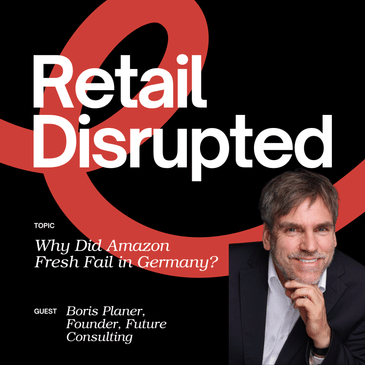

Boris Planer, Founder and Managing Director of Future Consulting, joins Natalie to discuss the news that Amazon is terminating its online grocery service in Germany.
They discuss:
- What went wrong for Amazon Fresh in Germany, what does this tell us about Amazon's global grocery strategy, and where next? (It's all about the partnerships.)
- Inherent challenges of grocery retailing in Germany. Did you know that 98% of German consumers live within 10 minutes of a discounter?!
- The Amazon Effect - how competitors have raised their e-commerce game.
- Implications for Amazon Fresh internationally. The news follows a similar move in the UK earlier this year when Amazon scrapped Fresh outside of London and Manchester.
- Why you need to know more about Rohlik, the Czech grocery delivery start-up that has just announced a partnership with Amazon and is aiming to launch in 10 European cities over the next 6 years.
The news was first reported by The Information.
Bio:
Boris Planer is a retail thought leader, speaker and consultant based in Frankfurt, Germany. He is the founder and managing director of Future Consulting, a consultancy supporting international retailers, suppliers and tech businesses in their efforts to spot trends early on and take new market opportunities effectively. Boris has 25 years of experience in retail insight and consultancy, including at retail insight group Planet Retail/Edge by Ascential and WGSN, the world's leading consumer trend forecasters. He is also a speaker at Zukunftsinstitut, the Institute for the Future based in Frankfurt and Vienna.
Connect with Boris on LinkedIn.
[00:00:06] You're listening to Retail Disrupted, a podcast that explores the latest industry developments and the trends that will shape how we shop in the future.
[00:00:16] I'm your host, Natalie Berg.
[00:00:29] On today's episode, we're going to be talking about the news that Amazon is terminating its online grocery service in Germany.
[00:00:37] Amazon Fresh launched in the German market in 2017.
[00:00:41] The service was available in three major cities, Berlin, Hamburg, and Munich.
[00:00:46] According to the information which first reported the news, Amazon will still play a role in the German grocery e-commerce space.
[00:00:54] But instead of delivering their own products, they're going to be focusing on delivering for their retail partners, Tagit and Rollik Group.
[00:01:03] And Rollik, if you haven't heard of them, they are an online grocer based in the Czech Republic.
[00:01:08] And we're going to talk about them a little bit later on in the episode.
[00:01:11] To help me break all this down, I'm delighted to welcome Boris Planner back to the podcast.
[00:01:15] Boris is a former colleague of mine.
[00:01:18] He's a friend.
[00:01:18] I've known him for nearly two decades now.
[00:01:21] And he is my go-to person for all things German retail.
[00:01:25] Boris, welcome back to the podcast.
[00:01:28] Yeah, Matt.
[00:01:28] Hello.
[00:01:29] It's good to be back.
[00:01:30] Thanks very much.
[00:01:31] It's so great to have you back on the podcast, Boris.
[00:01:33] It's like the old Planet Retail days when I was running the research team and you were the chief economist.
[00:01:40] And we used to meet up and have many great conversations about all things global retail.
[00:01:45] So it's a real throwback to those days.
[00:01:47] And I'm excited to get your views on Amazon.
[00:01:51] And it's so timely because we had a catch up last week and you kindly offered during our call, you kindly offered to come on the podcast as and when anything interesting happened in the German retail space.
[00:02:03] And literally the next day we heard about Amazon shutting down its online grocery service.
[00:02:07] So very, very timely.
[00:02:09] And I am looking forward to discussing this with you.
[00:02:12] Now, you are based in Frankfurt.
[00:02:14] So maybe you never had the opportunity to test the Amazon fresh service.
[00:02:19] But with your analyst slash economist hat on, what did you make of the offering?
[00:02:25] And I guess the second question to you, the obvious one that I think our listeners will most want to hear about is what is it that went wrong?
[00:02:33] Yeah, look, Amazon as an online player was active pretty much in a niche market.
[00:02:40] When they started Amazon fresh in 2017, the market got a bit nervous.
[00:02:45] People thought they would go very big, very fast.
[00:02:48] It then didn't happen.
[00:02:49] And it had the positive effect of alerting everyone else and triggering some investment with mainstream grocers in online.
[00:02:55] So what went wrong?
[00:02:57] Probably Amazon overestimated the speed at which e-commerce would develop in Germany.
[00:03:02] And that's for several reasons.
[00:03:03] That's partly because of consumers.
[00:03:04] We can talk about that.
[00:03:05] It's partly about the lack of early willingness with mainstream grocers to take the risk and invest in online.
[00:03:12] Germany is a more risk averse market than other countries.
[00:03:16] But also, you know, the structure of the German retail market is quite different from other countries.
[00:03:22] So discounters, the Aldis and Lidls and the like, they have got a combined market share of 43%.
[00:03:28] 98% of the population can reach a discounter from their home within 10 minutes.
[00:03:33] So it's very difficult to save time shopping online when such, you know, affordable stores are so close to your home.
[00:03:40] And obviously, there is potential for online grocery in Germany.
[00:03:46] And the market share of online more than doubled from 3% to 7% since the pandemic.
[00:03:50] But that looks still pretty small compared to other markets like the UK where online, you know, better than me, but probably is close to 20% now.
[00:03:59] The long-term potential remains remarkable.
[00:04:01] But I think Amazon is understanding that the market isn't developing as fast as they were originally hoping to.
[00:04:08] Yeah, I think there is certainly an element of underwhelm in all of this.
[00:04:12] I think that perhaps the market hasn't grown just as quickly as maybe a lot of analysts and spectators had thought it would during the pandemic.
[00:04:22] There was a real feeling that this was an inflection point for grocery e-commerce.
[00:04:29] And I'm not talking specific to Germany here, but globally, it felt like this was going to be the thing that propelled e-commerce that would finally get people buying their groceries online.
[00:04:40] And, you know, as we've seen, especially in grocery, it turns out we actually like shopping in stores.
[00:04:49] So there's a lot to unpack there, and I don't want to dwell on that.
[00:04:53] Grocery e-commerce in the UK, if we look at penetration rates, it's actually even lower than 20%.
[00:04:58] I think it's hovering around kind of 11% to 13%.
[00:05:01] So, again, it shows even in one of the most sophisticated online grocery markets in the world, it's still, you know, kind of inching along.
[00:05:11] It's not, you know, I guess I always go back to the fact that if a pandemic can't propel us forward in terms of online grocery penetration,
[00:05:20] well, I'm not really sure what can.
[00:05:22] And, you know, that's a whole other topic for another time.
[00:05:25] I loved your point, Boris, just now about how 98% of German shoppers can reach a discounter within 10 minutes.
[00:05:33] I mean, that says it all, right?
[00:05:35] Yes, the discounters are trading on the concept of value.
[00:05:39] And, of course, value doesn't just mean low prices.
[00:05:42] It's that combination of price and quality.
[00:05:45] But there's also a convenience element here, and you can see why it's been hard for German grocers to compete with that.
[00:05:52] So I'd love to dive a little bit deeper here, Boris.
[00:05:55] You touched on something that we often refer to in the industry as the Amazon effect.
[00:06:01] And one thing we have to give Amazon credit for, even if they are shutting down their Amazon Fresh service,
[00:06:07] but I think one thing we have to give them credit for is igniting change.
[00:06:11] Because, you know, the industry, the rest of the industry scrambles to keep up with Amazon's innovations.
[00:06:17] And ultimately, the customer ends up benefiting.
[00:06:20] And you touched on the specifics of the German market.
[00:06:25] You know, the competition being tough, birthplace of Aldi and Lidl, so discount shopping being firmly entrenched, and the market becoming digitized.
[00:06:34] And I spotted a statistic from PwC.
[00:06:37] They said that 17% of German consumers now buy groceries online, which is twice as many as three years ago.
[00:06:44] And 32% of Germans would like to buy their groceries online in the future.
[00:06:48] So even though the discounters have such a strong presence, there is this growing desire to buy groceries in different ways.
[00:06:56] So I'd love to get your thoughts, Boris, on how you've seen the sector evolve, the online grocery sector.
[00:07:02] And obviously, COVID was a huge catalyst.
[00:07:06] But how have you seen it evolve?
[00:07:08] And to what extent do you think Amazon has played a role in driving this change?
[00:07:12] Yeah, I think Amazon has played a vital role in driving the change.
[00:07:16] Germany, as a typically risk-averse market, was dominated by retailers in the mid-2010s,
[00:07:22] who were hoping to probably not have to invest in grocery e-commerce too much because it's big investments.
[00:07:29] The profitability is doubtful.
[00:07:31] And German retailers, they tend to wait and see how the market develops, how consumers develop.
[00:07:35] And then suddenly, in 2017, Amazon makes the announcement to set up an online food shop in Germany.
[00:07:41] And that really woke up people.
[00:07:45] And now we've seen a number of really, really promising and good initiatives that probably wouldn't have developed as fast as they did without Amazon.
[00:07:53] So Rewe Online, for example, they are available in around 80 cities, I believe, now in Germany.
[00:08:01] And that covers a pretty big percentage of the German market.
[00:08:05] Rewe also has a stake in Flink, which was the winner of the big consolidation battle in Quick Commerce.
[00:08:10] And then Edeka, the grocery market leader, they're invested in Picnic, which is probably one of the world's or at least Europe's most promising e-commerce forecasts,
[00:08:22] which is also expanding fast now.
[00:08:24] So Amazon really helped to wake up a sleeping market and drive dynamics.
[00:08:29] And I think people are now at a point where they understand that e-commerce is going to be an important part of the future of retail.
[00:08:35] Currently, 7% market share, 17% of people shop online quite regularly.
[00:08:41] They don't shop everything online, but so the market share is probably around 7% now.
[00:08:46] But I think consumers, they don't ask which business model a retailer prefers to operate.
[00:08:52] They just shop in a way that is easy and convenient for them, like we did when we were 20 in not such a long time ago.
[00:09:00] So, and, you know, the digital natives, they are entering their prime spending years now.
[00:09:05] And with them, there's new shopping habits coming into the market, new ways of getting informed.
[00:09:10] Let's remember what a big share of purchases are probably happening in stores still, but are digitally influenced.
[00:09:16] And all the marketing and loyalty is becoming digital now.
[00:09:19] And then, you know, in a short while, Gen Alpha will become independent consumers and they are the first AI natives.
[00:09:30] So they grow up with artificial intelligence as a normal thing.
[00:09:33] So again, this will influence the way they get informed and make decisions and shop.
[00:09:38] And I believe online grocery has a potential of reaching perhaps 15% market share by the end of this decade.
[00:09:45] Just to go back to Amazon, I think Amazon's main problem with grocery is that it's not perceived as a credible food destination.
[00:09:55] I don't think shoppers tend to think of Amazon when they think of, you know, lettuce and apples and milk.
[00:10:01] So to what extent is that case in Germany?
[00:10:05] It's pretty much the same.
[00:10:06] So if you go and look at the online offer on the Amazon platform of Tegut and probably Knospa slash Rolex is going to look very similar.
[00:10:14] Well, that looks like the standard Amazon offer.
[00:10:17] And that is the contrary of inspirational.
[00:10:19] It really is designed to almost scare off people.
[00:10:22] I would say it's so terribly transactional.
[00:10:24] And you need to understand what you want before you even start shopping.
[00:10:29] You want bananas.
[00:10:30] You enter bananas as a search term.
[00:10:32] But, you know, there's very few areas where you can actually explore and get inspired and then perceive shopping as something that is fun and entertainment.
[00:10:39] And then you do a lot of surprise purchases that you weren't planning to do before.
[00:10:43] I think there's a lot to learn from Asia where e-commerce from the start has been designed as a pastime activity that's entertaining.
[00:10:50] And Amazon is looking so transactional.
[00:10:53] And I think what's been catching up with Amazon, not least in grocery, which is such an experiential category,
[00:10:58] what's been catching up with Amazon is the fact that people have higher expectations now on how fun shopping should be
[00:11:04] and how inspiring it should be, how easy it should be to navigate through aisles to discover new things.
[00:11:12] And I sometimes wonder why can't online shops really visually replicate a physical supermarket where people virtually can walk around
[00:11:18] and there's big opportunity for the next generation of technologies here.
[00:11:22] Amazon looks a bit, you know, 2010s, I would say.
[00:11:27] A little bit dated.
[00:11:28] Yeah.
[00:11:30] Yeah, yeah, yeah.
[00:11:30] And I think as a consumer, you are naturally pulled to alternative offers, I would say.
[00:11:36] Yeah.
[00:11:37] And I mean, I would, I would, I agree with a lot of what you just said, but I would also counter that and say that I think with food shopping,
[00:11:44] that yes, it would be nice for it to be a little bit more experiential and feel a little bit more native, I guess is the right word,
[00:11:53] where you're walking through a kind of digital supermarket.
[00:11:56] And I'm pretty sure Walmart experimented with something like this and, you know, what kind of role, I don't know,
[00:12:02] the metaverse might play or some, some form of the metaverse.
[00:12:05] So it's just a little bit more intuitive for the shopper.
[00:12:07] But I'd also make the case that I think with food shopping, food shopping is habitual.
[00:12:12] We buy the same stuff week in, week out.
[00:12:15] It's non-discretionary.
[00:12:16] We all need to eat.
[00:12:17] So I think in that sense, transactional isn't maybe as bad as it might be for non-food shopping.
[00:12:24] I think that with grocery retail, there is a real opportunity to take the chore out of food shopping.
[00:12:30] And I think there's also a huge opportunity to provide more recipe inspiration.
[00:12:36] We're certainly seeing a lot of that with generative AI.
[00:12:38] From Amazon's perspective, there is an opportunity for them to disrupt the status quo.
[00:12:44] I think the fact that they have terminated their Amazon Fresh service in Germany,
[00:12:51] and they have also scaled this back in the UK.
[00:12:54] So earlier this year, I'm not sure if you're aware of this, Boris, but earlier this year,
[00:12:57] they scrapped Amazon Fresh in five cities in the UK.
[00:13:03] So Glasgow, Portsmouth, Sheffield, Leeds, and Newcastle.
[00:13:07] And that service had been trading for a similar amount of time as the one in Germany.
[00:13:12] They're still offering Amazon Fresh to shoppers in London and Manchester.
[00:13:15] So I think it's interesting that after kind of seven, eight years of testing grocery e-commerce,
[00:13:22] that they've decided to make such significant changes.
[00:13:24] And I think it gives us an indication of where they see the opportunities going forward.
[00:13:29] Because at the end of the day, Amazon is a tech company,
[00:13:31] and their USP isn't selling apples and bananas.
[00:13:35] It's licensing their technology to other retailers, in this case, within grocery.
[00:13:41] I really think that, you know, we've said for a long time that at some point,
[00:13:44] they're going to have to make the decision as to whether they want to be a grocery retailer
[00:13:49] or they want to be the rails that the grocery retailers run on,
[00:13:53] that they want to be the infrastructure.
[00:13:55] So, I mean, there's lots to unpack here.
[00:13:57] But I think it's interesting, the partnerships that they've had
[00:14:00] and how that's really going to be their focus.
[00:14:02] So in the UK, you know, they have storefronts for Morrison's, Coop, Iceland.
[00:14:06] And there's always been on and off rumors about Waitrose potentially coming on the platform.
[00:14:12] They also sell products from Booths, which is a northern British grocer.
[00:14:17] So partnerships are really important.
[00:14:18] And I think that helps them achieve that kind of credibility
[00:14:21] and also helps them learn a lot about selling groceries online.
[00:14:25] So it'd just be interesting, I guess, like with their partnerships in Germany.
[00:14:30] I don't know.
[00:14:30] Do you think that more German grocers might be more willing to partner with Amazon
[00:14:36] now that they're no longer a competitor?
[00:14:38] I think so.
[00:14:39] I think that's possible.
[00:14:40] And mainly if we look at the Tier B and Tier C of more regional retailers,
[00:14:44] there are some partnerships in place already.
[00:14:46] For example, Amazon has this online partnership with Teegut
[00:14:50] and Teegut is going to continue to sell fresh food.
[00:14:53] Amazon itself is going to limit itself to dry groceries.
[00:14:56] But through their partnership with Teegut,
[00:14:58] people will still be able to buy fruit and veg from Amazon.
[00:15:01] And then they have a partnership in place with Bünding,
[00:15:04] which is a regional retailer from northern Germany.
[00:15:07] They buy private label from them, economy private label,
[00:15:09] because they found out the German market is so price competitive
[00:15:12] and price is so important to consumers here
[00:15:15] that they need entry-level private labels.
[00:15:19] So they have a Marcant label.
[00:15:21] They've been offering and sourcing from Bünding,
[00:15:24] but they also developed their own economy range,
[00:15:29] which is called Our Essentials,
[00:15:30] a long time before they're now finally starting
[00:15:33] to do something similar in the US,
[00:15:35] where they're just launching Amazon Saver.
[00:15:37] So I think on that level,
[00:15:39] but then also sharing technology,
[00:15:41] there's partnership opportunities
[00:15:42] because a number of retailers have been experimenting
[00:15:45] with checkout-less stores or with grab-and-go formats.
[00:15:49] And, you know, one leading player here, again,
[00:15:52] you know, Teegut, you know,
[00:15:54] the parent company of Teegut,
[00:15:56] Mikorov from Switzerland,
[00:15:57] they are really accelerating growth
[00:16:00] of their TO format now.
[00:16:01] And then the mainstream grocers,
[00:16:03] Edeka, Riva, Aldi,
[00:16:05] they've all been experimenting
[00:16:06] with their own checkout-less stores
[00:16:08] and grab-and-go formats.
[00:16:09] So I think on the level of the more regional grocers,
[00:16:12] there's a real opportunity here for Amazon
[00:16:14] to do partnerships,
[00:16:15] especially the grab-and-go technology
[00:16:17] over the next few months
[00:16:18] is going to become more affordable for retailers.
[00:16:20] And the sort of economic viability of that format,
[00:16:25] along with the successes,
[00:16:26] the popularity with consumers,
[00:16:28] that's going to make a number of retailers
[00:16:31] think about partnerships with whoever.
[00:16:33] And then Amazon obviously has a good chance
[00:16:35] to position itself here.
[00:16:36] Yeah, yeah, really interesting.
[00:16:38] It'll be interesting to see what happens internationally
[00:16:39] if they decide to scrap Amazon Fresh
[00:16:43] or really limit it to the big cities
[00:16:45] and then focus on those partnerships
[00:16:47] and that could be really how
[00:16:49] Amazon's grocery strategy evolves.
[00:16:51] That's probably more lucrative
[00:16:53] than them being an online grocery retailer
[00:16:55] and enables them to kind of capitalize
[00:16:59] on their technology prowess.
[00:17:01] So really interesting stuff for us.
[00:17:03] I just want to wrap up
[00:17:05] with getting your thoughts on Rolik,
[00:17:08] the Czech startup that I mentioned
[00:17:09] at the beginning of our conversation.
[00:17:11] They have really ambitious growth plans for Europe.
[00:17:15] They're planning to launch in 10 new cities
[00:17:17] over the next six years.
[00:17:19] And it's interesting that at least in Germany,
[00:17:21] they are looking to Amazon to make that happen.
[00:17:24] It sounds like they have
[00:17:25] a really interesting business model.
[00:17:27] So instead of trying to take a physical supermarket
[00:17:30] or a physical superstore
[00:17:31] and translate that proposition online,
[00:17:34] their focus has been on operating smaller warehouses
[00:17:37] and then collaborating with local producers
[00:17:39] and local sellers, butchers, fishmongers,
[00:17:42] that kind of thing.
[00:17:43] They have 17,000 SKUs.
[00:17:45] And the other final interesting fact
[00:17:48] that I will share about this business
[00:17:49] is that Rolik means baker in Czech
[00:17:52] and they actually bake bread at their DCs.
[00:17:55] So there you go.
[00:17:56] Boris, what do you make of Rolik?
[00:17:59] I know it's branded differently in Germany,
[00:18:01] but what do you make of it?
[00:18:02] And do you think it's doing a good job
[00:18:04] differentiating from the existing grocers?
[00:18:06] Yes, I think they do a good job.
[00:18:08] They expanded into Germany some years ago,
[00:18:10] set up headquarters
[00:18:11] in their first urban operations in Munich,
[00:18:13] then expanded to Hamburg and to Berlin
[00:18:18] through their merger with Brinkmeister
[00:18:20] some months ago.
[00:18:22] And they do a good job.
[00:18:23] So the product range in Germany
[00:18:24] is a bit smaller than internationally.
[00:18:25] It's 15,000 SKUs.
[00:18:28] There's a minimum order value of 39 euros,
[00:18:32] free delivery from 79,
[00:18:34] but they're very flexible in terms of delivery.
[00:18:37] They can deliver within three hours
[00:18:39] and they keep listening to customers
[00:18:41] and just introduce more precise delivery time slots,
[00:18:45] narrowing it down from one hour to 15 minutes.
[00:18:48] And I feel they're in touch with customers
[00:18:51] and I think they're a great partner
[00:18:52] for a player like Amazon.
[00:18:54] Boris, it's always great to get your views.
[00:18:57] Thanks again for coming on the podcast
[00:18:58] and I hope to talk to you again soon.
[00:19:00] That's been fantastic.
[00:19:01] Thanks for mentioning it.
[00:19:02] All the best.
[00:19:08] Thank you for listening to Retail Disrupted.
[00:19:10] If you enjoyed this episode
[00:19:11] and would like to support the podcast,
[00:19:13] please leave a rating or review
[00:19:15] or share it with others.
[00:19:17] It really makes a difference.