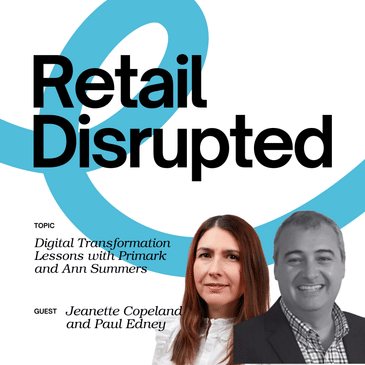

Paul Edney, Technology Director Channels at Primark, and Jeanette Copeland, Technology Director at Ann Summers, join Natalie to discuss lessons from their digital transformation projects. They explore:
- The rationale behind Primark’s click & collect roll-out and how it’s enabling the retailer to engage with new customers.
- How Ann Summers completed a 12-month transformation project in just four months.
- 2025 strategic priorities for both businesses.
- Working backwards from the customer, testing and learning, embracing failure – how digital transformation requires cultural change.
- The importance of speed to market while balancing cost and flexibility. Is WAgile (waterfall + agile) the new way of working?
- From virtual sizing tech to in-store payment innovation, which technologies are the retailers excited about for the future?
Today’s episode is sponsored by PMC and was recorded live at the PMC customer event at Silverstone Museum.
From supporting end-of-life legacy systems through to providing the latest digital retail solutions, PMC helps you take control of your technology and drive your own agenda. PMC has proudly supported the commerce sector for over 20 years, and our specialist domain knowledge, experienced teams, and proactive approach makes us the partner of choice for delivering customer-centric transformations. For more, visit PMC.
Bios:
Paul Edney, Technology Director Channels, Primark Paul is a senior IT leader with 20+ years of experience, specialising in retail, ecommerce, and transformation. He excels at crafting strategies that enhance customer experience and operational efficiency. As Technology Channels Director at Primark, he leads global tech initiatives, overseeing system integrations, re-platforming, and business transformation to drive growth and innovation. Jeannette Copeland, Director of Technology, Ann Summers Jeannette leads the technology division at the iconic Ann Summers brand, spearheading digital innovation since 2022. With over 20 years of experience in IT, she has held key roles at Joules and Systemax Europe Ltd, specialising in ERP, data integration and business intelligence.
[00:00:06] You're listening to Retail Disrupted, a podcast that explores the latest industry developments and the trends that will shape how we shop in the future.
[00:00:16] I'm your host, Natalie Berg.
[00:00:29] Hello and welcome back to Retail Disrupted.
[00:00:32] Today's episode is sponsored by PMC, a leading global retail technology service provider.
[00:00:37] PMC supports over 120 brands worldwide with consulting, delivery capability, managed services, engineering expertise, and Mac platform solutions.
[00:00:49] I'm here at PMC's customer event at quite an impressive and unusual venue.
[00:00:55] I'm at the Silverstone Racetrack, so if it's a little noisy, hopefully it'll cut me some slack.
[00:01:01] My first guest on today's episode is Paul Edney, Technology Director at Primark.
[00:01:07] Paul, welcome to the show.
[00:01:09] I know you cut your lunch break short, so I really appreciate you being here today.
[00:01:13] Tell us a little bit more about yourself and your role at Primark.
[00:01:16] Yeah, sure. Great to be here.
[00:01:18] So I look after all customer-facing technology for Primark in all our markets.
[00:01:22] So I'm the link, if you like, between Primark and the customer.
[00:01:26] Our world is really to enable engagement with the customer,
[00:01:30] but also get Primark to tell the customer what we're up to in terms of product,
[00:01:36] ways of working, the whole ethos we have around trading.
[00:01:40] Great. And you were on stage earlier today talking about digital transformation at Primark,
[00:01:44] and specifically Project Oscar.
[00:01:46] Tell us more about the project.
[00:01:48] What did you set out to achieve, and what did you learn along the way?
[00:01:51] Okay, so Project Oscar was our digital transformation journey.
[00:01:56] It started back in June 2021, and our objective was to change the way we engage with our customers.
[00:02:03] We realized the way we had grown and got that customer brand loyalty wasn't the way we would need to work with them going forward.
[00:02:13] So we came up with a strategy that says, okay, how do we improve the engagement?
[00:02:17] So Project Oscar was all about digitalizing that communication link between us and the customer.
[00:02:23] And a couple of things you said on stage stuck out to me.
[00:02:26] You said that the project finished, but it's now very much a way of life.
[00:02:30] It's how you work.
[00:02:31] I wonder if you can elaborate on that and also touch on the importance of collaboration in all of this.
[00:02:36] Yeah, sure.
[00:02:37] It's like everything.
[00:02:38] You need to focus on a specific goal.
[00:02:40] So Oscar was to achieve a certain point in time and a certain level of capability.
[00:02:46] So it was never a one-off and throwaway.
[00:02:49] It was just a new way of working.
[00:02:51] So it was all about not just providing that leap in terms of a new way of engaging with customers,
[00:02:56] but it was also the leap for us as a business to think and work differently.
[00:03:00] We talk about collaboration, not just within our own business functions, but also with partners.
[00:03:07] So who's strong in the digital space?
[00:03:09] What could we learn?
[00:03:10] How could we improve that relationship, not just with our internal people, but with our partners and our customers?
[00:03:16] So it was all about a new ethos, a new culture.
[00:03:19] Paul, how important is speed to market?
[00:03:22] And I'm not just asking you that because we are at Silverstone.
[00:03:25] How important is this?
[00:03:27] And how do you balance this with other things like the need to keep costs down and flexibility?
[00:03:32] Yeah, it's really hard.
[00:03:33] It's all about value of the option you're trying to deliver.
[00:03:38] We've learned over time that the longer it takes to deliver something, the less value it can bring
[00:03:42] because it's either outdated or your initial payback, the market's changed or the perceptions change.
[00:03:49] So we knew we had to run at pace and we knew the only way to do that was to have specific targets to work for.
[00:03:56] So it was all about, OK, to achieve a certain point in time, what was the value we could gain from that experience
[00:04:03] in terms of the technology, the way we worked as a business, but also the engagement we would get from our customers?
[00:04:09] Yeah.
[00:04:09] And I guess technology moves so quickly that that speed to market is critical for any retailer.
[00:04:15] I want to talk about e-commerce and specifically click and collect.
[00:04:18] This is a really exciting area for you guys.
[00:04:20] For a long time, you were one of very few retailers that didn't have a transactional website.
[00:04:25] And as an analyst, we've kind of been, you know, wondering and guessing, will they, won't they?
[00:04:29] I know you were very active on, you are very active on social and you do very much reach customers digitally.
[00:04:36] You mentioned that traditionally the product sold itself.
[00:04:40] But like any value retailer, I think sometimes the economics of e-commerce don't always stack up.
[00:04:44] So just really interesting to see, you know, the move towards click and collect.
[00:04:48] And now you're rolling this out to all stores, I think you said.
[00:04:52] And today you launched click and collect in six stores alone.
[00:04:56] So, you know, very much a priority.
[00:04:58] I'd love to know what changed and how is click and collect allowing you to reach customers in a different way today?
[00:05:03] Yeah, I think, as we said earlier, it's a change in our customers' behavior.
[00:05:09] They're more of an informed shopper now.
[00:05:12] So we needed a way to engage with them at a different level.
[00:05:15] So our strategy has always been and will always be our stores.
[00:05:19] That's what makes Primark great.
[00:05:21] We call it the Primark wow factor.
[00:05:23] When you walk into one of our stores, you look around, you go, wow, we didn't realize Primark did those products.
[00:05:27] So it's all about how do we drive traffic to our stores.
[00:05:29] We see stores as a central part of our strategy going forward.
[00:05:33] So click and collect was a bridge to bring that younger generation or different types of consumers to our stores
[00:05:40] by giving them a new window to experiment and understand what Primark is all about.
[00:05:44] And you're finding that customers are using it and appreciating that digital aspect.
[00:05:49] Yeah, yeah.
[00:05:50] We've seen amazing growth and great feedback.
[00:05:52] And I think it's also refreshed some of our stores.
[00:05:55] Yeah.
[00:05:56] So we have, as you probably know, we have a different range of store sizes.
[00:06:00] So for the smaller stores, it's been an absolute seismic change in terms of the experience they're now giving the customers and getting from the customers.
[00:06:09] Is that because shoppers now have a much wider range of assortment because they're shopping online and collecting in store,
[00:06:15] which means that they don't have to go to the larger stores.
[00:06:19] They can go to a smaller store and possibly pick something else up in the store as well.
[00:06:24] So you've got the incremental sale, which is always a fantastic benefit of click and collect.
[00:06:29] Exactly.
[00:06:30] Yeah, yeah.
[00:06:30] It's driving.
[00:06:31] And it's also driving people who wouldn't have considered Primark because they knew that store didn't stock that product.
[00:06:37] Yeah.
[00:06:37] Interesting.
[00:06:38] Really interesting.
[00:06:40] In your talk, you stressed the importance of working backwards with your click and collect launch, both in terms of getting the service off the ground,
[00:06:47] but also in terms of rolling it out internationally.
[00:06:49] And I wonder if you can elaborate on this in more detail for our listeners.
[00:06:53] Yeah.
[00:06:54] I mean, the way to deliver at pace is to deliver in increments.
[00:06:58] So you have to have a vision and a longer term target, but you can't deliver everything at once.
[00:07:03] And for some things, they'll evolve.
[00:07:05] You have an idea of what you think, but it's all about choices.
[00:07:09] We have to make choices based on what we think we know about our customers.
[00:07:12] But once we've actually delivered something, we then need to learn and then change based on what our customers are telling us.
[00:07:18] So the whole idea of delivering in a series of increments was we could deliver at pace, but it gave us a flexibility to change as we were progressing.
[00:07:26] So it was like a large conveyor belt of change, which we ran for two years.
[00:07:29] And at every point, every time we deliver something, we went back to say, OK, what did we previously deliver?
[00:07:34] And what needs to change versus what are we now delivering going forward?
[00:07:38] And it was just that continuous test and learn approach.
[00:07:41] Yeah.
[00:07:41] And that, I guess, requires a cultural shift.
[00:07:44] It is.
[00:07:44] I mean, if you get it right, back to the choices, you can test the market, you can establish a presence, and then you can learn from it.
[00:07:53] And the beauty of delivering in increments is it's very quick for you to go back and change.
[00:08:00] So whereas, you know, you look at a traditional waterfall project, which can take you two years to deliver, then you have to wait for the next two years to change it.
[00:08:08] Whereas if we're delivering every day, every week, every month, we can make small changes more frequently.
[00:08:13] So the risk is reduced.
[00:08:15] It's still all about choices, but speed to market allows us to adjust really quickly.
[00:08:20] I'd like to just get your thoughts on the consumer.
[00:08:23] You mentioned that a key learning for you is that value isn't just the price of the product, and I thought that was really interesting.
[00:08:29] You said that customers also want you to be an ethical retailer, and clearly they want digital, and you're responding to this in a big way.
[00:08:36] Aside from digital and sustainability or ethics, what else are you seeing from customers today?
[00:08:43] And how do you balance all of this when value is still presumably a very big driver for Primark shoppers?
[00:08:49] Yeah, I think it goes back to what I said earlier.
[00:08:51] It's all about choices.
[00:08:52] It's giving the customer the choice, you know, and for us as well as a retailer, there's some things we can do and some things we don't want to do.
[00:09:00] So it's getting the balance right.
[00:09:02] There's no silver bullet.
[00:09:03] There's no correct answer.
[00:09:04] It's all about a test and learning strategy.
[00:09:05] So I think as long as we keep listening to our customers, as long as we keep focusing on our values, I think then it's just getting the balance.
[00:09:14] Sometimes we'll get things wrong, but hopefully we can go back quickly and address that, like we've shown with some of the digital delivery.
[00:09:20] And if we look ahead to 2025, what are your strategic priorities for the year?
[00:09:25] And just very briefly, I'd love to get your view on how you think the industry will evolve and if there are any particular technologies or innovations that you're excited about as we look to the future.
[00:09:35] The focus for 2025 is to keep building on what we've done, keep the momentum going.
[00:09:40] But it's back to that culture.
[00:09:42] It's more around a specific program.
[00:09:44] It's now it's becoming a standard way of working for us, this new test and learn strategy.
[00:09:49] So it's all about that culture shift, constantly evolving, constantly developing in terms of technology.
[00:09:54] It's how we can use technology to help us, again, move smarter and quicker.
[00:09:59] So everybody talks about AI.
[00:10:01] Everybody talks about data.
[00:10:03] I mean, the key is to really get to know your customer, understand through data and experiences how you can improve that engagement.
[00:10:11] And hopefully then that's beneficial for both us and the customer in terms of trade and also the way we can work with them and support the planet.
[00:10:20] Yeah, fantastic.
[00:10:21] And you just touched on this idea of perpetual innovation, that there's no real end date to any of this.
[00:10:26] You've got to keep evolving as a retailer.
[00:10:28] And something else that you said that I thought was interesting, and it comes up a lot on this podcast, is really understanding what makes you special as a retailer.
[00:10:35] Understanding your USP, focusing on your strengths and really differentiating from the competition.
[00:10:40] Do you have any advice for retailers that maybe haven't quite figured that out yet?
[00:10:45] How do they kind of take that long, hard look in the mirror and work out what it is that makes them special?
[00:10:51] Yeah, I think it's just giving yourself choices.
[00:10:54] It's like we said, we didn't know and we still don't know all the answers.
[00:10:57] So we have to make our business a safe environment to test and learn.
[00:11:02] So I think that's it.
[00:11:03] If you can get the commitment from the senior management and the support within the business, it's all about that test and learn.
[00:11:10] And then it's just a case of just try something.
[00:11:13] Yeah, just get started, right?
[00:11:14] Yeah, yeah.
[00:11:15] It's as simple as that.
[00:11:16] Fantastic.
[00:11:17] Paul, thanks so much for coming on the show.
[00:11:18] Okay, thank you.
[00:11:24] And now I'm delighted to welcome my second guest to the podcast.
[00:11:28] Jeanette Copeland is the technology director at Anne Summers and she is joining me live from the PMC event at Silverstone.
[00:11:35] Jeanette, welcome to the show.
[00:11:36] Thanks, Natalie.
[00:11:37] Now, earlier today, we heard from Nick Baton, the former CEO of ASOS and Matches.
[00:11:43] And we also heard from Primark's technology director, Paul Edney, who actually came on the podcast just before you.
[00:11:48] And I picked up on some recurring themes throughout the day, such as managing disruption, working backwards from the customer was something I think we heard a lot of.
[00:11:57] And also this idea of constant evolution.
[00:12:00] I'm curious to know, as a retailer, what stood out for you?
[00:12:04] What did you find most interesting or most affirming?
[00:12:07] There were lots of things that were really interesting.
[00:12:09] So I definitely agree with you.
[00:12:11] I think picking a single thing to talk about is difficult, but was interesting to hear from Nick in terms of his leadership style and how that evolved and how he doesn't consider himself the finished article even now.
[00:12:28] I think it's a really healthy approach to leadership and interesting how much emphasis he puts on culture and the people that work in his teams.
[00:12:42] Yeah, that's a really good point about culture.
[00:12:44] And that came up, I think, in a number of sessions throughout the day.
[00:12:48] One of the things that Nick said specifically, and I actually jotted this down because I thought it was such a great quote.
[00:12:54] He said that if you have a transactional internal culture, then you have a transactional external culture and customers will see that.
[00:13:01] And so he says, yes, you have to make sure you have a great product.
[00:13:04] And yes, technology and logistics can scale you.
[00:13:07] But culture is the thing that makes you fly.
[00:13:10] So as a technology director, what do you make of that?
[00:13:13] Is that a fair assessment?
[00:13:15] Yeah, I think it's fair.
[00:13:16] I think that nothing happens without people.
[00:13:21] I think there's potential that people are worried that people will become a thing of the past in the technology world.
[00:13:29] But in reality, I think that's a considerable way off.
[00:13:33] And it's really important that people are engaged and feel part of a community, not just part of a business.
[00:13:43] So that they deliver their best outputs.
[00:13:47] And you can have people that are engaged enough to listen when you're leading.
[00:13:54] And a lot of things that we do as leaders focus on figuring out what it is the people want in our organization, I think.
[00:14:05] Yeah, that's really interesting.
[00:14:06] And I'd like to talk about digital transformation now.
[00:14:10] Unfortunately, I missed your session earlier.
[00:14:12] But I understand that you got a lot done in a relatively short space of time.
[00:14:16] So could you talk us through the business overhaul at Ann Summers?
[00:14:20] What were the objectives and how did you set about achieving them?
[00:14:23] Yeah, so we were looking to re-platform our ESB, which is the Enterprise Service Bus.
[00:14:32] And our objectives were to ensure that we could continue to trade the business,
[00:14:41] deliver that project with as little disruption as possible.
[00:14:45] But also realizing the benefits of the journey to a composable architecture.
[00:14:56] So it definitely wouldn't have been my choice if I could have all the time in the world to do a project.
[00:15:03] I would not have done what should have been a 12-month project in four months plus critical care.
[00:15:09] Wow.
[00:15:11] But it was sort of born out of necessity.
[00:15:15] There was, you know, peak coming up and we needed to be ready for that.
[00:15:20] So we didn't have a lot of choice in terms of timescales.
[00:15:23] It was either go for it or wait probably one to two years to be able to do it.
[00:15:29] So, of course, we had stage gates through the process and made sure that we were okay to continue.
[00:15:40] So I wouldn't say that when I first started talking about this in April to the point that we actually began,
[00:15:47] we'd always said this will definitely happen.
[00:15:49] There was certainly a huge amount of exploration to make sure that it was possible.
[00:15:55] And, you know, we owe a lot to the team that took on our interfaces and now manage them for us
[00:16:03] in terms of making sure that that could happen in the timescales that we had.
[00:16:07] And in terms of online versus in-store, were you investing in both of these channels or was it about joining them up?
[00:16:13] What our interfaces do is they connect all of our systems together, both within the business and externally to third parties.
[00:16:25] So, yeah, I think we describe it as heart and lung transplant, basically.
[00:16:31] So we touched everything.
[00:16:34] And that was technically challenging, but it was also quite challenging because it had such a breadth across the business.
[00:16:42] So it did touch stores and it did touch online purely because those things were already integrated and we needed to reintegrate them,
[00:16:53] as well as kind of unstitching a lot of things that had happened in the past,
[00:16:58] which there was nothing wrong with those decisions.
[00:17:02] It was just an evolution.
[00:17:04] So we had arrived at a point where the way that I described it to the folks when I did the talk is just that kitchen drawer that you have that's got all the cables and the sellotape and the fuses in it
[00:17:22] and how we kind of pulled it all out and straightened it up and put it back in there.
[00:17:28] Yeah. And from a customer perspective, will they have seen any of these changes or is this just kind of fixing everything that's important behind the scenes?
[00:17:39] They shouldn't have seen any of the changes.
[00:17:43] A customer will have come to the website, their order will have been placed on the website,
[00:17:47] and it will have been transferred in simple terms to the logistics team to ship out.
[00:17:54] And those things continued to happen.
[00:17:56] So they won't have seen any difference in that respect.
[00:18:00] There has been some things that have not quite gone to plan.
[00:18:03] And so that might have been visible to customers.
[00:18:06] So some of our emails were not triggered that we expected.
[00:18:10] And we've been working through a lot of issues.
[00:18:13] But in the May, orders came in, be that from our website or anywhere else, and they went out of the door to our customers.
[00:18:23] So, yeah, we kept trading and that was what was important.
[00:18:27] And that touches on something that Paul mentioned earlier and has come up throughout the day, which is this idea of testing and learning.
[00:18:35] And as you just said, sometimes things don't go to plan, especially with these huge transformation projects.
[00:18:43] Do you think that our attitude towards failure has evolved?
[00:18:48] It's difficult to say if everybody really embraces that.
[00:18:51] I think Nick talks about wagile.
[00:18:54] Wagile. It's a fun term for people who can't get off the waterfall drug and onto wagile completely.
[00:19:01] They kind of started a journey of agile, found that they were over budget, not delivering, not really sure when things would land.
[00:19:10] And so adopted this wagile approach.
[00:19:12] And I guess I've worked on that premise for quite a long time is try and do as much as you can, as quickly as you can.
[00:19:21] But there are some things that just don't lend themselves to that.
[00:19:25] So I think, yes, people are getting better at it, but it's never where you want to be in that position where you say, OK, that's a fail.
[00:19:37] I think hopefully the way that we look at it is we learn some stuff from that and we'll know what we want to do in the future.
[00:19:44] We tend to try and apply the W of waterfall to get us to a position where we feel relatively certain that we won't need to say, let's stop doing this.
[00:19:57] But, yeah, we we will take that decision and some is to stop doing things.
[00:20:04] I hope that more retailers are doing the same as well.
[00:20:07] Yeah, I mean, my personal view is that there has been this shift and that obviously some retailers are further along this journey than others.
[00:20:14] But accepting that, you know, innovation and failure sort of go together.
[00:20:19] Easy for me to say from the sidelines.
[00:20:20] But so now looking ahead to 2025, I wonder if you can talk through some of your strategic priorities and any any changes maybe that you're excited about.
[00:20:31] So we're very clear in terms of the changes that will be driving going forward in that they are customer focused and that they turn the dial in some way.
[00:20:44] So everything that we're focusing on will be looking to pull one of those levers, essentially.
[00:20:53] We have got some specific things, quite small things, actually, in comparison to the things that we've been doing.
[00:21:01] Very excited to make sure that we stay focused on customer and having that front of mind.
[00:21:09] Yeah, yeah, absolutely.
[00:21:10] And I guess that brings up another important point around the pace of change.
[00:21:14] And I know you touched on this in your talk that the industry has evolved dramatically over the past few years.
[00:21:20] But can you know, can we sustain this pace of change?
[00:21:23] And obviously, technology has accelerated a lot of the change that we're seeing.
[00:21:27] But I'd love to get your views now on how you see the retail sector evolving.
[00:21:32] If you look, you know, the next few years or even, you know, 10 years down the line, what what are you expecting?
[00:21:37] Do you think it'll be evolution or revolution?
[00:21:40] Pretty certain it's going to be evolution.
[00:21:43] I feel like we have a lot of challenges in retail from a cost based perspective.
[00:21:48] And so the investment that we can make has to be done really carefully.
[00:21:55] I think there's certainly huge amounts to go after in terms of AI, machine learning and data.
[00:22:02] We keep talking about it, but actually applying it requires quite a lot of change of thinking.
[00:22:11] And it's almost less about the technology and more about the bringing the folks along on that journey to a position where they don't feel that their job's threatened,
[00:22:21] that they actually understand how the technology works and what it can do for them.
[00:22:26] So I think there's quite a lot to go after there.
[00:22:28] I would love to see technology in terms from a fashion perspective in terms of fit.
[00:22:37] So being able to get people's fit more virtualized.
[00:22:41] And I've seen a lot of tech that tries to do that.
[00:22:45] More recently, a couple of things that have been a little bit more ready for the market.
[00:22:52] But I think that if everybody really wants to be sustainable, if everybody really wants to be green,
[00:23:00] we have to stop the culture of massive hauls from places that then get returned and start buying more selectively.
[00:23:09] And that's not to say we shouldn't have returns at all.
[00:23:12] Of course we should.
[00:23:13] But just not returning because it doesn't fit is crazy bonkers if we can get technology to deal with that for us.
[00:23:23] But I think it's a few years ahead.
[00:23:26] There's probably a lot more tech that's available in terms of being able to transact in store more easily.
[00:23:34] You know, we're all attached to these devices.
[00:23:37] I'm pointing to my mobile phone that we never let go of.
[00:23:41] And of course you can tap of pay, but that can go further, I think.
[00:23:44] So that will be interesting to develop in store.
[00:23:48] Yeah, yeah.
[00:23:49] Really interesting to get your views there.
[00:23:50] And it's a great point about returns and how it's so difficult, isn't it,
[00:23:55] to kind of take something away from the customer or put some friction into the experience
[00:23:59] when we're so focused on taking friction out.
[00:24:01] But as you say, when it comes to sustainability and greater transparency
[00:24:05] and there's regulatory changes coming in that space as well,
[00:24:09] we're going to have to stamp out this buy to try mentality.
[00:24:12] So really interesting stuff.
[00:24:14] Jeanette, I just want to ask you one final question around some advice for other retailers
[00:24:19] because digital transformation is a journey that probably never really ends.
[00:24:24] You know, this idea of constant evolution, as I said at the start, is very much a theme of the day.
[00:24:29] Some retailers are clearly further along their digital transformation journeys than others.
[00:24:34] So what advice do you have for those retailers?
[00:24:38] What are one to two things maybe that they can do after listening to this episode
[00:24:42] that might help them accelerate their transformation goals?
[00:24:45] I would probably say there's three things.
[00:24:49] One is keep it as simple as possible.
[00:24:52] The other is keep it as short as possible
[00:24:55] so that you remove the fatigue from the change.
[00:25:00] And then I would also say, no, it's going to change.
[00:25:04] So very often, you know, if you either are in an organisation or arrive there,
[00:25:10] the first thing that happens is let's have a three or five year roadmap.
[00:25:14] Well, know that it's going to be OK if that gets torn up and put in the bin
[00:25:21] and you kind of start again.
[00:25:23] I mean, you never start from the very beginning,
[00:25:25] but you might just need to evolve and change that
[00:25:28] because rarely in technology do I think it lasts that long.
[00:25:33] Yeah.
[00:25:33] And I think in retail, the only constant is change.
[00:25:36] So you could always be prepared.
[00:25:38] Fantastic.
[00:25:39] Jeanette, thanks so much for coming on the podcast today.
[00:25:41] Thank you.
[00:25:45] Thank you for listening to Retail Disrupted.
[00:25:47] If you enjoyed this episode and would like to support the podcast,
[00:25:51] please leave a rating or review or share it with others.
[00:25:54] It really makes a difference.