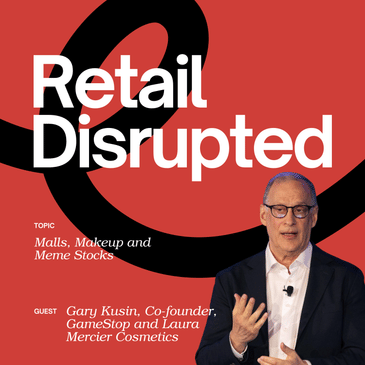

Gary Kusin, co-founder of GameStop and Laura Mercier Cosmetics, joins Natalie on the podcast to discuss:
- GameStop’s origins: what inspired Gary and James McCurry to launch the world’s first video game store in the early 80s?
- Successes and missed opportunities: what would Gary have done differently?
- The pivot to makeup: Gary discusses how a conversation with former Macy’s Chairman Terry Lundgren sparked the idea for Laura Mercier.
- Continuous improvement versus continuous change.
- Customer centricity: why so many brands today fail to get this right.
- Kinko’s: Gary shares how, as Kinko’s CEO, he turned the loss-making business into to a highly profitable enterprise that was later acquired by FedEx.
- Meme stocks: Gary shares his views on the GameStop stock market frenzy.
Gary’s bio:
Gary Kusin is a mentor, investor, entrepreneur, business advisor, and author of the forthcoming book Always Learning: Lessons on Leveling Up from GameStop to Laura Mercier and Beyond [April 2024]. He today advises an array of public and private companies, large and small, on strategy, management and growth issues. In addition, Kusin continues his full schedule of mentoring and has mentored well over 1000 individuals during the course of his career. Kusin co-founded two companies, Babbage’s, operating today as GameStop (NYSE: GME), and Laura Mercier Cosmetics, both of which are well-known global brands. Gary spent 13 years as a senior advisor to the global private equity firm TPG, including a large amount of his time mentoring CEOs of TPG portfolio companies. He served from 2001-2006 as President and Chief Executive Officer of Kinko’s, today operating as FedEx Office. Kusin was responsible for the turnaround, strategic growth and transformation of Kinko’s and oversaw the ultimate sale to FedEx, directly reporting to Fred Smith, founder of FedEx, for the 2 years required to integrate Kinko’s into FedEx and be renamed FedEx Office. Kusin is an Inc. Magazine “Entrepreneur of the Year” award winner and has served on the boards of many public and private firms both in America and abroad including names such as Electronic Arts, Petco, Sabre, and Myer Department Stores in Australia. Kusin has been very involved in Dallas community activities throughout his career. A representative sample of organizations and positions include the St. Mark’s School of Texas Board of Trustees, Dallas Young Presidents’ Organization (YPO) chairman, Dallas Citizen’s Council Board of Directors and the Southwestern Medical School Foundation. A member of the University of Texas McComb’s School of Business Hall of Fame, Kusin earned a BA from the University of Texas at Austin and an MBA from Harvard Business School.
[00:00:07] You're listening to Retail Disrupted, a podcast that explores the latest industry
[00:00:12] developments and the trends that will shape how we shop in the future.
[00:00:17] I'm your host, Natalie Berg.
[00:00:29] Hello and welcome back to Retail Disrupted.
[00:00:32] I know it's been a little while since the last episode and as many of you know that
[00:00:37] was always the plan I always take August off to be with the kids and have a little
[00:00:46] little bit of a little bit of an effort to get other analysts on the podcast, which is how
[00:00:46] the podcast is called Retail, or at least talking Retail.
[00:00:49] And then pick up again in September.
[00:00:51] So it's great to be back that last episode by the way, which was about the need for Amazon
[00:00:55] to disrupt itself in order to stay relevant in the future.
[00:01:00] That last episode with my insights has been really, really popular.
[00:01:04] So I'm really glad that the content is resonating that you're getting value from it and I'm going
[00:01:10] to make a little bit more of an effort to get other analysts on the podcast.
[00:01:15] Which is how the podcast started out.
[00:01:16] I started out kind of reaching out to my many friends and former colleagues in the industry
[00:01:23] to bring you original insight and opinions.
[00:01:26] So we're going to do more of that, but I'm also going to be balancing that with my interviews
[00:01:30] with Retail Leaders.
[00:01:33] So the podcast is booked out for most of the rest of the year.
[00:01:36] I do have a few slots available in early December, and if you are a retailer or a brand
[00:01:43] or an analyst.
[00:01:44] And you'd like to join me on the show.
[00:01:47] Please get in touch.
[00:01:48] You can reach me directly on hello at nbkretail.com.
[00:01:54] And let's have a conversation.
[00:02:01] Today's guest is the founder of two well-known global brands,
[00:02:05] GameStop and Laura Mercier cosmetics.
[00:02:07] I'm thrilled to have Gary Cuce and joining me on the show today to talk about everything
[00:02:12] from malls to meme stocks.
[00:02:15] Now let me tell you a little bit more about Gary.
[00:02:18] He is a mentor, investor, entrepreneur, business advisor, podcast host,
[00:02:25] an author of the book Always Learning, lessons on leveling up from GameStop to Laura Mercier
[00:02:30] and Beyond.
[00:02:32] Today, Gary advises and a ray of public and private companies on strategy,
[00:02:36] management and growth issues.
[00:02:39] In addition, Gary continues his full schedule of mentoring and has mentored well over a
[00:02:44] thousand individuals during the course of his career.
[00:02:47] Gary spent 13 years as a senior advisor to the global private equity firm TPG
[00:02:53] and he also served as president and CEO of kinkos which of course today is operating as FedEx office.
[00:03:01] Gary was responsible for the turnaround, strategic growth and transformation of kinkos
[00:03:05] and he oversaw the sale of the business to FedEx back in the early 2000s.
[00:03:11] Gary has been named entrepreneur of the year by ink magazine.
[00:03:14] He has served on the board of a number of retail businesses both in the US and internationally,
[00:03:21] including electronic arts, pet co, saver, and higher department stores in Australia.
[00:03:33] Gary, it's such a privilege to have you on the show.
[00:03:35] Welcome to retail disrupted.
[00:03:37] Thank you and thank you for inviting me.
[00:03:40] Gary, I'd like to start out talking about game stop.
[00:03:44] You started out in retail at a very young age working in the warehouse of your family furniture store.
[00:03:50] You then went on to work at Macy's after graduating college and then became the co founder of two well-known global brands.
[00:03:58] Game stop which of course was called Babbage's at the time and the cosmetics brand Laura Mercier.
[00:04:04] We're also going to talk about your time at kinkos, but just to get us started I wonder if we can go back to the early 80s.
[00:04:11] Can you remind us what retail was like then and what inspired you to launch GameStop?
[00:04:16] Sure.
[00:04:17] That is a very good question.
[00:04:21] And thank you for asking us that's a very good question.
[00:04:25] So I was in the department store business and that time period made your regional malls were opening up all over America.
[00:04:33] That was actually a new thing led by developers like Mel Simon, like the Talman companies, like the DeBardalo companies.
[00:04:41] And what was happening is department stores were looking for ways to expand.
[00:04:47] Expand their footprint America was growing.
[00:04:49] People had discretionary income.
[00:04:52] But something in more insidious was happening inside the malls and I tried to run a red flag up on the issue that I saw multiple times inside of Macy's.
[00:05:03] And it never worked. It was falling on down fears essentially. It was this when a developer opens a major regional mall and puts in four very big department store anchors.
[00:05:14] They have to fill anywhere from 500,000 to 800,000 square feet with smaller space retailers.
[00:05:22] So what happened this whole malling of America as it was called created an enormous opportunity for specialty stores to emerge.
[00:05:32] And what I was seeing when I was walking through the malls, I was having just outstanding results in my various positions in the department stores.
[00:05:43] But I got a not in my stomach every time I walked through a mall because as well as I would think I was doing in mall after mall for one end of America to the other.
[00:05:53] I was seeing stores with names like the limited like Lane Bryant, like Victoria's Secret, like Zales, jewelry. I could go on and on and on incredible number of shoe stores.
[00:06:05] And what I realized was department stores had an interloper for the first time ever because customers in fact did go to major regional malls.
[00:06:16] I was walking around the malls and you could read in all the standard business racks, the explosive growth of specialty retailers across America.
[00:06:28] And it occurred to me that we're taking our lunch in department stores.
[00:06:32] Department stores had shot themselves in the foot to start with by keeping local name plates on local for instance. I'm in Dallas, Texas.
[00:06:43] There was a division called Sanger Harris in Dallas. There was a division called Folies in Houston. There was a division called Riches in Atlanta and on and on and on.
[00:06:53] And so we had to suffer through literally down to different labeling on the insides of clothes, different advertising plans different ways you hire all of those things and incredible redundancy and stuff.
[00:07:08] So I developed a point of view which I in fact put up bold print and presentations to the chairman of basically to that time.
[00:07:15] Which said in any category of retail merchandise that reaches measurable size and I used a billion dollars is measurable size in 1982.
[00:07:28] And then I would make the case by using the names when you start talking about jewelry and it's margins in a matter of peril and it's margins they were clearly targeting highest margin parts of department stores.
[00:07:46] And I was not getting it was heresy to talk about going to one name. I said we should have one name nationally, we should you know that and all the things you would think I might have said.
[00:07:57] And so I was highly frustrated because I saw department stores lumbering towards the swamp is the dinosaurs did.
[00:08:06] And at the same time a business school buddy came through town. He was a senior partner at bay and out in the silicone valley and he started talking about this new emerging business called video games and it was any went through great detail to explain more's law and semiconductor chips were rising and speed and power and graphics capabilities while their cost was dropping in half so that video games were going to.
[00:08:38] And I said, well, whoa, Jim, let me talk to you about my premise that in any channel of retail and I said this sounds like this is very much going to be a billion dollar.
[00:08:54] A lot of money was going to be a million dollar, but the real thing is that you should have a lot of money and a lot of money, so that's going to be a million dollar.
[00:09:14] And then I said, let me talk to you about the money I said, I said, don't know what's going on with my research.
[00:09:23] as well. And I do you touched on a few of the
[00:09:25] Paral ones and toy, I, I, I, I,
[00:09:27] Sorry, and shoes, but also things like pets and toys and office
[00:09:31] and DIY superstores, you know, this was really the time for,
[00:09:34] for the category specialist. It was also the peak mall period
[00:09:38] and you just touched on the emergence of personal computers.
[00:09:42] And these devices, of course, are laughable by today's standards.
[00:09:46] But at the time, the idea of having a computer in your own home
[00:09:49] was revolutionary and, and as you say, it's fond, it's
[00:09:53] fond a whole new industry which is video games. So really
[00:09:55] interesting to see how all the pieces kind of came together for you.
[00:09:59] I guess my question to you is how, how did you stay on top of all
[00:10:02] this change? And maybe with a benefit of hindsight, is there
[00:10:06] anything that you would have done differently? Well, in this particular
[00:10:12] part of the evolution, specialty store retailing and video
[00:10:18] games, I'd say we pretty much nailed it. I can give you a very long list
[00:10:24] of ways we screwed up later on the butt and identifying and identifying
[00:10:31] an evolutionary change and acting on, but, but, I think on it, based on
[00:10:37] what the implications would be for future channels of distribution.
[00:10:42] We clearly history has shown with that that was a pretty good, pretty good
[00:10:46] decision. Can't complain with that again. We learned a lot and ever since
[00:10:52] I've worked in my family's furniture warehouse and listening to my father,
[00:10:56] the mantra was the customers are always right. And, and Napoleon saying,
[00:11:03] if you want to know what's going on in front lines, go look. So I wasn't just
[00:11:06] visiting the power department stores all over the southwest
[00:11:11] and go in and look at the store, shake hands, glad hand and get my car and leave.
[00:11:15] I was walking through the ball and you didn't have to help walking through what ended up
[00:11:21] being hundreds and hundreds of miles in America. You can't walk through those without
[00:11:26] it hitting you in the face and that's, you know, that even someone as thick
[00:11:32] head of this me could see that was coming. And the problem is you couldn't get
[00:11:37] anybody at Macy's to walk out of their anchor stores and look at what was happening
[00:11:41] and that's got them all in there. We're going to talk about GameStop a little bit more later on
[00:11:45] in the conversation, but if we maybe switch gears now and talk about Laura Mercier,
[00:11:50] in your book you mentioned that in the mid-90s, something was brewing in the world of cosmetics
[00:11:55] and you say that the oldest form of selling these products had become new again.
[00:12:01] Brands like Mac and Bobby Brown were trumping the fashion and tech oriented brands
[00:12:05] and so you had an idea to launch a cosmetics line led by a makeup artist. Now that is quite
[00:12:12] a pivot from video games, you share this idea with Terry Lungren former CEO and chairman of Macy's
[00:12:19] who at the time had just left Niman Marcus what happened next? How did the idea progress and
[00:12:25] what did it learn along the way? Again great questions. I can tell this retail oriented. I love it.
[00:12:31] I love this. So when I was in the department store business, I was in charge of cosmetics
[00:12:41] as one of the areas I was in charge of and obviously being a very young fresh out of business school
[00:12:48] just very aggressive wanting to grow my career. I realized cosmetics was not something I knew
[00:12:55] much about. So I said about studying the history of cosmetics and was struck by it was so easy to lump
[00:13:03] the evolution of cosmetics into three buckets in order. And when you go back to the dawn of retail
[00:13:12] cosmetics, the everyone who started a cosmetics company had a brand as a makeup artist. They had
[00:13:24] more gacy was a makeup artist. The Rebson brothers, incredibly, they started Revlon. They used to put
[00:13:32] if you can imagine an imagine in the mid 1940s when they would travel on airplanes which was
[00:13:38] already unique enough. They wore fingernail polish. These men wore fingernail polish and would ask the
[00:13:45] women on the flights what do you think about these colors? Now think about that in the 1940s. So they
[00:13:51] true, this is true old school merchandising. And then as you take that evolution forward,
[00:13:59] you realize as a stakeholder and the other brand started getting larger they could start using
[00:14:04] the labs that they had the laboratories to generate new products and they very quickly figured out
[00:14:10] through lines like Klemuk. That's sure enough if you add new products to your line based on the
[00:14:19] labs where they were developed and developed scientifically to help women. And there's a whole big
[00:14:25] then there was a giant leap forward all based on lab results for cosmetics. And if you go forward
[00:14:36] from there, and that lasted for about 20 years and if you go forward from there it became very
[00:14:41] fashion oriented so that all the couture lines started bringing out their own cosmetics. And so
[00:14:47] Chanel had a particular red apparel in their line. They would develop a red lipstick. And they
[00:14:55] would come out and say red is the color for the fall. Here's the dresses you'll wear to a cocktail
[00:15:02] party and here's the lipstick. So it was a very consecutive and there was a huge move towards fashion.
[00:15:09] All of a sudden tearing, I'd been going to lunch probably two, three times a year for years.
[00:15:15] We were two and inside of May sees he and two, I think it was if you will. So we always
[00:15:22] cross paths when they invite us up to Cincinnati to have conversations. And I would say what's
[00:15:28] going on new and exciting and different and he would say, and not really much nothing really.
[00:15:34] And in 1995, all of a sudden or even late 94, he said you would not believe this line out
[00:15:42] a candidate called Mac. And he started giving me numbers and I said, what's the
[00:15:48] Mac stand for? And he said, make up artists cosmetics. And it light went on in my head at lunch.
[00:15:54] And I went, oh my gosh, everything old is new again. Do you think this cycle
[00:15:58] and started talking about makeup artisty? And that's when he told me about Bobby Brown. And that's
[00:16:03] we told me about Trish McAvoy. So I had three, three data points essentially that validated
[00:16:10] my notion. And I said, so I got to know a little bit and they were all three very creative people
[00:16:17] developing these lines. And it occurred to me that if you approached it from a very academic end,
[00:16:25] you know, with thought about how do you launch a makeup artist line and came up with a few
[00:16:30] big ideas. One was you consult fashion leaders in all the fashion magazine, and what are the
[00:16:36] hot, who are the hottest makeup artists? You would have a lab set aside to develop based on them.
[00:16:42] And I needed, I knew I needed a face of the company and Terry Lundgren introduced me to a woman
[00:16:50] named Janet Gerwitch. And I took her to lunch. And I was talking with her about all this evolution.
[00:16:56] She wasn't sure she wanted to leave her job. She's seen your merchant at Naman's. And I said,
[00:17:00] well, you don't have to. I'm going to do this way that you do it or not. And she said, I'll do it.
[00:17:05] And next thing, you know, we started the company and the rest of the history.
[00:17:09] Were there any learnings that you could apply from game stop to your time at Lermost?
[00:17:14] Yeah, or is it just such a different industry?
[00:17:18] There are on a couple of levels such a different industry. It was a combative cosmetics
[00:17:24] very combative compared to we were the first and everyone was interested in us.
[00:17:30] So we have a very different world as merchants in a video game store versus an industry where you
[00:17:36] have to fight for shelf space. You have to fight for what is the financial agreement between the
[00:17:43] retailer and us relative to the beauty advisors on the counter when you have to fight for lab time
[00:17:50] and you have to fight for shipping rates. You know, stuff like that. It was a tough and gritty business.
[00:17:57] And I have to tell you, I didn't like it at all. Really.
[00:18:01] To having the other side of the table, I'm not them. I can't. I don't have sharp elbows.
[00:18:09] I just refuse. I'm to me businesses should just be an extension of your life. And if I don't
[00:18:15] live my life that way, I don't want to live my work that way. I do think that a really important
[00:18:20] lesson for people who might be listening to your podcast, I hear so much about people starting
[00:18:27] businesses because it's their passion or it's their hobby or it's something and I think those
[00:18:34] are great. I can't believe people would want to ruin something that's a passion and making it
[00:18:40] work. But so be it. I have two examples there where we came at the business by having a hypothesis.
[00:18:50] We tested it. We validated the concepts and we move forward with it. I hear so often
[00:18:58] of people starting companies and there are obviously huge success stories out there or people doing
[00:19:03] that. But I can't imagine in this day and age with access to data information technology and all
[00:19:09] those things why people wouldn't do some serious homework before they decided to launch a new
[00:19:16] business. Especially in retail. I know I get that it's funny because what you're saying is sparked
[00:19:23] a thought. I obviously love retail and I'm really passionate about it enough to have been an
[00:19:28] industry observer and commentator for 20 years and to have launched this podcast. But I'm also
[00:19:32] really into gardening and every now and then I think should I quit retail and become a garden designer
[00:19:37] and then I just think no because I'm too passionate about it and I don't want to be a senior
[00:19:40] who work with Litter. You've got to love outside of work and it's passionate to hobby, you're an
[00:19:48] enthusiast, you love it and you know well enough that it doesn't matter what the business is
[00:19:53] starting it gets to be a drag. There are days when you just say oh my gosh I cannot believe
[00:19:59] I did this to myself and I don't ruin gardening with all of that. I'll stick to retail.
[00:20:05] Now that is really interesting. I mean it's it does kind of go against what a lot of you know
[00:20:12] a lot of people do say go find your passion and then it never feels like work and I actually had
[00:20:17] James Keys on the podcast the former CEO of Blockbuster for 711. Yeah, he was very passionate about
[00:20:28] education and continual learning and we talked about the importance of embracing diversity
[00:20:34] and surrounding yourself with people that don't look and think like you and that was I thought
[00:20:39] a really important point. He also talked a lot about constant evolution and adaptability and I
[00:20:45] love this term that he's coined that CEO shouldn't stand for chief executive officer but change
[00:20:52] equals opportunity. So yeah, I just it's just funny. I mean he was he did kind of call out the
[00:20:59] importance of finding your passion. So I'm interesting to hear contrasting views around that but
[00:21:04] teach their own. Yeah, I speak to a lot of retail leaders on this podcast from both sides of the
[00:21:11] Atlantic and something that comes up a lot is the importance of focus. This idea that you have to
[00:21:16] know what your brand stands for, know who your customers are, not try to be everything to everyone
[00:21:22] and then executing really well. So in your opinion, how important is clarity and I guess consistency
[00:21:30] when it comes to vision? So there are two parts I think to that. The first part is incredibly critical
[00:21:38] at the outset. You need to know, you know, all of brand is is a promise. It's a promise of what
[00:21:47] you're going to get and especially when you're starting and you're trying to make a name for
[00:21:52] yourself and establish your brand. Having extreme focus, especially on those points where you touch
[00:22:00] the customer and where you present yourself very important that that you deliver on that promise,
[00:22:08] not just in your advertising and marketing but where the customer meets the merchandise. So I
[00:22:14] agree with that but frankly, my co-founder at GameStop's, Gunning Jim McCurray and he and I both went to
[00:22:22] grad school together and he and I've been best friends like brothers ever since and we had a debate
[00:22:29] a month ago that he clearly and he's probably batting a thousand with me. That's a low bar but
[00:22:35] he has in his view. I'm, I, I, I, I, in my book with a list of leadership principles the last one
[00:22:43] being continuous improvement. He argues very persuasively that it's not continuous improvement in
[00:22:50] a longer, it might have been in the 80s where you want the goal is do whatever it is you're doing
[00:22:56] better, smarter, faster, more efficiently. He believes because of the way of the world we live
[00:23:02] and today the right term is continuous change and I could, and I believe because change is more
[00:23:10] dramatic change requires not looking like like Wayne Grettska used to say about hockey. I don't
[00:23:18] skate through where the puck is, I skate to where the puck is going to be and and you have to
[00:23:25] be thoughtful, very thoughtful about how your vision for your brand will evolve based on outside
[00:23:34] forces and so you focus very important however certainly within a couple of years of starting
[00:23:44] you really should start thinking about continuous change and what should we do differently
[00:23:53] that delivers a more enhanced customer experience moving forward based on available technology,
[00:24:00] based on new psychographic data, based on whatever new internal efficiencies you know you can
[00:24:07] go on and on so so I would say yes of course focus is important but sometimes you can have your
[00:24:15] blinders so close on what you're doing that you miss and I can give you two great examples from
[00:24:22] GameStop that Jim and I with the benefit of decades behind us and our ego's not so much and
[00:24:30] it we made two really bad mistakes and it was for this lack of a mindset on continuous change. We
[00:24:38] nailed the fact that malls in America were growing explosively and we had to get to the regional
[00:24:43] big major reach on close malls and we did it and we did it very effectively before you know
[00:24:49] we had for 700 stores what we missed 10 years later retail evolution continued in the emergence of
[00:25:00] power centers outside of malls it weren't enclosed and that didn't have necessarily department
[00:25:06] stores as anchors but maybe a home beef or lows maybe a major sporting good store maybe toys
[00:25:13] are us and it became a new locus if you will for retail and that retail cost per square foot
[00:25:22] was half a fraction of the imposed malls and they didn't have the requirements that you had to
[00:25:29] pass through their design and graphics people who never understood video games you could do so much
[00:25:36] chief like we missed that trend and that's that's unforgivable now with 2020 hindsight so that was
[00:25:46] one thing and the other thing our premise at the start was that video games are very expensive
[00:25:51] they're 49 99 in the early 80s and we knew that the malls were where the upscale moms were because
[00:26:01] at that time moms were who bought the video games for their kids typically boys back then and
[00:26:08] today they goodness it's now everybody but we wanted to be where the economics were we expected
[00:26:15] prices to go down and the only way they went down is they never went up okay so today video games
[00:26:23] still 49 99 but that argued for an emergence of a used
[00:26:31] used business that certainly started emerging by the mid 1990s and that we were late to that
[00:26:38] party by 2010 the re manufactured resale trade and business for game stop was over half of their
[00:26:48] it's each year so that was the right next leg of growth there were Jim and I didn't see that one
[00:26:55] culminated so yeah and again with the benefit of hindsight you know it's it's easy to call these things out
[00:27:01] but but I think I feel like the retail industry more generally is getting better at kind of embracing
[00:27:08] mistakes and and being more agile failing fast and and kind of understanding that mistakes are an
[00:27:16] typical part of of learning and innovating and moving forward and staying relevant so it's nice
[00:27:22] day nice to speak openly about it well and I love to see that evolution and as much as they're
[00:27:30] making a lot of right moves I hope they're noticing the things that are initially for instance
[00:27:36] it's something I experienced in Austin two months ago so I love that starting back with but no
[00:27:44] and I guess the Sun got the glass company I glass company they started they they merged online
[00:27:52] and they started migrating to retail locations kind of cool up the trendy retail locations but inside
[00:28:02] you couldn't actually buy anything had every item they had and then there's a kiosk in
[00:28:06] the kiosk so that that has emerged as a very powerful way to companies who approve in their
[00:28:17] chops online retail chops online to migrate out to where the people are not knowing in malls but
[00:28:23] maybe going into next retail area so it's a little bit part of their part of their brand to do that
[00:28:32] and I was in Austin two months ago and for reasons that don't matter all of a sudden I learned
[00:28:40] I needed a pink shirt for an event that had then I was unaware they had wanted everyone to wear
[00:28:47] pink to the event so it's great I'm in a hip-cool trendy part I often you know six straight
[00:28:53] fourth straight I'll just go get myself a pink shirt I found six men's stores within two blocks
[00:29:01] of my hotel and not one of them had a pink shirt I could buy right then like pink shirts all I could
[00:29:11] do was order them and I think that's a problem you know I I don't think I'm the only person that
[00:29:18] maybe they forgot to dress shirt which is a more typical thing to do but how can I go
[00:29:23] into six mainstream headline men's stores and find the shirt I wanted it was ready to pay for and
[00:29:31] have them tell me no it's not how we work here yeah just step over to this kia she going or
[00:29:37] so that's somehow how they're going to figure that one out yeah because I think one of the you know
[00:29:42] one of the USBs of physical retail stores is the immediacy of being able to go in and buy something
[00:29:48] and walk out with it I mean that that is something that online retailers are really trying to
[00:29:52] compete with you know same day one hour thirty minutes delivery but at the end of the day
[00:29:58] you would expect that from a bricks and mortar store yeah so on the topic of retail today I mean
[00:30:04] what do you make of the current retail environment and are there any lessons from your time
[00:30:09] as a retailer that you feel irrelevant today? I would say the main thing and this and this has
[00:30:16] never changed and it has always been a problem and for me continues to be a problem I cannot believe
[00:30:27] that so many companies get so inwardly looking that everything about their business is about them
[00:30:36] it's about how what can we do to make it easier on us and cheaper for us to deliver our products
[00:30:46] to our customers that's not a way to run a business you should always be thinking about the
[00:30:52] customer interface what how does a customer receive our product and what can we do better and
[00:31:00] differently to make that a more seamless, fun, experiential kind of thing and so few retailers
[00:31:09] so few anybody frankly in any area of retail thinks that way and it is shocking to me that people
[00:31:20] don't understand that it's all about the customers and they really don't and I have this I have this
[00:31:29] analogy that I say to people you know sometimes you have to look out the window
[00:31:36] sometimes you have to look in the mirror and the ratio should probably be looking out the window
[00:31:44] is the right answer one time out at 10 and nine times out at 10 you need to be looking in the mirror
[00:31:51] because it's a time-honored thing to to blame bad results on the weather, economic environment
[00:32:02] we're in the politics whatever but come on that's not if you could spend as much time thinking
[00:32:10] about the customer as you do about making excuses for what's happening. Oh man now that's a look
[00:32:18] out the window you know okay and genuine excuse that leads to should have led to and did for so many
[00:32:29] companies now what do we do to deliver our product customers and once who did it well did well
[00:32:35] and the one who couldn't figure out how to do it didn't do well so you know I mean it's it's the
[00:32:42] same thing and I would have thought that there was a lot more pressure on retailers to spend
[00:32:49] more and more time on that customer relationship they talk about it but it's you don't see it.
[00:32:58] Yeah they do talk about it and I think in some ways retail is it's a lot more simple than we
[00:33:04] make it out to be I think we sometimes are guilty of over complicating things it's really you know
[00:33:12] the boss and they can fire everyone so and if you look at the companies that have done really well
[00:33:18] they're the ones who again like Amazon they start with a customer and then they work backwards
[00:33:22] they build that strategy around the customer. Yep everyone calls themselves customers electric but very
[00:33:27] few I think genuinely are so really interesting to get you these. Yeah I got that first one go ahead.
[00:33:35] No no you go ahead God. I learned that I knew this but I learned it first hand at Kinko's
[00:33:43] when I started there Kinko's was in the ditch period full stop in lost 11 million in the
[00:33:50] prior 12 months to me starting and I walked around the corporate headquarters on day once and
[00:33:55] what that that is going on here what a great brand why's it in the ditch and all I heard from everyone's
[00:34:01] many things to even list it's everything which I was highly unsatisfied with that tell them okay
[00:34:09] you know what we have 1200 stores in America and 42 regions I am leaving corporate headquarters
[00:34:16] I'm gonna spend the next six to eight weeks visiting everyone at the 42 regions having town hall meetings
[00:34:24] because 100% of our stores work 24 hours a day I'm gonna have town hall meetings on every shift
[00:34:30] in every region of America and I'm gonna talk to our people in the stores I'm just going to say
[00:34:35] what the heck is happening and what do we do about it and guess what and that was a grueling
[00:34:40] that was probably the hardest stretch I've ever had because I was doing two in the morning
[00:34:44] town hall meetings I was doing eight at night town hall meetings to an afternoon. I knew exactly
[00:34:50] what was wrong because the store met the people who were on the floor with the customers in front
[00:34:56] all told me the same thing and it didn't matter if I was in Bangor main or for a knockout
[00:35:02] California I was hearing the same thing and we were able by the time I two months later
[00:35:08] we were able to have established a strategy and go forward turnaround strategy that addressed
[00:35:15] everything I heard in the field and as it happened surprisingly our people were up and it worked
[00:35:21] until the turnaround was in a normal success because we listened to the front line.
[00:35:26] Yeah and it's so important and I think again to bring it back to sort of retailers today
[00:35:32] we're seeing more and more of that where store managers are being given more autonomy
[00:35:37] retailers are bringing customers into their management meetings you know there's no more ivory
[00:35:42] towers we're seeing retail leaders walk the stores and really kind of breaking down those silos
[00:35:48] so really fascinating stuff I want to ask you another question about kinko's and I wonder
[00:35:54] if we could talk a little bit about the FedEx acquisition because I think there's some very
[00:35:58] real and relevant lessons there for retailers today so why was kinko such an attractive acquisition
[00:36:05] target can you just maybe talk us through some of the synergies there? Yeah so when French
[00:36:12] math walked into my office unannounced and set down with me which was quite a shock as you could
[00:36:19] imagine he said in this explains it all he said Gary you don't know this but we have
[00:36:28] 1000 FedEx drop off locations around the United States places where people could go to drop
[00:36:34] off their FedEx activities what I did know was it in about 500 of our 1200 kinko
[00:36:42] stores we had a a man to FedEx drop off location where it was staffed by FedEx person there
[00:36:52] every hour the store was open for them to accept shipments FedEx shipments for FedEx he said
[00:37:00] yes what out of our 1000 locations the worst performing of your 500 locations
[00:37:08] ranks number 500 of our 1000 locations which says every single kinko store that has a staffed
[00:37:20] FedEx person is better than the best non kinko's FedEx drop location in the United States
[00:37:30] and he said you know we're we try to think about how we're going to compete with UPS stores who have
[00:37:37] thousands of locations when it's very clear kinko's has the same customer as we do
[00:37:45] and we think it would just make a lot of sense to come higher forces and that was the common
[00:37:50] and it just shows the kind of value and physical spaces but also the need to your earlier point
[00:37:57] to be open to you know changes and the idea that sometimes you have to you know repurpose those
[00:38:04] spaces or there's opportunities if you repurpose that space so in your case not just copying and
[00:38:09] printing but also being able to drop off packages and then again ultimately I guess it's about improving
[00:38:14] the customer experience right ultimately comes back to the customer you know driving footfall driving
[00:38:18] sales and providing a better experience we were 12 hundred stores and we grew to 1800 before FedEx
[00:38:28] but we had over a million transactions every week in our stores so we had enormous foot traffic
[00:38:38] and that's and FedEx was a beneficiary of that along with us I mean we were the largest buyer
[00:38:45] of cut paper in the world when I was at kinko's and the second largest was the U.S. federal government
[00:38:53] wow yes some idea yeah of what we were doing in that space just being enormous let's talk a little
[00:39:01] bit about the stock market friends the around game stop now I grew up in the U.S. I grew up in Connecticut
[00:39:06] so of course very familiar with the game stop brand but I think a lot of our UK and international
[00:39:10] listeners will have learned about the business during the pandemic because something happened to make
[00:39:16] a game stop a global news story I wonder if you could talk us through the mean stock crazed and what
[00:39:21] you made of at the time sure so what I'll do is I will talk about a I have found because I've been
[00:39:29] asked this and Jim and I've made a point when the mean stock crazed started we talked on the phone
[00:39:35] said we will not talk about this people can call and ask this not our story to tell someone else's but
[00:39:41] being both new very clearly why it happened in the best and the best way to describe that is
[00:39:52] I'm not going to tell you about badges I want to talk about a potential new company on the market
[00:39:59] okay uh and it's got to do with the music industry it's got to do a Taylor Swift okay Bruce
[00:40:05] ringstein has sold his music catalog as has Paul Simon all of the major artists have sold their
[00:40:13] catalogs so Wall Street now knows exactly how to price music okay your backlog all the music that
[00:40:24] you have now imagine based on the eritor of Taylor Swift she looks around and says wow I own all
[00:40:32] a chance to maybe take my company public okay and and people know how to value everything and so they
[00:40:41] value from company and it's a big deal and all the Swift is by a little bit of stuff and you know
[00:40:46] it's a very cool thing she has an incredibly high market share in that space and a lot of Wall
[00:40:55] Street following now imagine a Wall Street analyst is looking at this hot stock and says we're
[00:41:04] way to second I see how many albums she has I see how many songs she's written I see how many she
[00:41:10] sold using the most aggressive metrics for any catalog ever sold she has still way over price
[00:41:20] okay because for whatever reason and I think it's a short opportunity because there's no standard you
[00:41:27] could you could find the value that she has and that bubble's gone and they want to Monday morning
[00:41:32] meeting and their hedge fund and they make the case and their hedge fund folks about it says you know
[00:41:38] he's right to this is this is what we don't know where it should be but it should be a lot lower price
[00:41:44] so they go and start buying a position they start shorting Taylor Swift stock all of a sudden
[00:41:50] word comes out that there are people who are trying to crush her stock no and they defend
[00:41:57] fast they defend Jordan people and they defend the brand and people who don't understand the word
[00:42:04] of what was said get it when someone is attacking Taylor and Swifties all over the world show up
[00:42:12] and buy the stock and crush them okay crush the shorts I call this EQ versus IQ okay you got an
[00:42:23] IQ suggests one thing but the thing about IQ people has ain't got much EQ and if the head EQ
[00:42:30] they'd understand passionate fans push it aside there was only one company I will argue until Taylor
[00:42:39] Swift that had tens of millions legions of fans whose relationship with game stop had bridge since I
[00:42:48] were young teenagers standing in line on a cold night at midnight with their mother father with them
[00:42:55] so they could be the first of all their friends to my game at midnight through their 20s
[00:43:00] 30s and now they're in their 40s and they're still avid gamers and game stop is part of the fabric
[00:43:07] of their lives they mark time in their lives by what titles had come out or when they were in their
[00:43:14] game stock and you let's EQ and when they heard that as hedge fund was trying to kill their company
[00:43:24] the am because they had rented as their communication depot they got together and globally
[00:43:33] drove that stock price and they were the first meme stock others had been variations but not big
[00:43:40] and no one understood why did these people do that well you got to have a high EQ and a low EQ
[00:43:47] to not understand when people have had a 30 year and this in last year was a 40th year of game stop
[00:43:55] to have that long of a relationship with the brand and that's your asking for hand-to-hand combat
[00:44:03] if you want to come out of Wall Street and try and kill a brand and that's what was happening
[00:44:08] no one seemed to understand it and Jim and I were just sitting back laughing we were there at
[00:44:14] store one when we had a customer big day from Garland Texas and he'd come in and his cover all
[00:44:22] he was determined by every new game that came out in the history video games and you couldn't
[00:44:27] he loved the company there wasn't the internet then to talk about it but he talked about anyone
[00:44:32] who'd listen and we knew big day and he would call us yeah I mean we had a personal relationship with them
[00:44:38] and we got it yeah it's been so fascinating to follow I mean it's it's still making headlines now and of
[00:44:45] course it's led to congressional hearings about market manipulation and inspired the movie dumb
[00:44:50] money with Seth Rogan and you know game stop was the most famous game stop was the most famous
[00:44:57] meme stock but it's also happened with other businesses like AMC which owns the Odin Cinema Chain
[00:45:04] and Blackberry so yeah just just really interesting as an observer to watch it all unfolds
[00:45:09] your questions were awesome you covered the water front you managed because I am all over the water front
[00:45:15] I know about myself but you managed to keep me reasonably curled which is good on you today oh thank you
[00:45:23] thank you for listening to retail disrupted if you enjoyed this episode and would like to support the podcast
[00:45:35] please leave a rating or review or share it with others it really makes a difference