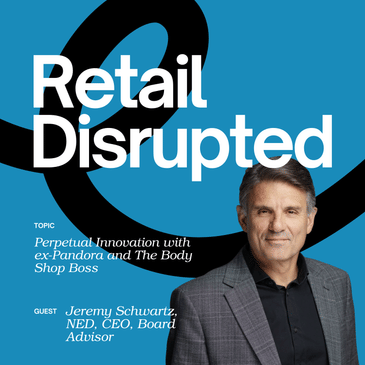

Jeremy Schwartz was the turnaround CEO of Pandora, the world’s largest jewellery company with 2,500 stores and e-commerce sites in 90 countries. Prior to that, Jeremy was Chairman and CEO of The Body Shop from 2013 to 2017. He also previously spent time at Sainsbury’s and, as Brand Director, he was the architect of the grocer’s turnaround in 2005 which saw a decade of growth after years in decline. He is the former Managing Director of L’Oréal UK and, as Innovation Director for Coca-Cola Europe, he invented Coke Zero. Jeremy is currently the Chairman of Kantar’s Sustainability Transformation Practice
In this episode, recorded live on stage at the Richmond Retail and E-commerce Directors’ Forum, Jeremy and Natalie discuss:
- Why some retail businesses fail and how to avoid becoming a statistic.
- How to embark on a successful turnaround strategy.
- The importance of perpetual innovation and how Jeremy uncovered an opportunity to create the Coke Zero brand.
- ESG – addressing the intention-action gap and FMCG best practices.
- Customer loyalty and doubling down on your top 20% of customers.
The video version of this episode is available on YouTube: https://www.youtube.com/watch?v=GBVMRe4GCOY
[00:00:00] You're listening to Retail Disrupted, a podcast that explores the latest industry
[00:00:05] developments and the trends that will shape how we shop in the future.
[00:00:09] I'm your host, Natalie Berg.
[00:00:16] On today's episode I'm going to be sharing my fireside chat with the Xbox of Pandora
[00:00:21] and the Body Shop, Jeremy Schwartz.
[00:00:24] My conversation with Jeremy was recorded live on stage at the Richmond Retail and Ecommerce
[00:00:29] Directors Forum.
[00:00:30] This episode is available in both audio and video formats so if you prefer to watch the
[00:00:35] discussion, you can pause now and head over to YouTube.
[00:00:39] Now a little bit more about Jeremy.
[00:00:42] He was the turnaround CEO of Pandora, the world's largest story company with 2500 stores
[00:00:48] and e-commerce sites in 90 countries.
[00:00:51] Prior to that, Jeremy was the chairman and CEO of the Body Shop from 2013 to 2017.
[00:00:57] He also previously spent time at St. Spurries and as brand director, he was the architect
[00:01:02] of the Grocer's turnaround in 2005 which saw a decade of growth after years in decline.
[00:01:10] He is the former managing director of L'Oreal UK and as innovation director for Coca-Cola
[00:01:16] Europe, he invented Coke Zero.
[00:01:19] Jeremy is currently the chairman of Cantar Sustainability Transformation Practice so
[00:01:25] as if we didn't already have enough material to delve into.
[00:01:29] We're also going to be talking about ESG and what retailers can do in this space.
[00:01:34] Lots to discuss and I really hope you enjoy this conversation.
[00:01:40] There are a lot of retailers and brands out there that are still finding life difficult
[00:01:44] and I think what we're seeing is that even if these are much loved brands,
[00:01:48] even if these are brands with a ton of heritage, they're not immune to the challenges facing the
[00:01:54] high street. I'm not going to name a shame but it's talked out there for some brands.
[00:01:59] As a turnaround specialist, what is it that these businesses are getting wrong?
[00:02:07] On the turnaround of the sales was in the turnaround of Pandora and if you after this
[00:02:10] have a look because frankly the turnaround both of those surprised me at the speed with which we
[00:02:16] went from continual decline to turnaround. It was amazing and incredible. In both instances,
[00:02:24] it came from a detailed understanding of what is the truth or insight behind the customer.
[00:02:31] In fact, we've seen the risk I engaged Clinton's political strategist, Polster and I said
[00:02:36] we're going to run the turnaround of the sales list like running an election. We're going to set
[00:02:40] an election date and we're going to pull Tesco floating customers to work out what we would have
[00:02:46] to say to get them to come to the sales list and not to Tesco. The whole turnaround which was
[00:02:51] 10 years of decline and in February of 2005 we went to plus five and just in King then had 10
[00:02:59] years of growth. It all came from the insights of what do we need to do? With Pandora, it was the
[00:03:05] same just to keep summarized you know the company I'm sure most of you by the vote or given or
[00:03:09] received the charm they'd walked away from charms as the core that made them the biggest jewelry
[00:03:16] coming in the world because you have to buy five or six or seven. You don't have to buy five
[00:03:19] rings or five necklaces but they got distracted by all these other products. They felt that the
[00:03:24] fashion for them had disappeared and actually I went on to an Instagram site. On Instagram there
[00:03:32] was a whole lot of people who were buying 20 or 30 charms a month and then creating nice
[00:03:36] little Instagram posts and I put at DM saying could I have a chat to you? I'm the CEO Pandora
[00:03:42] I'd like to speak to you as a passionate supply or user. I had to say she came back to me and said
[00:03:47] go away weirdo, you know I don't believe you or the CEO. So I had to say no no go on Google I
[00:03:52] had the CEO look at my name and then we had a chat and she told me for example two
[00:03:56] several things she and another insight was that we were promoting so heavily that the passion
[00:04:03] core heavy buyers were losing interest in faith and actually also just saying right we'll wait
[00:04:08] to the promotion comes but the core thing is the people who really made the brand the big buyers
[00:04:13] were losing faith in us because we were chasing the float of you know they the transient buyer
[00:04:19] with promotions and therefore in that example for example we cut promotions by 40% and saw the
[00:04:25] business grow which is completely no kind of intuitive. So those companies are going under some
[00:04:29] of them are structurally not relevant anymore but lots of times they've just not changed anything
[00:04:36] and they just hope that things look better as opposed to radical change if required.
[00:04:41] Yeah so it kind of goes back to my previous point of standing still being a really a dangerous
[00:04:45] thing to do and we said disrupting you know disrupt yourself is a better place than being disrupted.
[00:04:50] Yeah absolutely yeah it is a case of disruptor be disrupted isn't it it's it's retail
[00:04:55] Darwinism. You touched on the customer and how different everyone in this room is in terms of
[00:05:01] style and hair styles and I think customer needs generally are becoming highly individualized
[00:05:06] and we can't put customers into neat little boxes like we used to be able to but just for the
[00:05:11] sake of this question we're going to try. We should because I'll tell you there's a strange paradox.
[00:05:16] Okay okay no you go ahead then. The paradox is in all the data I've seen that at the very
[00:05:22] time we're becoming atomized I like that word because you know we are totally individual in
[00:05:29] everything we do and you could look at if I looked at all your TikTok you are on TikTok or Instagram
[00:05:34] every one of you be looking at different stuff. At the same time when we then say let's try and
[00:05:39] segment people we find you do cluster we all cluster and actually one of the most shocking examples
[00:05:45] of that was when I was in the 11th in the room which was the CEO of the body shop in 2013 just
[00:05:50] 2017. Do you set it? I did right that I should let's get the sales started to decline worldwide
[00:05:56] in 60 countries in the same way and it was like custom money. People talking on social media how
[00:06:03] can every country be declining? Well we had put some prices up in a way we hadn't observed
[00:06:09] and customers around the world were responding in the same way so we are at the same time atomized
[00:06:13] and at the same time still hoodie in segments and it's trying to work out are you in the hoodie
[00:06:18] bit and the segments or are you atomized and that's what we have to try and balance. Yeah absolutely
[00:06:24] but I guess I guess just for the sake of the question like I'd say broadly speaking how have you seen
[00:06:30] customer expectations evolve what are the most notable changes that you've witnessed in terms
[00:06:34] of shopping behavior? You know I think we all there's three that I think are important. The first
[00:06:40] one is we all want more convenience and the convenience that we want we're never satisfied with
[00:06:48] as we get things like Wi-Fi on planes and then it suddenly doesn't work but what the hell's happened
[00:06:54] to the Wi-Fi for the sake? And even Wi-Fi on the plane you know that because the technology is incredible
[00:06:58] by the way I've just stolen that from a comedian so I just tell you that but nonetheless it is a truth
[00:07:04] that you know our intolerance is continual and therefore we have to be continually finding more
[00:07:09] more convenient solutions if we want to engage people. I think the other thing is that we are both
[00:07:16] wanting new things and we get bored with the new things quicker than ever before so the idea that we can
[00:07:24] just do something and then it's going to be fine for the next two years whether it's a store
[00:07:28] design an e-commerce site the the PLP page they copy we write the video we put on there all of that
[00:07:34] we have to continually say it can have a lifetime of actually let me just tell you after this I'm
[00:07:42] running out of the room I'm getting the airport I'm flying the Dublin to do a speech and doing a
[00:07:46] speech to a company that builds data centers for Amazon and Netflix they're telling me that their data
[00:07:52] centers used to last for four years before they have to rebuild them and now because of
[00:07:58] nevidia and AI they are only lasting 18 months so the speed with which even thing like building a
[00:08:05] data center have to be unbuilt and therefore what we're doing is just accelerating and that's why
[00:08:10] we have to go faster and that's why we call this you know acting fast yeah absolutely and you touched
[00:08:17] on convenience which I think is absolutely true I think is consumers you know we get used to the
[00:08:22] next new shiny thing and then we just want the next new shiny thing and it just is perpetual isn't it
[00:08:28] but I guess at the same time sustainability is a concern and I know with your work in cantar
[00:08:34] this is something that you're very close to and I just wonder what are you seeing from a consumer perspective
[00:08:41] obviously we I think we've seen a little bit of a depriorization of green purchases because of the
[00:08:46] cost-of-living crisis but it feels like it is firmly back in the agenda and that customers want to
[00:08:50] make better choices they want to buy products that are better for the environment they don't always
[00:08:54] want to make sacrifices whether that's convenience or cost what are you seeing in this space so
[00:09:00] let me share some data because you know with cantar we've got the world's biggest data tracking
[00:09:05] company we've got data across every country in the world on this subject and the the common story
[00:09:11] is the country by country by country category by category category 68 or percent of people say they
[00:09:17] want to buy sustainably sustainable products but on average of course all its countries and all
[00:09:22] this categories 28 percent of people say at the point of purchase they actually do and when we
[00:09:29] ask well why is there a gap the number one reason or the three reasons actually the number one is
[00:09:34] a perception that the price is more expensive for the sustainable product than the non-sustainable
[00:09:40] and frankly I want a big mission on this subject because what's happening is manufacturers believe
[00:09:47] that they have the right and I'm choosing my words carefully here and slowly because I want
[00:09:51] to label it with you all hit you with it they have the right to charge a premium on a product
[00:09:57] that's sustainable versus the non-sustainable product that is wrong what I'm championing now through
[00:10:05] cantar is that every FMCG company has to start with what I'm called price match pricing your starting
[00:10:12] position is that a sustainable product should be priced at exactly the same price as your non-sustainable
[00:10:18] product because if you don't do that our price elasticity shows that people will not pay a premium
[00:10:24] unless the differences are substantial and you can make the difference it says that you know we can say
[00:10:29] is the most beautiful example of a sustainable product with different benefits but most you know
[00:10:35] hard to see or not value them up so start with price match pricing yes you might say you're
[00:10:41] costahier but they're work on cutting your costs or looking at other benefits you can bundle in
[00:10:47] so that the resurgestification if you need to put a price up that's really interesting and I think
[00:10:52] also the lack of transparency is potentially a barrier from a customer point of view as well because
[00:10:57] you know as customers we're so informed when it comes to things like pricing and reviews and product
[00:11:01] information but actually we're kind of fumbling in the dark when it comes to sustainability
[00:11:04] so there's the second two reasons that they give for not purchasing a number one they can't find
[00:11:09] this sustainable product and then secondly they can't desagregate well what is sustainable about
[00:11:14] this product and can I read it can I see it can I finally do understand it so yeah I'm seeing
[00:11:18] right yeah interesting I want to ask one more question about sustainability and then I'm going to
[00:11:21] open it up to the floor um I thought it was really interesting from the BRC um manifesto they said
[00:11:28] that one third of every UK citizens carbon footprint comes from the goods that they buy so retail
[00:11:34] plays a vital role in helping to reduce emissions as a society now as the industry moves towards
[00:11:40] net zero over the next decade I'd love to know what you make of the progress that retailers have made
[00:11:47] in their sustainability efforts and what might help them to accelerate their plans for
[00:11:52] the carbonization I don't know if you know what I'm seeing as retailers are not that committed
[00:12:00] they are doing what is required but are they taking actions to be leaders I'm questioning
[00:12:07] obviously they actually have made me dependent on their their suppliers in some ways and the company
[00:12:12] that I'm most excited by at the moment and I and I think it's a benchmark reference is of all
[00:12:18] things for a margarine and if you've seen that as uh having been sold by Unilever they're run by
[00:12:24] private company and they've launched a couple of months ago a new completely non plastic
[00:12:30] cardboard packaging that's going to be on their two billion products now that's the first time I've
[00:12:35] really seen a fast moving consumer good completely replaced plastic with an alternative that's
[00:12:40] price match and that seems to have the same performance I hope to be speaking to them probably tomorrow
[00:12:45] to talk about this but I'm not so sure if we've seen that much and I think it's important we say
[00:12:53] that so that we don't be too concoct like concrete regulatory we need to see more action and
[00:13:00] my view on this subject is that politicians are not going to save this planet it is companies
[00:13:08] that are going to do it consumers aren't because they're going to follow and they want to make
[00:13:11] decisions are point of purchase around price and convenience and what makes their life simple and
[00:13:16] easy therefore it's people in this room it's all of us as leaders in companies that are going to
[00:13:20] save this planet by inventing solutions like for a and others and that's what I would
[00:13:25] request of you inspire you and challenge you to take that mental I'm very passionate about
[00:13:29] this subject and the rain has made me even more passionate fantastic great this feels like a good
[00:13:35] time to open up two questions does anyone have a question for Jeremy at this point we've got one
[00:13:40] right here I think if we could just sorry if we could just wait for a microphone
[00:13:46] what are you coming from behind you behind you the gentleman behind you hello is it on yes
[00:14:03] and so I really really liked that term at treacle meetings and I think that probably a lot of people
[00:14:10] in this room have treacle meetings and generally the reason why we have that is because senior
[00:14:17] directors people have been there for a long time obviously have their opinions and their wisdom
[00:14:23] and I think you said quite eloquently but what you do is you come back that with data
[00:14:29] but I was a conference last year and some months ago to yourself said their advice to
[00:14:37] like two businesses and companies is going find the youngest people in their organization
[00:14:43] listen to them and promote them to the top so so data is one way of kind of getting your change
[00:14:50] through but what do you actually do the treacle is still there how do you how do you fight
[00:14:55] to the treacle and how do you kind of flip this because as I say everything is innovating so fast we
[00:15:01] need to be looking at the young people to kind of understand what we need to do so thank you for
[00:15:06] your fantastic question I'm going to give you two answers to very very concrete things you can
[00:15:12] so laurel which is the world's biggest cosmetic company 40 billion turnover grows at
[00:15:18] a bit dark every single year in every important meeting the boss whether it's a CEO whether it's
[00:15:27] me not being important but you know in my level the first person we turn to in a meeting
[00:15:32] is to the youngest person and we say look we're discussing this what's your point of view
[00:15:38] and then we work at the hierarchy now the reason we do this is for two three reasons the first
[00:15:43] is because we want to hear the views of young people who I believe fundamentally bring us fresh
[00:15:49] dynamic unimpaired thoughts and we need to listen more than ever because they're more connected
[00:15:55] even the second thing is it gives teachers them and trains them how to participate in thinking
[00:16:01] but the third reason which we've never expressed but I can tell you the truth it gives me is the
[00:16:04] boss time to get mine into the best thinking I possibly can because I nick everybody's good
[00:16:09] ideas and then represent them as mine so that's so to answer your question actually the answer
[00:16:16] is a lot on the boss's shoulders to change so that's point one because I speak you know one of
[00:16:21] the things I tell you know most leadership team audiences who I in a mainly speak to is something
[00:16:27] I put in place in Pandora and was transformational which is I looked up myself and said
[00:16:32] bosses have this belief that we should be the gatekeeper in meetings people come to the meeting
[00:16:39] to ask permission and I'm the gatekeeper I stand on high and I give my performance what happens
[00:16:45] if I reverse my role and actually I put myself at the bottom of my triangle and my whole objective is to
[00:16:51] shut up and my only role is to empower or remove problems that my teams come and tell me that they are
[00:17:01] seeking to have a solution to and therefore they're only role in the meeting is to bring me the problem
[00:17:06] that they can't solve they need me to arbitrate or make a point on but other than that
[00:17:11] I don't talk and they don't come we just thought they'd come with things that need to be act on
[00:17:16] that dramatically changed the efficiency of the meetings the role of the meetings the speed of
[00:17:20] decisions the empowerment and therefore I think as in our job we need to reinvention of the role
[00:17:25] of bosses and the role of meetings so that we can go quicker would you like to try that I would like
[00:17:31] you know the thing with these two thoughts is please go and try them and test them because they work
[00:17:36] and number two it could create a revolution your company with two really quite small ideas
[00:17:42] okay great any other questions at this point
[00:17:47] by the way I'm completely and only here for you so please use this chance you know if you don't agree
[00:17:52] with me or you want to add a build you know speak up because we're here friends together for you
[00:17:57] know 30 minutes and so on to make the most so don't hold back because it's for your advantage
[00:18:01] if I can help is that on can you hear me so I was thinking about the way that
[00:18:08] big companies use data and why they collect it and especially thinking back to your experience at
[00:18:14] sales嬌ís and whether I think our opportunities for people to do much more for the customer
[00:18:23] with the data so I was speaking with a supermarket in Scandinavia where they collect similar kinds
[00:18:33] of data to test goes and sales嬌ís here but the way they use it is much more innovative so they
[00:18:40] would say to somebody for example within the loyalty program we've looked at your basket that
[00:18:48] you're shocked for this week and looked at all the products that you're interested in that
[00:18:53] you like to buy and if you substituted product x for product y you would have a better carbon footprint
[00:19:04] for example so serving that data back to the customer in really useful ways that could make a
[00:19:10] difference than which makes sense you're certain so do you see that as an area where companies
[00:19:17] here could do much more because it seems to me often the data is only looked at in terms of how
[00:19:24] can we drive more sales how can we make more money rather than how can we help the customer
[00:19:29] so I think I've got three responses from my experience so you know what I felt when I was
[00:19:35] both a year of the body shop and Pandora was I had as retailers we have for normal volumes of
[00:19:42] data and you can imagine every single transaction and every single store every single minute my
[00:19:46] every single customer and my big grapple was how can I get insight from this in fact in 2018
[00:19:53] I made a program for BBC in business called retail's AI Revolution where I wanted to expose
[00:20:00] and to express how AI even in 2018 was being used by retailers powerfully to both
[00:20:07] internalize the data but also bring chat and the various tools to the consumer but my first
[00:20:13] problem was how can I have the expertise to actually just find me in sites or patterns actually
[00:20:19] I was looking for patterns within the data and I first of all would say that journey has not finished
[00:20:25] for anybody and AI and there's coming in America I've been using call pattern recognition you know
[00:20:31] is one of the tools to help unlock it it's not exclusively but it says that's my first point
[00:20:37] my second point is that you know to find those ideas my experience you've got to start with this idea
[00:20:45] of hypothesis because data itself tells you nothing and if you crack it into segments it will tell
[00:20:50] you just what it sees you got to start by saying I wonder if I could find a way of substituting
[00:20:57] a product and would the data help me do that and therefore the third part to actually using data
[00:21:03] is also still speaking to humans because I find when you speak to humans they tell you the weird stuff
[00:21:10] they may not even tell you it can be the stores you know store a colleague or an e-con colleague
[00:21:16] I go to them and say tell me something to surprise me I did that in the middle of New Zealand in
[00:21:20] the store in the middle of New Zealand as there for one day terrible for carbon but I had to
[00:21:23] discover some store checks and they told me something to surprise me said this product
[00:21:27] is always out of stock and I rang up the head off of the separation guides about three o'clock
[00:21:32] in the morning saying man why is this product always that so you know it's been out of stock for
[00:21:35] three months of forecast or always wrong as if all they always wrong is it will be no
[00:21:40] he's taking any notice of the fact that it's always selling out and we then try to find out why
[00:21:45] I'm found that Chinese person has written a blog saying this product stock tell us and every
[00:21:49] Chinese in every country near every store where they were at students are working where they're
[00:21:53] just buying all this product so I wouldn't have found that I should have found that through the data
[00:21:58] somebody should have bought it but actually bringing the human aspect to the hypothesis to the data
[00:22:04] are these the way to find those opportunities so an answer to your question yes there are huge
[00:22:08] amounts of opportunity how you get that I think is the interesting question to be exploring as
[00:22:15] I'm just trying to give you three examples does that answer question more let's take that
[00:22:23] there's a green as my scorecards sorry say something what do we want to do with our days
[00:22:36] that they want to better serve the customer rather than always looking at it in a very commercial
[00:22:42] way yes yes well I think it comes back to the very thesis of this speech which and
[00:22:48] discussion which is transforming insight into action the objective I think of that would be
[00:22:56] to drive sales in the end yeah I mean if you're going to switch somebody they're going to then
[00:22:59] be more happy they're going to come by for you so it is switching sales but it's trying to find
[00:23:05] those insights that leads to opportunities that them will result in sales and my proposition to
[00:23:11] you is that you've got to start with an attitude of hypothesis and wondering and curiosity as
[00:23:18] opposed to I know the answer just give it to me or the data is what the data say you've got
[00:23:23] a drill into I can talk more about drilling into data in a minute I'll let somebody else ask
[00:23:28] question and come back to that I think well take one more question just here so my question is
[00:23:35] a follow up to what you were saying earlier about decarbonization and how retailers really are
[00:23:42] dependent on their suppliers and so obviously you know in the there manufacturing base substituting
[00:23:47] lower impact materials or promoting energy efficiency or decarbonization in the factories this is
[00:23:52] great but it can really only take you so far in terms of decarbonization and so a lot of people have
[00:23:57] been talking about the need to reinvent retail business models and not for more circular opportunities
[00:24:04] but I haven't seen that many that are really working and they're expensive to invest in
[00:24:09] and so I'm just curious what you're seeing or kind of what your prediction might be in terms of
[00:24:14] how businesses can do this effectively. I think there's three ways what couple of ways I'm
[00:24:22] going to answer I think the first one is the inertia of consumers driven by our love of convenience
[00:24:30] that we've been educated so brilliantly on the last 50 years means that for the majority
[00:24:38] and not the eco group that are small but growing everywhere. So taking a snapshot today is not
[00:24:45] a good answer to a snapshot in a year or even two years because that group and it we are we'll
[00:24:51] show many of us that group not the dedicated level will grow and by the way without it
[00:24:56] our I believe that as floods increase in Dubai as we've just seen here etc we are going to react more
[00:25:04] aggressively either as consumers or regulators or companies because we're going to we're seeing
[00:25:09] first-hand what's happening but to overcome the inertia is tough. However we are seeing a lot of
[00:25:15] exciting initiatives that are working and I think the resale and reuse of fashion clothing particularly
[00:25:22] the luxury reselling is very exciting and I got involvement in a couple of those businesses so where
[00:25:28] the value proposition means that people are willing to do it I think we can see a definite
[00:25:33] interest in them. I think we've been talking a lot to a particular entrepreneur who has got an idea
[00:25:40] which is done they actually did it for John Lewis which is a circular purchase where you purchase
[00:25:44] the clothing but you get a price told you on your app as to the value on return so that you get
[00:25:51] a data digital driven value for returning and I think these models will improve but they do feel
[00:26:00] less convenient and therefore I think it's going to be the opinion leaders who lead it and then
[00:26:06] potentially many of us or other of us will follow over time. I think the speed with which that change
[00:26:11] can occur should accelerate and concerned about the negativity towards EVs in Britain that's happening
[00:26:19] at the moment due to a lack of infrastructure due to some negative sound whites about the
[00:26:24] volume of plant rubber coming off the tires etc but when I see what China is doing to drive for
[00:26:30] example EVs and some of these initiatives I think momentum is there but it probably is not going as
[00:26:36] fast as it's true that we want it to be honest. It's up to us and I'm not even perfect by
[00:26:43] long way too I know my behaviour is not following my own words to the level that I would like it
[00:26:50] when convenience calls. I don't know that. Great. We have about 10 to 15 minutes left so
[00:27:02] I have a... Is this all working people? I would like to check. Yes, is it helpful? Yeah.
[00:27:07] Perfect. All right I'm going to come back to my question and then we'll come back to the audience
[00:27:11] so you know keep thinking of anything else you might want to ask Jeremy you just touched on AI and
[00:27:16] I'm wondering if you have any thoughts on any particular trends or innovations that are exciting
[00:27:22] you right now when we think about the future of retail obviously AI and generative AI is going to
[00:27:27] transform the way that we shop but it's going to transform the way that retailers operate
[00:27:32] but whether it's AI or any other technologies is there anything out there that's exciting you right now?
[00:27:36] Well I'm very excited about it. I'm at a very personal level as I'm sure all of you are
[00:27:41] are completely excited by chatGBT I'm sure all of you Gemini I'm sure you're using it all the time
[00:27:46] yes are you actually just gonna raise who's using chatGBT daily let's say you know I
[00:27:54] just I've worked for one second. I have actually believed strongly that AI and I argued this back in 2018
[00:28:00] I argued it with the CEO of IBM will still jobs and when they used to say to me yes
[00:28:06] it's going to solve the world's problems that was the line that deep mind and IBM and all
[00:28:10] everybody said oh it's going to solve the world problems is like yeah this is going to take away
[00:28:13] thousands and thousands of jobs I think that's still true but I am myself encouraged how chatGBT
[00:28:20] is it doing what they say is improving my work life it is making me better than just search
[00:28:27] and so the large amounts of AI that are just going to be helpful in a positive way without the
[00:28:31] room in jobs so let me give you the examples where I feel we need it and where I felt we need it
[00:28:37] is on first of all merchandising on an e-com to present better the choices that I'm looking for
[00:28:46] in large volume fashion e-com sites for example or beauty sites I've still feel that we're
[00:28:55] relatively dark ages in presenting to me individually what I probably want from either my historic
[00:29:01] search of the search that I'm doing particularly around sizing I don't shouldn't have to go and put
[00:29:07] my size in any more it should know me so I think AI is still as a huge role on e-com to anticipate
[00:29:14] what I want better I think you know back in 2018 we were predicting or wanting that AI would mean
[00:29:21] that Amazon et al would send I would give them my calendar I would load my Microsoft calendar
[00:29:31] into my e-com site and they would send me things that I needed before I knew that I wanted them
[00:29:38] because they could see what I was doing so they would see I'm going on holiday and they would say
[00:29:42] well we're going to send you these five things we think they'll be useful based on what we know of you
[00:29:46] if you like them pay for them if you don't you can return them so ideally there is still a great
[00:29:52] opportunity to make my life more convenient and anticipate what I want using AI in that way but the final
[00:30:00] one and that's again I'm going to compliment this gentleman here because we sat next to each other
[00:30:04] and it was very much where I felt and he's working on is the in store and basic supply chain
[00:30:11] operations there's just huge potential to make the lives of store colleagues or supply chain
[00:30:18] colleagues or operation colleagues just better because they would have the technology whether it's
[00:30:25] a blend of AI or just handheld technology and scanning technology to be able to stop tape the price
[00:30:30] to change store layouts with speed and ease and less hassle that I see is still a problem
[00:30:39] in the manual let's call them working areas which don't and have not been given the tools
[00:30:44] to their jobs really when they're also having their jobs cut lots of them or huge pressure on
[00:30:49] their time yeah so interesting I think you know AI is going to touch every aspect of the value
[00:30:55] chain you know from product I coming up with the ideas for the product all the way through to
[00:31:01] you know post consumption and returns so are really fascinating stuff actually is there any
[00:31:06] ideas that you guys have got that would be good for everybody here anybody want to throw an
[00:31:11] idea in the AI will contribute do you think yes there's a gentleman I think is that you mind by just
[00:31:16] do that just for me no go for it I'm sure there's a rich thought here and I don't believe
[00:31:23] hang on there's a microphone coming let's just so we've got the time just there
[00:31:27] yeah so we're kind of doing it using AI to help people choose their food basket
[00:31:33] so that through using DNA and epigenetics as well so that way they're choosing the right food
[00:31:38] for them and also reducing food waste and also helping their health and well being so you load your
[00:31:44] Zoe data profile oh don't say that swear no we have our own system which is far better okay
[00:31:52] this is an advertising plug bridge and I'm trying to break so I actually think that food waste
[00:31:58] is one of the biggest impacts on the environment as well and also obviously it's from a sustainability
[00:32:04] point of view so actually by empowering people to make the right food choices for them both
[00:32:08] on my health and from a sustainability point of view using AI will have a huge massive impact
[00:32:15] the other interesting dichotomy though is a more we use AI the carbon footprint from that is
[00:32:22] it is and you talked about EVs no what I had meeting with somebody about it's weird beacork
[00:32:29] they were saying just by swapping from using blue color ink in your emails to black if you
[00:32:35] were using blue that has a massive impact on the environmental footprint of the email yeah
[00:32:41] so I think you know sometimes technology is great but you've also got a bear in mind behind the scenes
[00:32:47] the environmental impact of a lot of it is enormous yeah you know I just want to say one point on
[00:32:53] that I noticed that for every good step we make forward in sustainability all these initiatives
[00:33:00] there is a danger that I'm going to call them the cynics or whoever will put out a counterpoint
[00:33:05] I'm not saying yourself because it's true about data centers but you know we always have the yes
[00:33:09] but and there's a yes but with petrol there's a yes but without existing environment but there's
[00:33:15] a love of doing a yes but on some of these initiatives so you're up to you right that AI does generate
[00:33:20] huge huge issues and that we did send us but we've got to have still be moving forward positive
[00:33:25] intent otherwise we'll talk ourselves out of every one of these sustainable initiatives it's my
[00:33:29] fear yeah thank you you're input anyway next right so we have or down to the final minutes now
[00:33:38] but I want to ask you a little bit about loyalty and the proliferation of choice that we've seen
[00:33:45] when it comes to shopping generally but if we look specifically at ecommerce we've seen an
[00:33:50] explosion in digital channels in recent years marketplaces direct a consumer
[00:33:57] quick commerce social commerce I think you said you're on TikTok right yeah there we go so I
[00:34:03] guess personally what do you make of this proliferation and how do you see ecommerce evolving in the
[00:34:08] future well look I think that I'm not saying anything profound at all if you don't know
[00:34:16] but in this assumption that the three things that drives most of what we want is a fallback cost
[00:34:24] something to do with price something to do with disposability let's call it comfort with a brand
[00:34:31] or a product or that's trust and finally and most importantly this desire for convenience
[00:34:37] that the fact that I have had to remove TikTok even though I got a channel because I spent one and
[00:34:42] half hours every night on the damn thing the ability to be presented a product that I didn't know
[00:34:48] that I really wanted in my Instagram or TikTok feed and be able to purchase it so simply
[00:34:54] was extremely helpful so my disposability my loyalty to those channels because they are actually
[00:35:00] presenting me products increased because they solve problems I either had or didn't know I had
[00:35:06] so I think that those new ways and the reason I mentioned this sales TikTok live
[00:35:13] sales of vehicle is it's a big element of ecommerce in China because ecommerce has got
[00:35:20] in some ways humanless and that's why probably we're still going back to stores and genzids are
[00:35:24] because of the sociability or just the human type and actually now having Instagram and TikTok live
[00:35:30] as a sales vehicle and advertising vehicle is growing and I believe we'll be another technology that
[00:35:36] we need so this isn't the very profound statement I would say or those are going to grow ecommerce
[00:35:41] in spite of the Daldrums and many I believe will continue to grow because of our local
[00:35:47] convenience because of the choice and because retailers are some of the most struggle to get the
[00:35:53] choice that people are wanting will continue to grow. So sort of just the natural evolution.
[00:35:58] I believe it's on a real let's go. Whether it's Amazon that wins all the games or
[00:36:02] boohoo and a source that can recover we shall see but my pen is worth is that it will continue to grow.
[00:36:10] Yeah and off the news. By the way so I just say one thing I noticed on this subject you know we are
[00:36:15] quite rightly sad that you know the body shot and others are going down and when we walk around
[00:36:21] our high streets so many stores are closing and being replaced by the restaurants which is probably
[00:36:26] or charity which is questionable perhaps. When you look at villages they used to have and I
[00:36:33] remember as a kid where I grew up there was a butcher there was a post office it shows all time
[00:36:38] but there were all these things they're all homes it is evolution and we've had it for 100 years
[00:36:45] as there's been concentration and closure. I suspect it's just going to continue as horrible
[00:36:49] and as painful as that is it may be replaced by restaurants and other things but I suspect the
[00:36:54] impact of e-commerce will continue to hurt retail even if we do love the sociability and the
[00:37:02] proximity and the human touch. Yeah my fewer better stores is probably the way it's something up.
[00:37:08] I just want to ask you one final question about loyalty which we started to touch on.
[00:37:12] There's been a lot of investment in digitizing loyalty schemes in recent years. We've seen the
[00:37:17] rise of real-time discounts and somewhat controversial member prices so I'm curious to know what you
[00:37:24] make of this and do you think these in order to make us more loyal or does it actually have the
[00:37:29] opposite effect to make us more promiscuous? Okay I'm going to be hands-on I don't have the data
[00:37:35] to answer that question on whether it is more promiscuous or more loyal. What I see are
[00:37:42] yeah okay but what I first have seen in all the businesses is that loyalty has been an incredibly
[00:37:48] powerful tool but and this is a big part. I'm going to finish on an insight here.
[00:37:54] Both with the turnaround of Pandora and with a business I'm even
[00:38:00] consulting on just yesterday the big are harpy sub-data that can be transformative for you if you
[00:38:06] want to help with your socioclient is to break down the numbers of people who buy just one product
[00:38:14] the numbers who buy 20 or three the numbers you buy five or 10 and the numbers you buy 20.
[00:38:18] It follows on the whole in 80 to 20 rule plus or minus that actually 20% of your customers actually
[00:38:25] buy 80% of your volume. What we spend all our effort on is chasing this huge tail of 80%
[00:38:32] of the people who buy one product because they are so volumous. Most retailers and most companies
[00:38:38] don't look at that breakdown and so they don't see an impandora what I discovered was that 80%
[00:38:44] of women were buying 20 or 30 charms and we did not have a laltis scheme in a product that
[00:38:52] was all about collecting and those group were the ones making us all the money it was the same
[00:38:57] incess to the same business. So in fact the role of loyalty or the way to think about it whether you
[00:39:02] have a product or not is track down what those people are doing and serve them and be careful
[00:39:08] you're not chasing the single buyer who will use a volume energy all your costs but bring you
[00:39:12] finalist value. So I believe in all the 100% and these tools can all work if they target it
[00:39:18] particularly that group. Yeah focusing on your most valuable customers. I'm not going to let you go just
[00:39:22] here. I think we have time for one more question from the crowd if there's any other burning questions
[00:39:27] about there. We've got one in the corner just here. Thank you for your patience by the
[00:39:34] wait and time. I appreciate the attention you've given in the ideas. Hi there. You speak about the
[00:39:40] yes but and obviously sticky meetings and you know our job is working is so aspirational and
[00:39:49] I think in and I'm trying to work out the question here but for the unit levers of the world
[00:39:53] for the co-curlers of the world and even the laurels of the world I think you know a humble brand
[00:39:58] manager brand director really want to do that. You know they want to have a way of being able
[00:40:06] to work with the machine to do some of these. Have you actually seen it work? Have you seen if we
[00:40:12] were advising a brand director within an ecosystem like you, Lever, to get hold of the data to
[00:40:18] come up with a hypothesis and actually see it through. Do you have examples of how that's been
[00:40:23] done and then how you know you could advise within that ecosystem? Yes the wrench, the phone
[00:40:33] caught by the cops in 19 2000 on about September 15 I think it was from my boss was
[00:40:46] over my dead body Jeremy are you going to launch that product? That was a guy who being in
[00:40:54] the Coca-Cola company for 30 years he was in charge of Europe which was a 200 billion power
[00:40:59] business and I've been working on Coke Zero as an idea. More money I got data to show that
[00:41:06] young men in Europe would dramatically increase their consumption if we presented that product
[00:41:12] versus the red or Coca-Cola because we discovered that the reason that young men started to drink
[00:41:17] less in Europe than in the US was because strangely surprisingly psychologically the red label of Coke
[00:41:26] made them think that they were a kid again and in front of their adult friends and themselves they
[00:41:31] didn't want to look like a kid they wanted to drink alcohol and coffee and look adult like and
[00:41:35] that crazy insight that if we made a product in black and called it Coke Zero in the since
[00:41:41] as I gave it a benefit we could talk to young men and add what turns out to be 10 billion sales
[00:41:47] revenue per year was something that he rejected because he was frightened of innovation he was frightened
[00:41:54] of change he was trying to risk what I believe but you have to decide to do this is that we have
[00:42:01] a responsibility to have a point of view on something to champion it with like a crusade and
[00:42:08] a commitment if you believe it's right and got data and then it's a case of getting it in
[00:42:12] front of the right people and most intelligent bosses are desperate for ideas to improve the business
[00:42:19] in fact what they're short of is great ideas they usually have the money they usually have
[00:42:24] the resources they just lack some brilliant ideas so in my experience but the riserisc I did
[00:42:30] have that boss say that to me and the only way I survived and got it was that he was fired by the
[00:42:37] CEO two weeks later because he'd been blocking innovation which I got in front of the CEO it does
[00:42:43] mean you sometimes you know have to play a little bit of the politics and so on to get it to the right
[00:42:46] people so it's not without risk or personal risk but intelligent bosses when presented well
[00:42:54] simply good ideas fact based you know should be smart enough to see that that's worth backing
[00:43:00] and if they're not intelligent then probably change company. On that note I think we are out of time
[00:43:07] but I just want to say thank you it's been fascinating to get your views thank you Jeremy.
[00:43:11] Thank you.