
Did you know that over 80% of the U.S. population lives within a 10-mile radius of a Goodwill store or location?
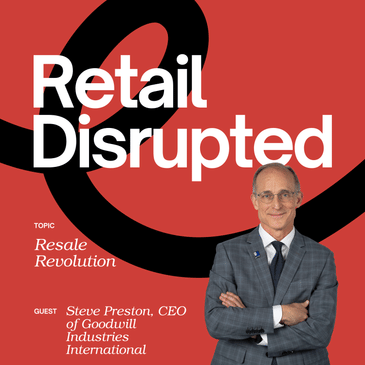
Live from the NRF Big Show in NYC, Natalie speaks to the CEO of Goodwill, Steve Preston. He discusses the organization's strategic priorities, why the perception of thrifting is evolving, and the impact of digital. Steve also shares his views on what’s driving the surge in the resale market today and how Goodwill’s proximity to the customer allows for deeper community engagement.
Bio:
Steven C. Preston is the president and CEO of Goodwill Industries International, which provides services to 154 local, independent Goodwill organizations which together represent the leading provider of workforce training and development. In 2022, Goodwill served more than 2.1 million people which range from lighter touch services to extensive training, career navigation and job placement support.
Preston has served in numerous operational and financial leadership positions in both the public and private sectors. He headed two federal agencies during times of national crisis, the U.S. Department of Housing and Urban Development (HUD) and the Small Business Administration (SBA); led successful turnarounds as the CEO of two private corporations, Oakleaf Global Holdings and Livingston International; and served as the CFO of two Fortune 500 companies during times of significant change and restructuring, Waste Management and ServiceMaster.
Preston served as HUD Secretary during the housing crisis of 2008, representing the federal agency on the board of the Troubled Asset Relief Program (TARP). During his tenure, HUD dramatically increased Federal Housing Administration and Ginnie Mae capacity to meet exponentially rising demand. Under his leadership, the agency also expanded its ability to assist victims of natural disasters, advanced the rebuilding of mixed-income neighborhoods in post-Hurricane Katrina New Orleans, and improved financial literacy programs.
From 2006–2008, Preston served as Administrator for the SBA. In addition to multiple small business services, the SBA provides disaster loans to homeowners and businesses. Following Hurricane Katrina, Preston spearheaded a reform agenda to expedite financial support to disaster victims and make the agency more responsive to customers, accountable for results, and efficient in the delivery of services. During his tenure, the SBA launched and advanced programs to expand entrepreneurship opportunities for veterans and military families, for people located in areas with high rates of poverty and unemployment, and for people who were facing various life challenges.
In his private-sector roles, Preston gained significant experience expanding into new product and geographic markets, leveraging technology for both client and efficiency benefits, improving employee engagement and restructuring operations. Preston graduated with highest distinction from Northwestern University and holds an MBA from The University of Chicago. He has served on numerous boards or in other capacities for organizations supporting the needs of people with disadvantages, especially in urban centers. He currently serves on the Board of Directors for the Partnership for Public Service and the Board of Trustees of Wheaton College. He and his wife, Molly, live near Washington DC and have five children — Anna, Madeleine, Gibson, Eleanor, and Steven Jr.
[00:00:06] You're listening to Retail Disrupted, a podcast that explores the latest industry developments and the trends that will shape how we shop in the future. I'm your host, Natalie Berg. On today's episode, I am bringing you a conversation that took place at the NRF Big Show in New York.
[00:00:36] Last week, I had the opportunity to sit down with Steve Preston. Steve is the president and CEO of Goodwill Industries International, which provides services to 154 local independent Goodwill organizations. Together, they represent the leading provider of workforce training and development.
[00:00:54] In 2022, Goodwill served more than 2.1 million people, which range from lighter touch services to extensive training, career navigation, and job placement support. Steve has served in numerous operational and financial leadership positions in both the public and private sectors. He headed two federal agencies during times of national crisis, the U.S. Department of Housing and Urban Development and the Small Business Administration.
[00:01:23] Steve led successful turnarounds as the CEO of two private corporations, Oakleaf Global Holdings and Livingston International. And Steve also served as the CFO of two Fortune 500 companies during times of significant change and restructuring. Steve graduated with highest distinction from Northwestern University and holds an MBA from the University of Chicago. He served on numerous boards or in other capacities for organizations supporting the needs of people with disadvantages.
[00:01:52] He currently serves on the Board of Directors for the Partnership for Public Service and the Board of Trustees of Wheaton College. I really enjoyed meeting Steve, and I know you're going to get a ton of value from what he has to say. Steve, welcome to the podcast. Thank you. We are recording this on the last day of the NRAF Big Show. I'd love to know what caught your eye this year. Was there anything in particular that stood out for you?
[00:02:20] Well, one of the things that stands out for us is the sustainability opportunities and challenges for textiles. And, you know, we are very focused at Goodwill, and I can tell you a little bit about why and how we're structured. But we're very focused on ensuring that every textile, from the time it's sold to the time it reaches what we would call sort of end of life, finds its best possible use.
[00:02:46] That we minimize what goes into the waste stream and we maximize what is reused, remanufactured, or even recycled. And those issues, because of the expansion in textile production, are becoming increasingly important to all of us. So, Steve, let's talk about Goodwill. It's a name, of course, very familiar to a lot of American consumers. It's the largest player in the secondhand retail market in North America. But, as you know, I have a very international audience.
[00:03:12] So, maybe you could say a few words about the business and how it differs from others in the secondhand space. Yeah. So, first of all, we are a social enterprise. We're a nonprofit organization.
[00:03:21] And that's because for over 120 years, the mission of Goodwill has been to help people with various challenges in life, you know, get the support they need to stabilize their lives, get training they need to move forward, and ultimately move into the workforce, hopefully into a career that allows them to continue to develop and grow. So, that's what we were founded on that 123 years ago.
[00:03:47] And the way it worked was our founder was working in the middle of Boston in a very poor area doing everything he and his wife could do to serve them. They were collecting clothes and giving them free clothing because they needed it. And then he said, well, what if we, you know, repaired these clothes and cleaned these clothes and actually turned this into a business? And lo and behold, the resale business was birthed and it gave people opportunities to work in the stores to develop job skills and in many cases move on.
[00:04:16] So, we now collect almost 6 billion pounds of items each year. And the vast majority of those items are donated by individuals. So, we love spring cleaning as we call it in the States. I don't know if that's an international concept. And so, and 94% of the people in the United States know who Goodwill is.
[00:04:44] I mean, we've got enormous brand name recognition, 3,300 stores, which puts us in the top 20 retailers in the U.S. in terms of numbers of locations. We're within 10 miles of 83% of the population. The reason that's important is we want to make it easy for people to donate goods. So, then what happens is we sell the clothing or the household items or whatever in those stores. Many of the people in those stores are people with various challenges in life, whether it's disabilities or coming out of poverty or whatever.
[00:05:11] But also, we serve 1.7 million people a year, not in the stores, in job centers. So, we help them. You know, many times people come to us in very difficult situations. We may help them, you know, find housing or other support.
[00:05:27] But ultimately, what we're trying to do is help that individual get foundational job skills as well as technical training so that they can then move into the workforce, take care of themselves, and have a different kind of future than they have today. Yeah. Yeah, interesting. And you were, of course, a really early mover into the resale space. This is an area that's now booming. The U.S. secondhand retail market has more than doubled in size in the last six years, and it's expected to grow to $73 billion by 2028.
[00:05:57] Now, I'd like to get your thoughts on what's driving this huge explosion in growth. Is it the economy and consumers being frugal and shopping secondhand because they have to? Or are shoppers buying secondhand because they choose to, because they care about the planet and they want more circularity? Or I'm going to throw a third potential scenario here. Is it perhaps a backlash to the homogeneity that we sometimes find in mainstream clothing and department stores and consumers just wanting more individuality in their choices? So what do you think?
[00:06:27] What's happening? Well, you've just gone through the list. It's really all of those things. So historically, I would say we were more – people were more interested in goodwill because of the deep value. And many of the people that would have shopped the stores probably 20 or 30 years ago would have been people who really needed to find that value.
[00:06:50] And – but increasingly, resale has taken on – people look at resale differently than they have historically. So number one is, as you mentioned, especially younger consumers really care about sustainability, right? And the textile industry, you know, is very pollutive in many ways.
[00:07:12] And so this is a great opportunity for people to feel like – validly so – to feel like they're buying goods that stay out of the waste stream, reduces the impact on the environment, the negative impact. So that is number one. Number two, you know, the real action I think is the treasure hunt, right?
[00:07:30] And the treasure hunt is both sort of ignited by the excitement of finding, you know, a great value for something that people love and it maybe is a great brand that they got for 10 percent of the price of a new good and the uniqueness. And so what we find in the United States is a lot of young people, even rather than saying I'm going shopping, they'll say I'm going thrifting. And so it really is – It's now a verb. It's now a verb.
[00:07:59] It is. And, you know, we know this through our research, but I also know it through, you know, other people sort of my age who have children that are teenagers who are in their 20s or early 30s. And when they know what I do, they'll often come to me sort of with this, you know, almost, you know, like they've got this new discovery, which I say, well, you know what my kids tell me, right?
[00:08:25] And they don't even – this is an activity that they have and they get their friends together. And so, you know, there's sort of a – And it's not online. I mean, obviously, we'll come on to your e-commerce, you know, the e-commerce side of things. But I think that's an important piece to all this. It's being in stores. It's experiencing, you know, engaging the senses and the discovery aspect. Yeah, exactly. And, you know, we continue to add new stores, you know, and we think there's a lot of opportunity for us to continue to add new stores. And, yeah, it's touching. It's feeling. It's looking at it. It's matching things.
[00:08:55] It's putting outfits together. And I've got a large family. I've got five children, mostly in their 20s. And I'll never forget a few years ago, my son was away at school and he and I were going out for dinner. And he said, oh, could you drive into this shopping center real quick? I just want to run into a store. And we were going to the Goodwill. This is before I worked for Goodwill. So I didn't really know the whole deal at that point.
[00:09:22] And he went in there and he pulled a few items out and he pulled out his frequent shopper card. And I thought, okay, I love this. Because he's a student. He's value focused. And I said, so what's going on? He goes, my friends, we love to come here. And it's everything from finding something that they love to wear to, you know, young people having fun getting crazy sweaters and going to a party with them on and trading them.
[00:09:50] And, you know, so, and we love it. We love it because it's good for everybody. It generates a lot of excitement and a lot of enjoyment. And it's great for the planet. And the other thing is, the more we sell, the more funds we have that are available to help people in need in our community. And every item that we sell, the value of every item we sell stays local. People think of us as a big national brand because we're a massive network.
[00:10:14] But we're actually the collection of 153 local organizations that have their local CEOs, local boards of directors, and local programs. So, you know, every bit of value stays in those communities to help people in need. Fantastic. Fantastic. I'd like to talk about the impact of digital on your business and more generally how it's fueling demand for secondhand clothes.
[00:10:37] Because over the past few years, we've seen around the globe retailers and brands experience phenomenal success when they're able to marry up affordability, sustainability, and digital being the kind of, I think, missing link. Both from the customer experience point of view, making it really easy to buy and sell pre-loved. And at the same time, I think social media has been really influential here in helping to shed that stigma that was once associated with buying secondhand clothes.
[00:11:05] And, you know, you've just touched on how it's cool to buy pre-loved. And it's almost the antidote to fast fashion. So what's your take on this? How is digital impacting your business? Yeah. So digital, the vast majority of our business is in store. Now, we do have digital platforms. We have digital platforms that are goodwill platforms where we sell textiles, jewelry, books, all sorts of things online.
[00:11:34] And digital is a really important channel in this space because, like any digital platform, you are able to have a different kind of relationship with the customer. It's super efficient. You gather data on that customer so you can present them with recommendations or get them to the right place simply. And for all the reasons all of us love shopping digitally.
[00:12:01] In resale, even though we have seen the growth in a lot of digital platforms, to your earlier point, people do lean toward in-store because of the experiential piece. The other thing digital has allowed the industry to do more broadly is to advance more different models.
[00:12:22] So, for example, we have effectively – there's one digital platform that buys goods from local consumers, inventories them, and then resells them. And so that's one model. We have other models which are effectively just brokers. I mean it's almost like an eBay where you've got your goods. You've got your item. You've got a buyer on the other side. You go onto the platform and you make a connection.
[00:12:47] And that has been an interesting way to expand the industry because you've got people who can actually make money by selling what's in their closet and then use that money to buy something else. Keeping it within that kind of ecosystem. Keeping it in the ecosystem.
[00:13:08] And, of course, now you have brands as well taking back items and having – either by managing it themselves or having third parties manage it, they'll have actually brand centers online. So all of those things have served to expand the industry. And each one of them plays a slightly different role, right?
[00:13:31] And so I think it's really good for everybody because it really – I think it's really a rising tide lifts all boats. And so if you have, let's say, a very high-end digital shop selling very expensive clothing or watches or whatever, it sort of sets a very high bar to say, look, even at this level, resale works.
[00:14:00] And so it really does, I think, broaden the acceptance and the awareness and actually the understanding of value. Yeah, because value isn't just low prices, is it? No, it's not. It's not. And especially on some of those higher-end items, many of those things are manufactured in such a way that quality is very, very high. It can stay in the ecosystem very long.
[00:14:28] You might be able to sell it two or three or four times and still have a pretty good item to buy. Yeah. I'd like to go back to a point that you raised earlier, which is that over 80% of the population, the U.S. population, live within a 10-mile radius of a Goodwill store. I mean, that's a very enviable position to be in. It is. But I think it's fair to say that the role of the store is evolving, right? So stores are still hugely important, but they're not just a place where you go and buy stuff anymore. Increasingly, we go into stores for discovery, for inspiration.
[00:14:56] You touched on the thrill of finding a bargain or getting a brand that you might love but 10% the price. You go to stores for advice, for that human touch, but also to kind of collect online orders or to return products. And there's still a huge digital aspect of being in stores. So how are you adapting your stores, or how do you see stores evolving in order to stay relevant to consumers? Yeah.
[00:15:22] So one thing which is important to us from a branding perspective is for people to understand when they walk into one of our stores that they're part of a bigger mission. We want to see a customer walking in the store and looking around and seeing the photographs of people we've helped, personal testimonials. We kicked off a wonderful ad campaign a little over a year ago called the New Lives Campaign.
[00:15:47] It's beautiful, it's clever, and it connects the work we do with the resale. For example, one of the visuals would be a person who got a job through Goodwill next to a guitar. And it said, you donated a guitar, I got a new job, who's the rock star now? They're wonderful, and they're so clever, and they're real people. They're all real people.
[00:16:11] They're not, you know, there's not a single person in those ads that didn't get support from Goodwill. And so we want people to understand when they go to the, and it's, people are looking for relevance with their brands today. And they're looking for connection, and they want to know that when they're, and this is especially important to us because our competitors are increasingly for-profit corporations.
[00:16:35] And so we want people to know that if you come into a Goodwill and you buy, you know, an item of clothing or a set of dishes from us, actually that person whose photo you see on the wall is somebody who's going to get a job because of it. So that's number one.
[00:16:48] Number two, increasingly, you know, like, you know, other retailers, we are, you know, we roll out loyalty programs and other kinds of ways to connect with individual consumers so that they will come back and embed with us more. So we have very specific pricing campaigns based on our understanding of how people purchase.
[00:17:11] And we have a unique model because every item we get, we have to evaluate, sort, and price separately, right, based on the way we think it's going to sell. So those are some of the ways that we're driving, I think, knowledge and data into it. Over time, we're not there yet. Over time, I think we would like to be moving more toward an omni-channel experience. And so some of those other things will be important.
[00:17:36] The other thing I think that's interesting about us is if something, we might try to sell something online. And let's say we find out Omni is not the right, the best channel, may move into the store. If it doesn't sell in one of our stores, we then may move it to a buy it by the pound store. So we have these multiple channels for the same item to optimize the ability to sell everything we get. Final question for you, Steve.
[00:18:02] You've just been named chair of the NRF Foundation, succeeding Tony Spring, the chairman and CEO of Macy's. Can you tell us about the foundation and what you're looking forward to in your new capacity as chair? Well, it's interesting. As I mentioned, Goodwill is the largest provider of workforce development services in North America. The NRF Foundation provides training and development for people interested in retail careers. Many of those are maybe some of the same people that we serve, right?
[00:18:31] They also have very extensive programs for college students to help them understand opportunities in retail. Obviously, retail is a very complex industry. I think sometimes people think if I'm going into retail, I'm going to be selling something in a store. They don't understand supply chains and data and technology and all of the sophistication that goes into the industry.
[00:18:54] So the foundation on so many levels is focused on not only developing talent for the industry but developing opportunities for people. And that's what we do. And so I see – and for many of the people we serve, retail is a perfect first step for a lot of reasons. And so we see retail as being a solution for many people who need a different path forward.
[00:19:22] So I just see a wonderful opportunity for us to think about the world together in some ways. And it's interesting. We actually have some of our local organization using NRF Foundation materials to do retail training for the people that they serve. So we love the workforce mission.
[00:19:41] We believe that every human being has an amazing amount of embedded potential, but way too many people never have an opportunity to realize that potential, to develop that potential, and to live a life that leverages that potential. And so that's one of the reasons it's so exciting for me. Steve, thanks so much for your time today and all the best for your new role. Thank you.
[00:20:10] Thank you for listening to Retail Disrupted. If you enjoyed this episode and would like to support the podcast, please leave a rating or review or share it with others. It really makes a difference.